Four Kyushu Sakes in a Wooden Masu: A Tasting Flight at Sumiyoshi Shuhan, Hakata Station
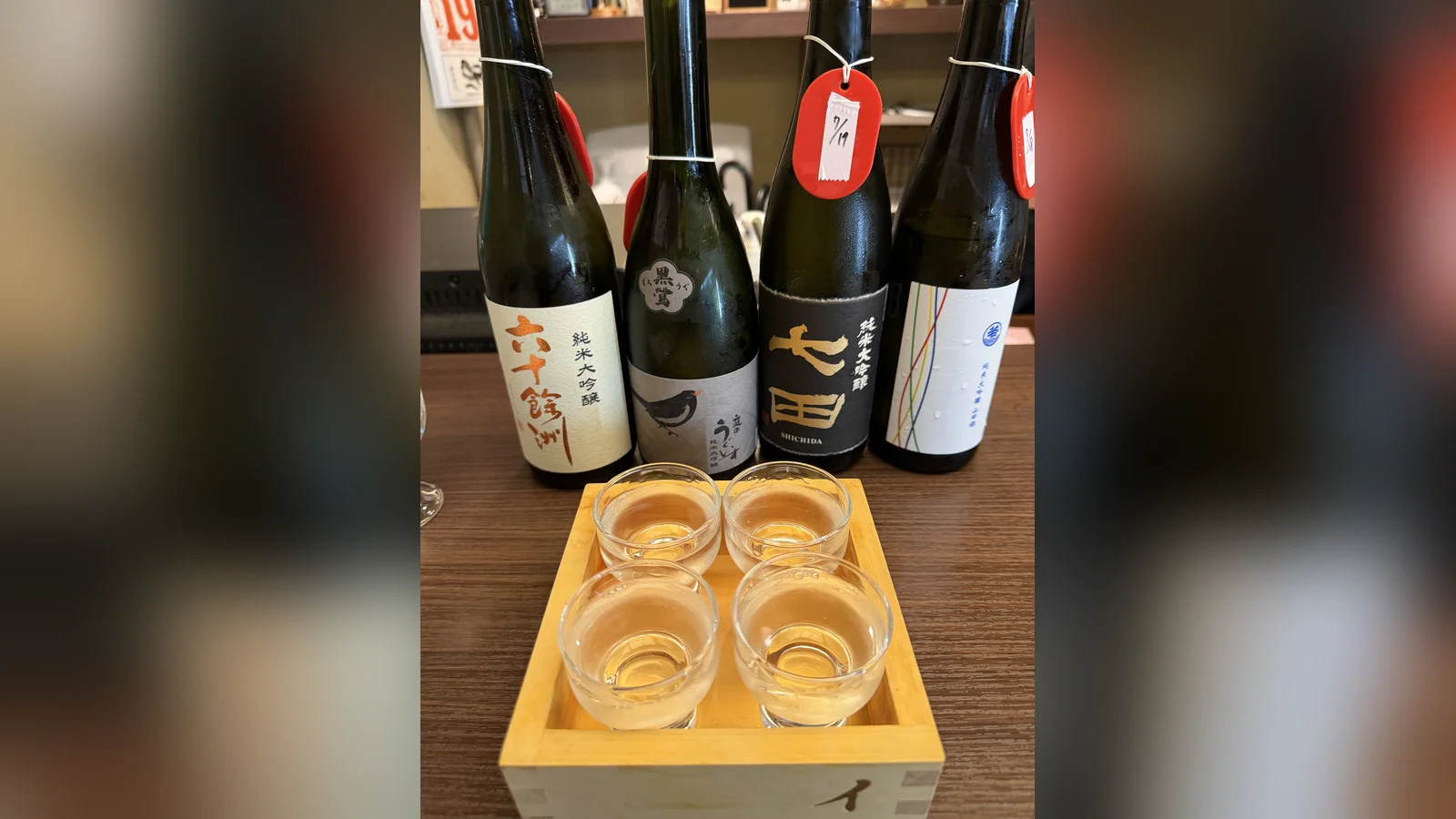
Table of Contents
If you ever find yourself at Hakata Station with thirty minutes before your next train, I know exactly where you should spend them.
Just outside the shinkansen gates, inside the DEITOS shopping arcade on the same floor, there is a small kakuuchi counter called Sumiyoshi Shuhan (角打 住吉酒販). You do not need a reservation. You do not need to plan far ahead. You walk in, receive a set of hanafuda cards, and begin choosing what to taste.
This is the story of one visit — four junmai daiginjo sakes from Kyushu, a plate of Hakata mentaiko with fresh mozzarella, and what I learned about a way of choosing sake I had never seen before.
What Sumiyoshi Shuhan is
Sumiyoshi Shuhan is a sake retailer with roots in Omuta, Fukuoka, operating since 1960. Their Hakata Station branch doubles as a kakuuchi — a casual drinking counter attached to a liquor shop, where you can taste before you buy, or simply drink what catches your eye.
The sake selection focuses on Kyushu: Fukuoka, Saga, Nagasaki, Kumamoto, and the rest of the island’s brewing regions.
The format is charmingly analog. On my visit, I received a set of ten hanafuda playing cards. Each card was worth 418 yen, tax included. You trade cards for drinks and food — five cards for a four-sake tasting flight, two for a half-size snack plate — and settle up based on how many cards you have left.
No digital ordering. No complicated menus. Just cards on the counter.
The bar opens at 9:00 AM and serves until 9:00 PM, with last order at 8:00 PM. I visited around 10:30 in the morning, which felt slightly indulgent — but the counter was open, the staff were welcoming, and the sake was cold.
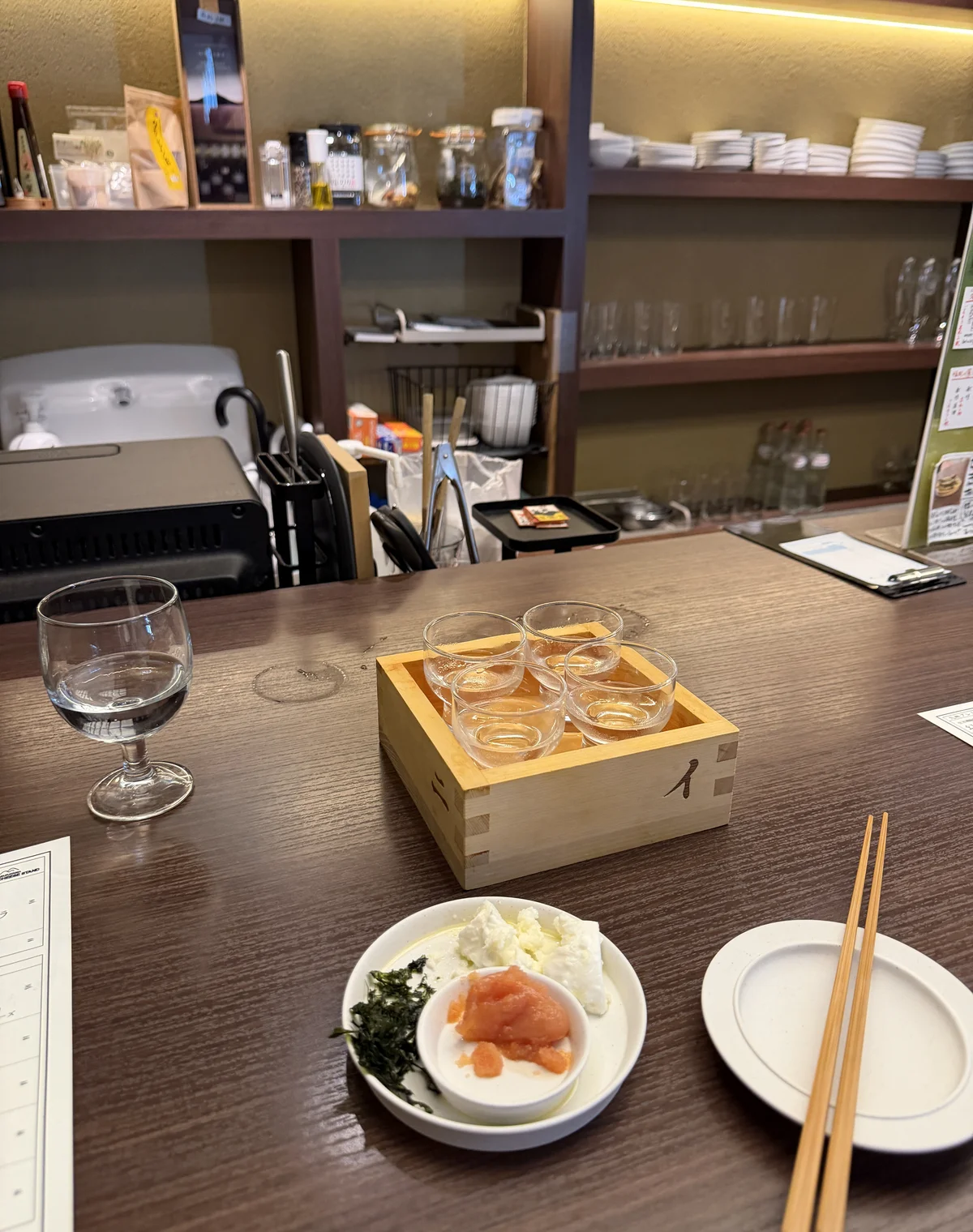
Morning at Sumiyoshi Shuhan: four glasses in a wooden masu, a plate of Hakata mentaiko with fresh mozzarella and nori, and an unhurried half hour before the train.
Modern and Classic, Light and Rich
Before I describe the four sakes, I want to share something I noticed on the wall.
Sumiyoshi Shuhan has developed its own framework for helping customers choose sake. Rather than relying only on traditional classifications like ginjo, junmai, or yamahai — terms that can intimidate newcomers — the shop sorts its sake along two axes: Modern vs Classic, and Light vs Rich.
In this framework, Modern sakes tend to feel fresher and brighter, often served chilled, while Classic sakes are more comfortable at room temperature or gently warmed, with more settled, food-friendly profiles.
Cross that with Light — clean, refreshing, easy to start with — and Rich — deeper, more expressive, layered with umami or sweetness — and you get four quadrants:
| Light | Rich | |
|---|---|---|
| Modern | Fresh, crisp, beginner-friendly | Aromatic, juicy, expressive |
| Classic | Gentle, food-supporting, understated | Full-bodied, umami-driven, aged-friendly |
This is not an industry standard. It is Sumiyoshi Shuhan’s own way of thinking, and they are transparent about that. But I found it genuinely useful.
It gives you a vocabulary to describe what you like without needing to know what yamahai or muroka means. And it maps neatly onto how people actually experience sake: “I want something refreshing” points toward Modern Light; “I want something I can warm up with a rich meal” points toward Classic Rich.
I mention this because the four sakes in my flight were chosen to represent all four quadrants — one from each corner.
The flight: four junmai daiginjo, four personalities
The tasting format is called Gochiso Iroha-ni Masu — four premium sakes served in small glasses, about 45 ml each, arranged in a wooden masu box. Each position is labeled with a character from the traditional Japanese syllabary: イ (i), ロ (ro), ハ (ha), ニ (ni).
You taste them in order — or in whatever order you like — and compare.
All four on the day I visited were junmai daiginjo, a premium category known for highly polished rice and refined aromatics.
The four glasses are small, but together they add up to about 180 ml — roughly one go of sake.
イ (i): Rokujuyoshu (六十餘洲)
Imazato Shuzo, Hasami, Nagasaki. Est. 1772. Category: Modern Light.
Clean and inviting, with a gentle acidity that opened the appetite rather than closing it. On an empty stomach at 10:30 AM, this was the right sake to start with — understated, food-friendly, with a quiet umami that lingered pleasantly.
After a bite of mentaiko, the sweetness of the sake came forward in a way it had not on its own.
A small but meaningful detail: Hasami, the town where Imazato Shuzo is located, is also the home of Hasami-yaki pottery — the same ceramics tradition on my list to explore later this year.
Sake and pottery from the same small town: that connection was a surprise I did not expect from this flight.
ロ (ro): Niwa no Uguisu “Kuro Ugu” Junmai Daiginjo (庭のうぐいす 黒うぐ)
Yamaguchi Shuzo, Kurume, Fukuoka. Est. 1832. Category: Modern Rich.
Richer and more textured than the Rokujuyoshu, with a gentle viscosity and umami that leaned savory rather than acidic.
The pairing with mentaiko was the standout moment of the flight: the sake’s richness and the mentaiko’s salt-sweet heat seemed to amplify each other, creating something neither could do alone.
If I had to pick one sake from this flight to pair with Hakata’s famous spicy cod roe, this would be it.
ハ (ha): Shichida Junmai Daiginjo (七田)
Tenzan Shuzo, Ogi, Saga. Est. 1875. Category: Classic Light.
A shift in register.
Shichida felt calmer, rounder, and more self-contained — the kind of sake that does not need food to be interesting, but quietly supports whatever you are eating.
There was umami and a gentle acidity, but the overall impression was of balance: nothing jutted out, nothing receded.
Steady and mellow.
Of the four, this was the one I would describe as the most composed.
Readers outside Japan may have encountered Shichida before — it has some international distribution, particularly in parts of Asia. If you have, this is the brewery and the town it comes from.
ニ (ni): Wakanami Junmai Daiginjo Yamadanishiki (若波)
Wakanami Shuzo, Okawa, Fukuoka. Est. 1922. Category: Classic Rich.
The deepest of the four.
There was a sense of maturity, a settled acidity, and a firm structure that held its ground even alongside the richest bites on the plate.
Not forceful — “firm” is the better word.
It felt like a sake that had already decided what it was.
Classic Rich suited it well.
What I ate alongside
I ordered the half-size Special plate: Fukusaya-brand mentaiko — Hakata’s famous seasoned cod roe — fresh mozzarella from Aburayama Cheese Stand, and nori seaweed.
The mentaiko was the real pairing partner.
Its salty, gently spicy warmth interacted differently with each sake: it sharpened the sweetness of Rokujuyoshu, married beautifully with Kuro Ugu’s richness, and tested Wakanami’s composure, which held firm.
Shichida, characteristically, remained steady through it all.
The mozzarella was milky and mild — more of a palate cleanser than a main pairing partner, though its softness worked well with the lighter sakes.
Where in Japan
Hakata Station sits in Fukuoka, on the island of Kyushu — about five hours from Tokyo by shinkansen, or a short subway ride from Fukuoka Airport after flying into the city.
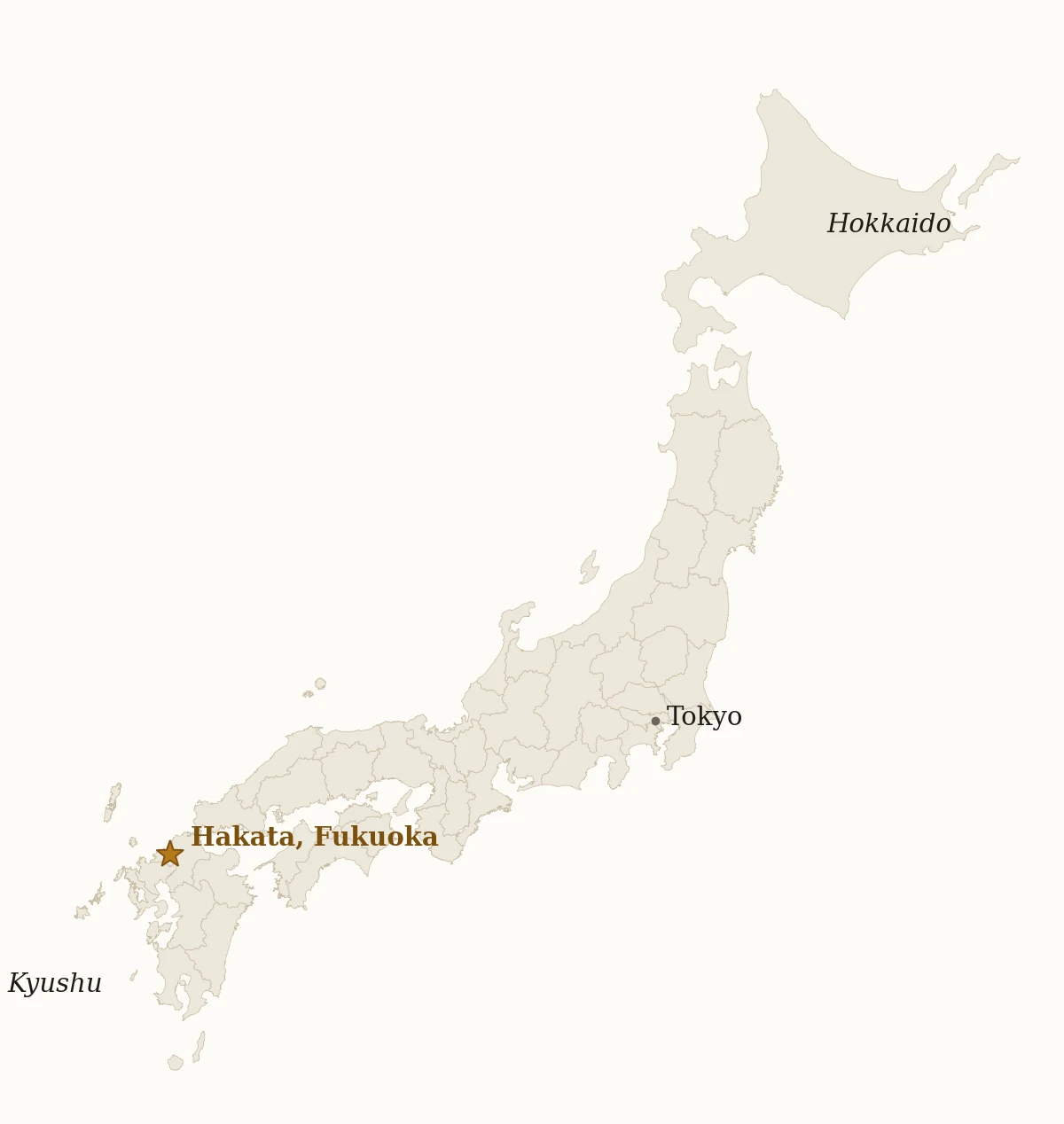
Fukuoka is Kyushu’s largest city and its main transport hub — the natural starting point for a trip around the island’s sake country.
What struck me most, mapping this flight afterward, is how close together these four breweries actually are. Rokujuyoshu’s home in Hasami, Nagasaki and Wakanami’s in Okawa, Fukuoka are barely an hour apart by car — and all four breweries sit within a couple of hours of the Hakata counter where I tasted them.
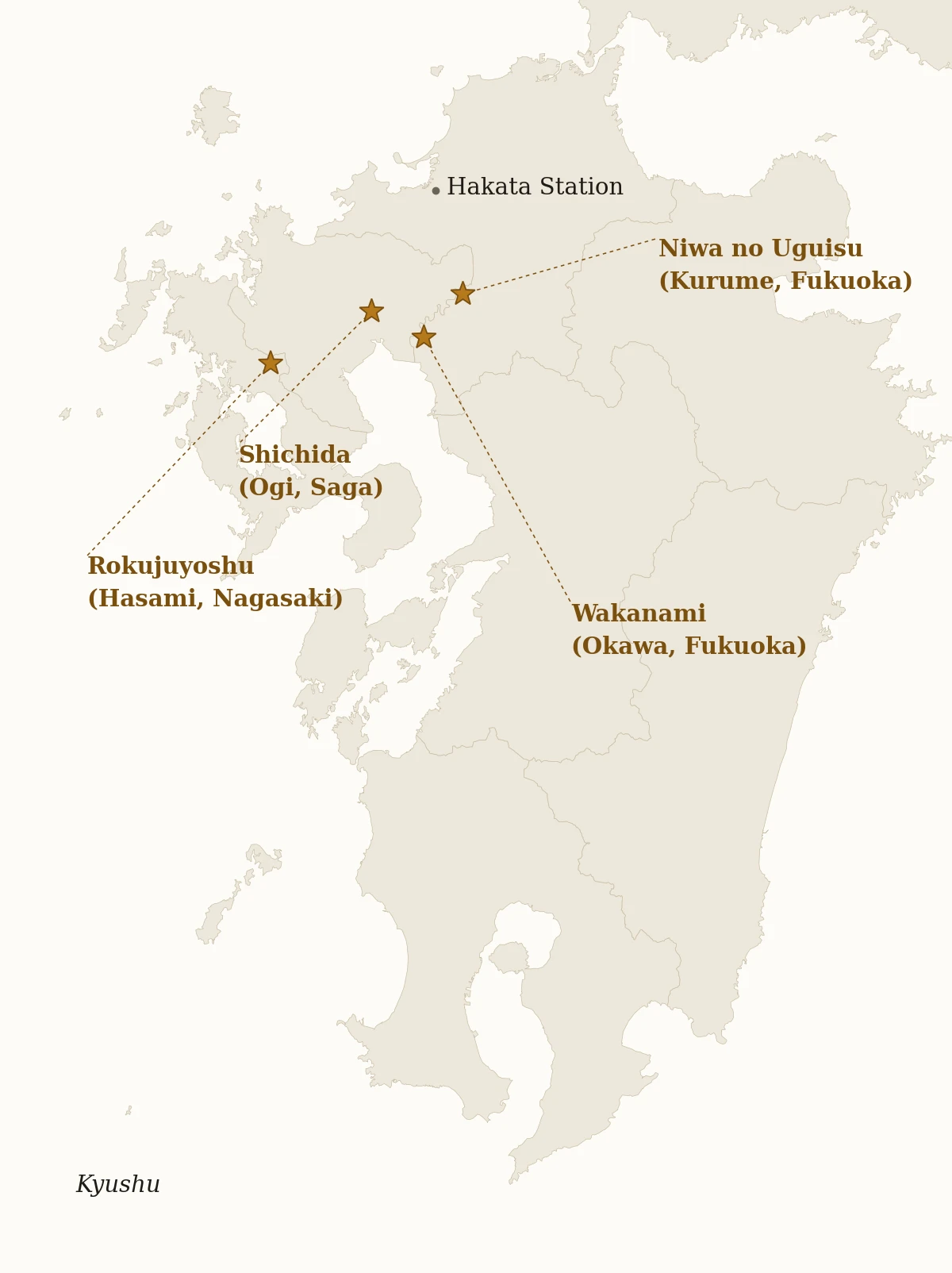
Four breweries, three prefectures, one train station: Rokujuyoshu (Nagasaki), Niwa no Uguisu (Kurume, Fukuoka), Shichida (Ogi, Saga), and Wakanami (Okawa, Fukuoka) all converge at Hakata.
Practical information for visitors
Location: Sumiyoshi Shuhan is inside Hakata Station’s DEITOS arcade, in the みやげもん市場 area, on the same floor as the shinkansen gates. You must exit the shinkansen gates to reach it, so it works well before or after a shinkansen ride, or for transfers between the shinkansen and subway, bus, or local trains. It does not work for shinkansen-to-shinkansen transfers without exiting the gates.
Hours: 9:00 AM to 9:00 PM daily, with last order at 8:00 PM.
Seating: A small counter with only a few seats. Best for solo visitors or pairs looking for a quick, focused tasting, rather than large groups or long stays.
Ordering: The hanafuda card system. On my visit, each person received ten cards, with each card worth 418 yen including tax. The four-sake flight (Gochiso Iroha-ni Masu) cost five cards, and the half-size snack plate cost two. Prices and card counts may change, so treat this as a snapshot from my visit.
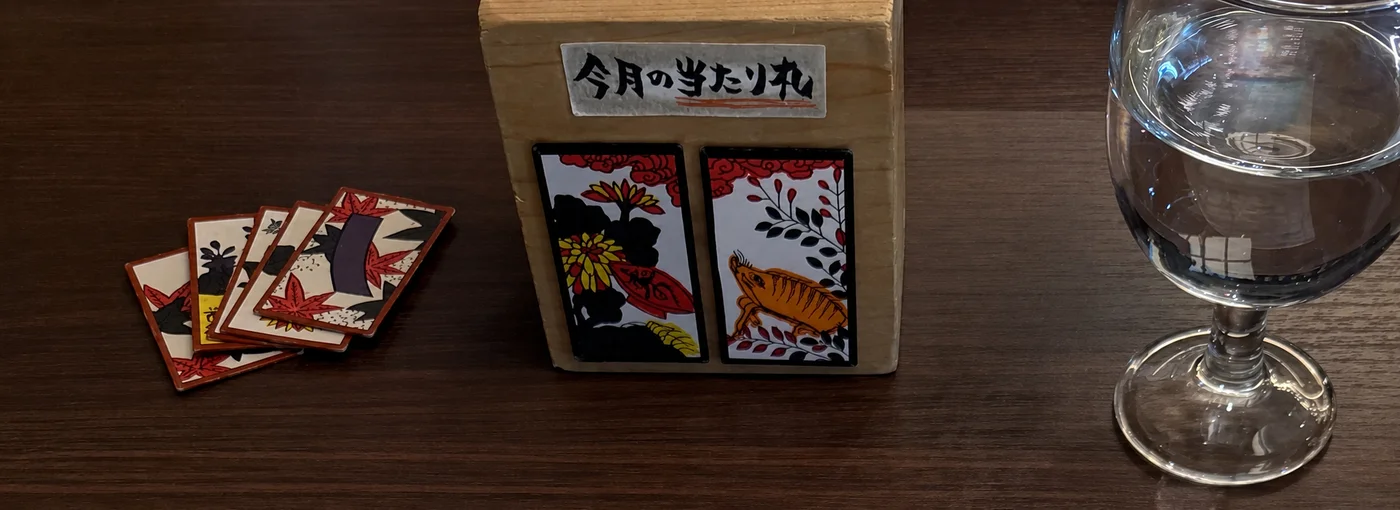
Hanafuda (“flower cards”) are a traditional Japanese playing card deck, usually used for games — here, repurposed as a drink and snack currency. The glass beside them is water, refilled automatically as a chaser between pours.
A note for readers unfamiliar with hanafuda: they are not unique to this bar. Hanafuda decks have been used across Japan since the Edo period, most commonly for games like Koi-Koi. Sumiyoshi Shuhan simply repurposes the cards as a charmingly analog way to pay.
It’s also worth knowing what you will not be charged for. At a typical Japanese izakaya, you can expect a seat charge (seki-dai) and an otoshi — a small appetizer served automatically at the start, whether you ordered it or not, and billed regardless. Sumiyoshi Shuhan has neither. There is no seat charge, no automatic starter dish, and no cover charge. The chaser water is free and continuous — simply part of how sake is served here, not a paid extra. Tipping, as in most of Japan, is not expected or practiced either. Your total is simply the price per card multiplied by the number of cards you use — nothing more, nothing hidden.
Time needed: About 20–30 minutes for the tasting flight and one small plate, as long as the counter is not crowded.
Japanese level: The basic tasting flight is easy to order even if you do not read much Japanese, especially because the format is visual and card-based. For detailed questions about individual bottles, some Japanese will help.
Tip: If you are catching a shinkansen after your visit, buy your ticket before you sit down. The ticket machines can have queues, and you do not want to rush the last glass.
Why this matters for this blog
This was my second visit to Sumiyoshi Shuhan, and it will not be my last.
For readers planning a trip to Kyushu, it may be the single easiest sake experience I can recommend: no reservation, a central station location, little Japanese required for the basic tasting flight, and a built-in framework — Modern/Classic × Light/Rich — that teaches you something about your own preferences in the space of four small glasses.
For me, it also confirmed something I have been feeling since this blog began: the best encounters do not require a pilgrimage to a remote brewery.
Sometimes they are waiting at the train station, in a wooden box marked イロハニ, thirty minutes before your platform lights up.
Kanpai — to the ones you almost walked past.
Please enjoy sake responsibly and follow the drinking laws in your country or region.
Sake is an alcoholic beverage. This article is intended for readers of legal drinking age in their country — please drink responsibly.