Bizen Ware Guinomi by Ryohei Sakai: Clay, Fire, and a Sake Cup with No Glaze
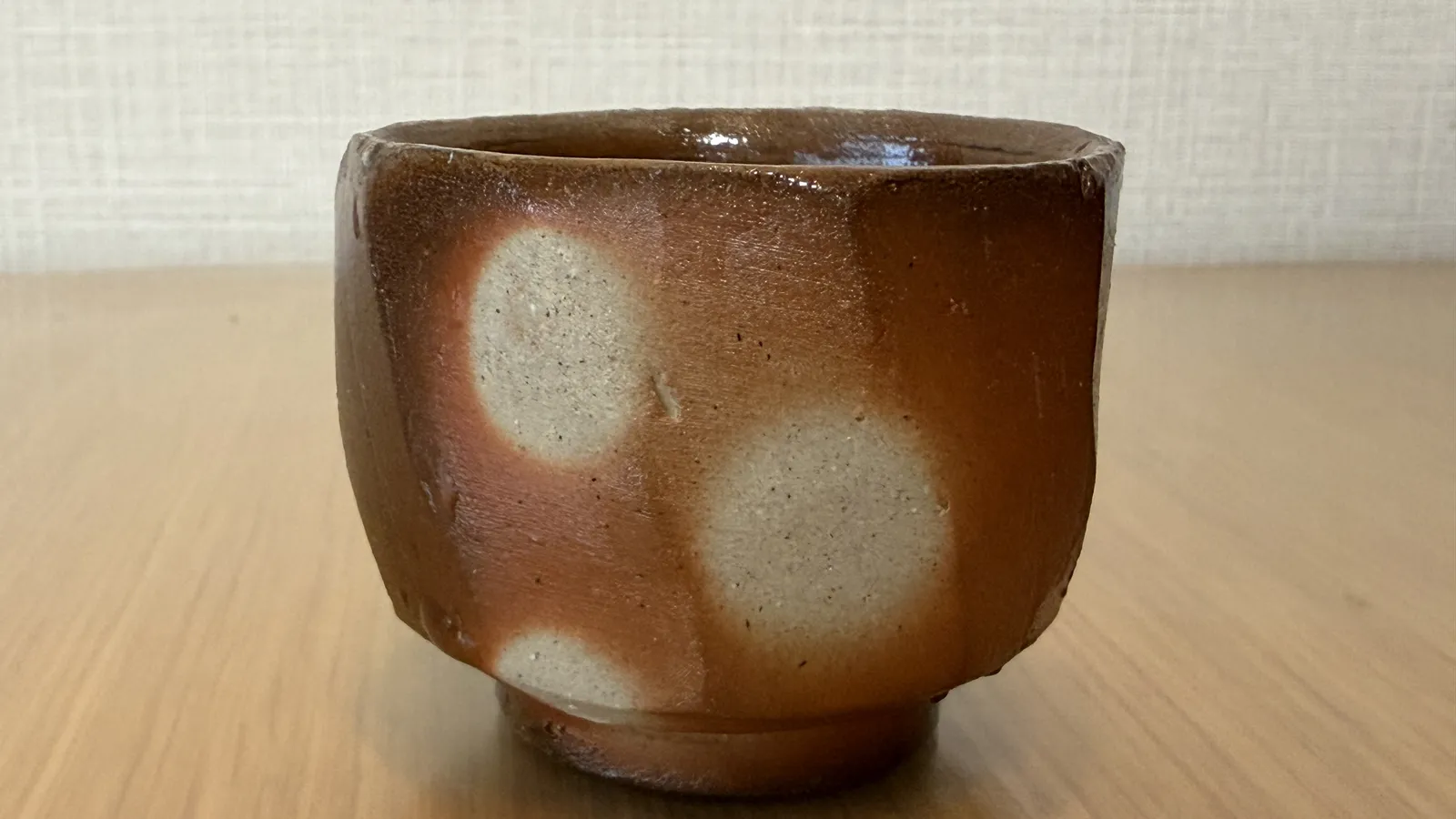
Table of Contents
- Cup Details
- Where in Japan
- What Is Bizen Ware?
- Ryohei Sakai and La Bizen
- The Three Pale Circles: Marks Left by Korogashi
- Why Is This Bizen Cup Brown Rather Than Gray?
- An Unglazed Surface You Can Actually Feel
- Does Bizen Ware Really Make Drinks Taste Better?
- Using the Bizen Guinomi with Sake
- Compared with My Porcelain Guinomi
- What I Would Try in This Cup Next
- Things to Keep in Mind Before Buying Bizen Ware
- Price and Where to Find La Bizen
- Final Thoughts
Disclosure: This article contains links to ceramic makers and related resources. Unless otherwise noted, these are not affiliate links.
I went to the pottery fair looking for sake ware.
Among rows of cups, plates, and vessels from across Japan, one small guinomi caught my attention. It was not brightly decorated, nor did it have the smooth finish of porcelain.
Instead, it was earthy, slightly rough to the touch, and covered in shades of warm brown.
Three pale circles appeared across one side.
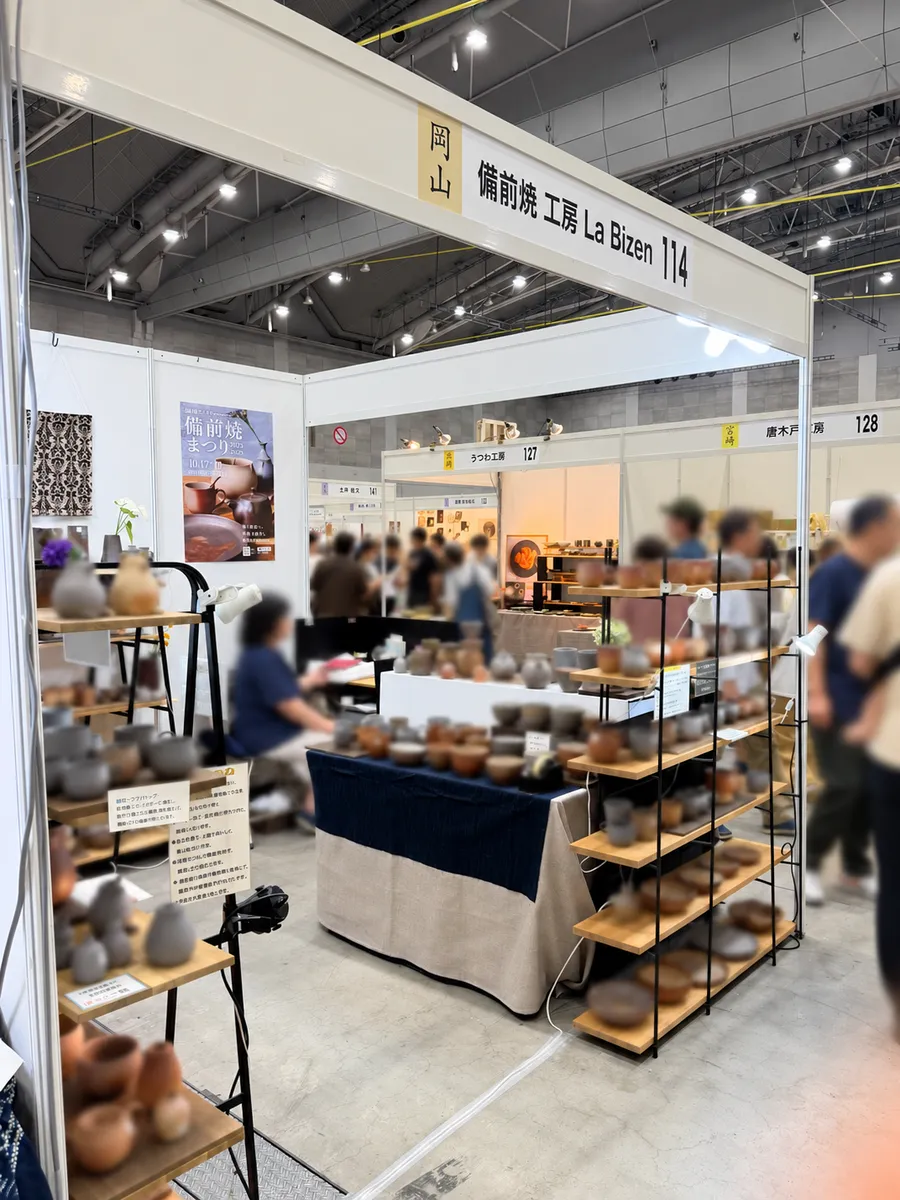
I bought it for ¥3,200 from the booth of La Bizen, where its maker, Ryohei Sakai, was also present.
Only after speaking with him did I begin to understand how much of what I was looking at had been created not by decoration, but by the firing itself.
Cup Details
| Detail | Information |
|---|---|
| Maker | Ryohei Sakai, La Bizen |
| Item | Bizen ware guinomi |
| Material | Unglazed Bizen stoneware |
| Purchased at | La Bizen booth, Nishinihon Tojiki Festa (West Japan Ceramics Fair), Kokura, Kitakyushu |
| Purchase date | September 20, 2026 |
| Price | ¥3,200 |
| Sake used for this article | Shichida Junmai Omachi Hiyaoroshi |
Where in Japan
This guinomi connects three places in Japan.
The first is Kokura in Kitakyushu, at the northern tip of Kyushu. This is where I found the cup, at the La Bizen booth of a large pottery fair held at the West Japan General Exhibition Center.
The second is Akaiwa City in Okayama Prefecture, where Ryohei Sakai has his kiln and workshop, La Bizen.
The third is Imbe in Bizen City, a short distance east of Akaiwa. Imbe is the historic center of Bizen ware, and the clay the tradition is built on comes from this area.
In other words, I met this cup in Kyushu, about 300 kilometers west of the place where it was made.
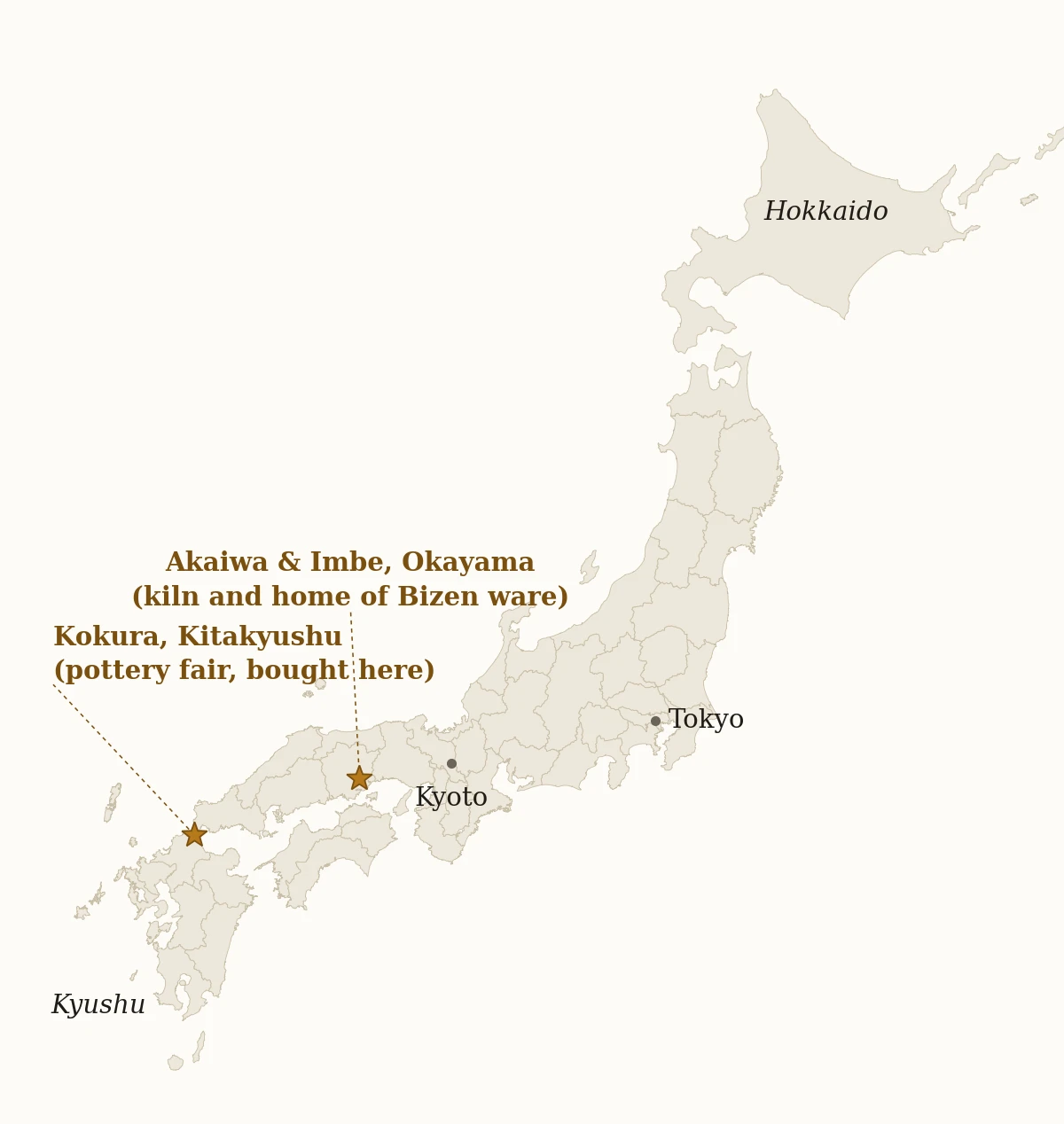
Kokura sits at the northern tip of Kyushu. The Bizen ware area lies in Okayama Prefecture, on the Seto Inland Sea between Kyushu and Kyoto.
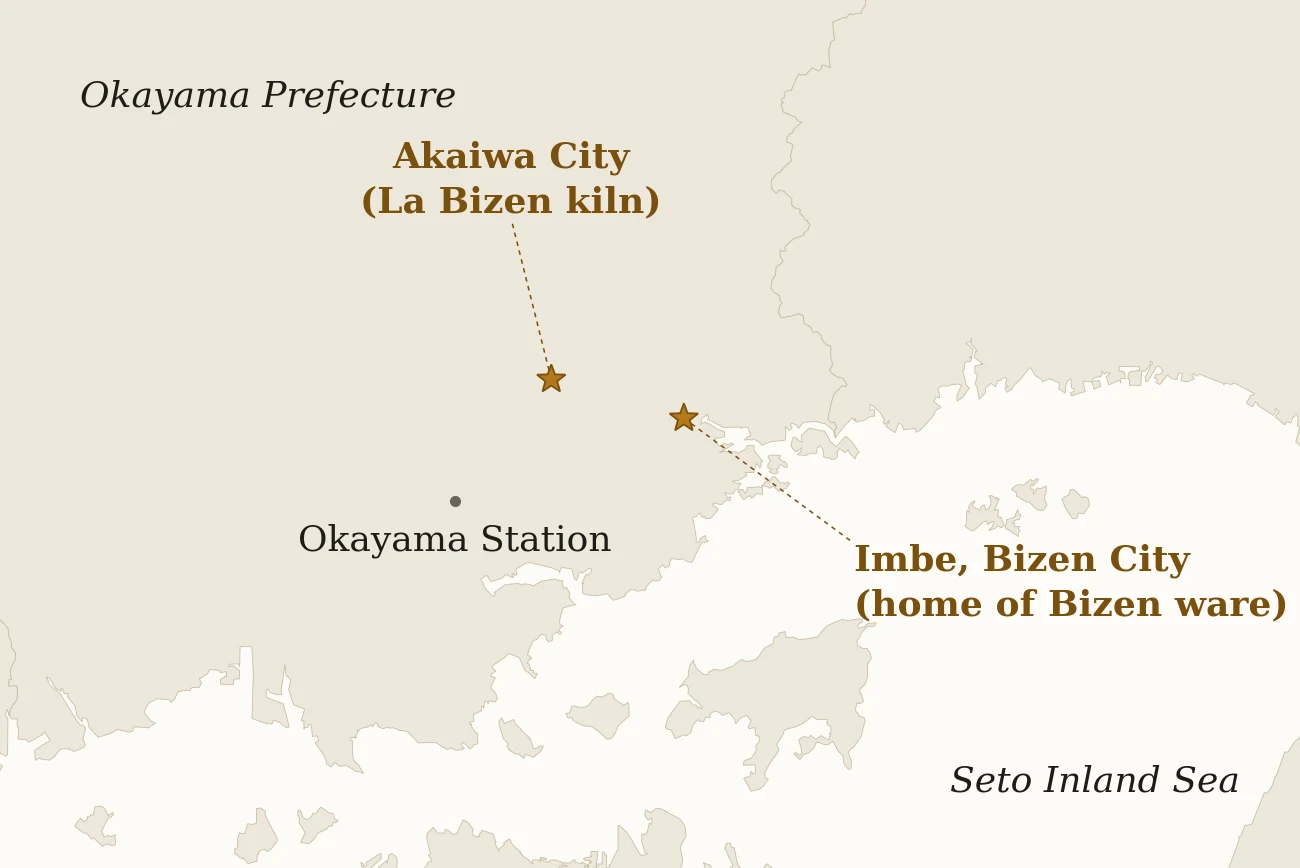
Where in Japan: I bought this guinomi in Kokura, Kitakyushu. It was made at La Bizen in Akaiwa City, Okayama, not far from Imbe in Bizen City, the historic home of Bizen ware.
What Is Bizen Ware?
Bizen ware, or Bizen-yaki, is one of Japan’s historic ceramic traditions and one of the country’s Six Ancient Kilns.
One of its defining characteristics is that it is traditionally fired without glaze. Instead of painting or glazing the surface, Bizen potters allow clay, fire, wood ash, temperature, and the atmosphere inside the kiln to create the final appearance. These natural changes created in the kiln are often described as yohen, or “kiln transformations.”
The leaflet that came with my cup explains the process in a few lines. The clay is prepared from a clay layer called hiyose, found underground around Imbe. Each piece is shaped individually, then fired without glaze at over 1,200°C until it becomes a hard, dense stoneware.
Official descriptions from Bizen City show just how varied the results can be: reddish brown, gray, blue-gray, black, and surfaces marked by ash, straw, or the position of one vessel against another.
That means the surface is not simply a decoration placed on the cup.
It is partly a record of what happened to it inside the kiln.
Ryohei Sakai and La Bizen
The guinomi was made by Ryohei Sakai, the potter behind the workshop La Bizen in Akaiwa City, Okayama Prefecture.
According to the profile printed on the leaflet and on his website:
- He was born in 1964 in Toyoake, Aichi Prefecture
- In 1982, he studied ceramics at a ceramics technical school in Seto, Aichi, one of Japan’s major pottery towns
- In 1983, he moved to Bizen and joined an established Bizen workshop
- In 1987, he studied ceramic sculpture under the Bizen potter Kimura Gyokushu
- In 1998, he set up his own kiln in Akaiwa City
He is also a certified Bizen ware Traditional Craftsperson (dento kogeishi).
What made this purchase particularly memorable was that I was able to speak with Sakai himself at the booth.
Rather than simply buying a cup and reading about it later, I could ask why this particular piece looked the way it did.
The Three Pale Circles: Marks Left by Korogashi
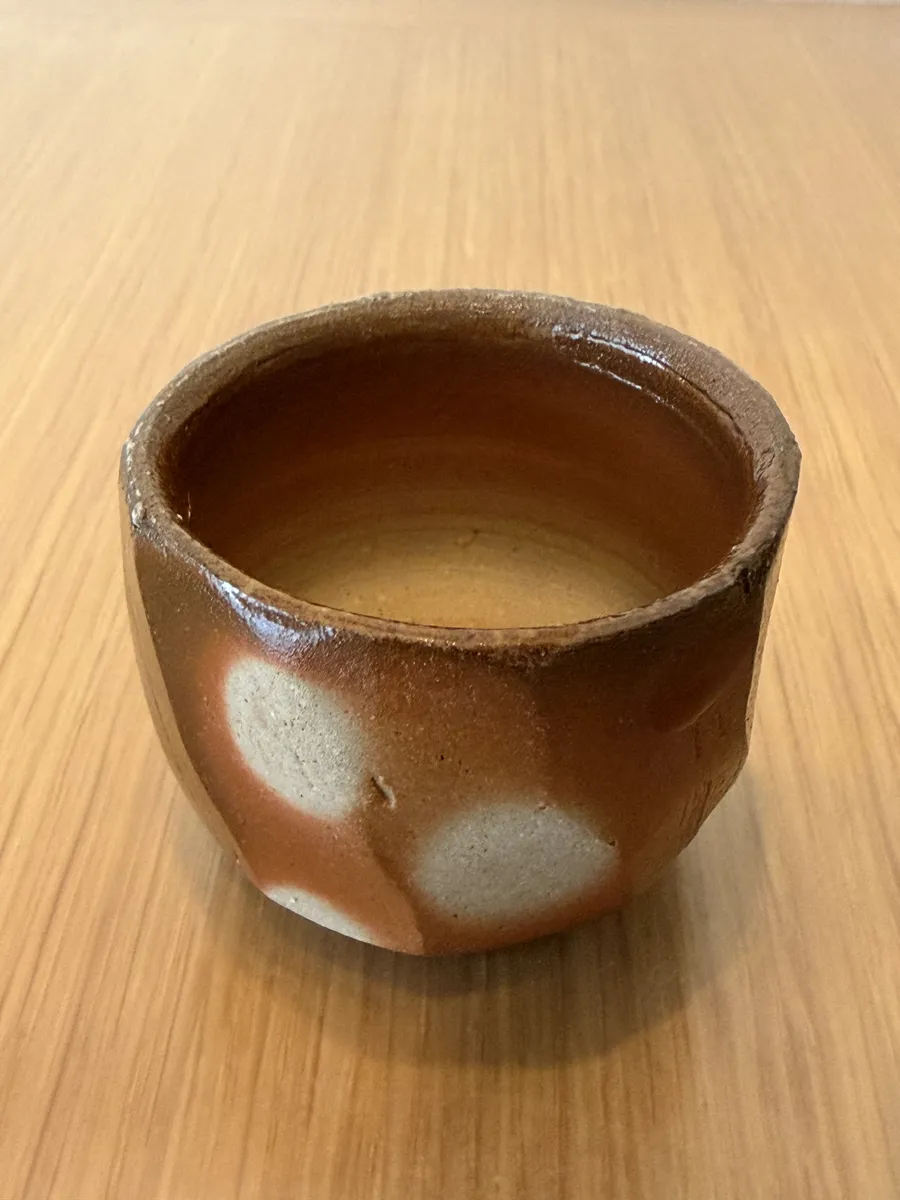
The most immediately recognizable feature of my cup is the group of three pale, almost white circles on its brown exterior.
At first, I assumed they were intentionally applied decoration.
They were not.
Sakai explained that they came from korogashi, a firing method in which the vessel is laid on its side in the kiln. The word comes from korogasu, “to roll” or “to lay over.”
According to Sakai, the pale circles on this particular guinomi are areas associated with the points of contact while it was fired.
Bizen ware also has other firing marks created when flame or ash is blocked from part of the surface. But Sakai specifically described the marks on my cup as the result of korogashi, so that is how I refer to them here.
What looks like a simple pattern is therefore evidence of how the vessel sat inside the kiln.
I like this detail because it changes the way I look at the cup. The circles are not painted on to imitate a firing effect. They are part of its firing history.
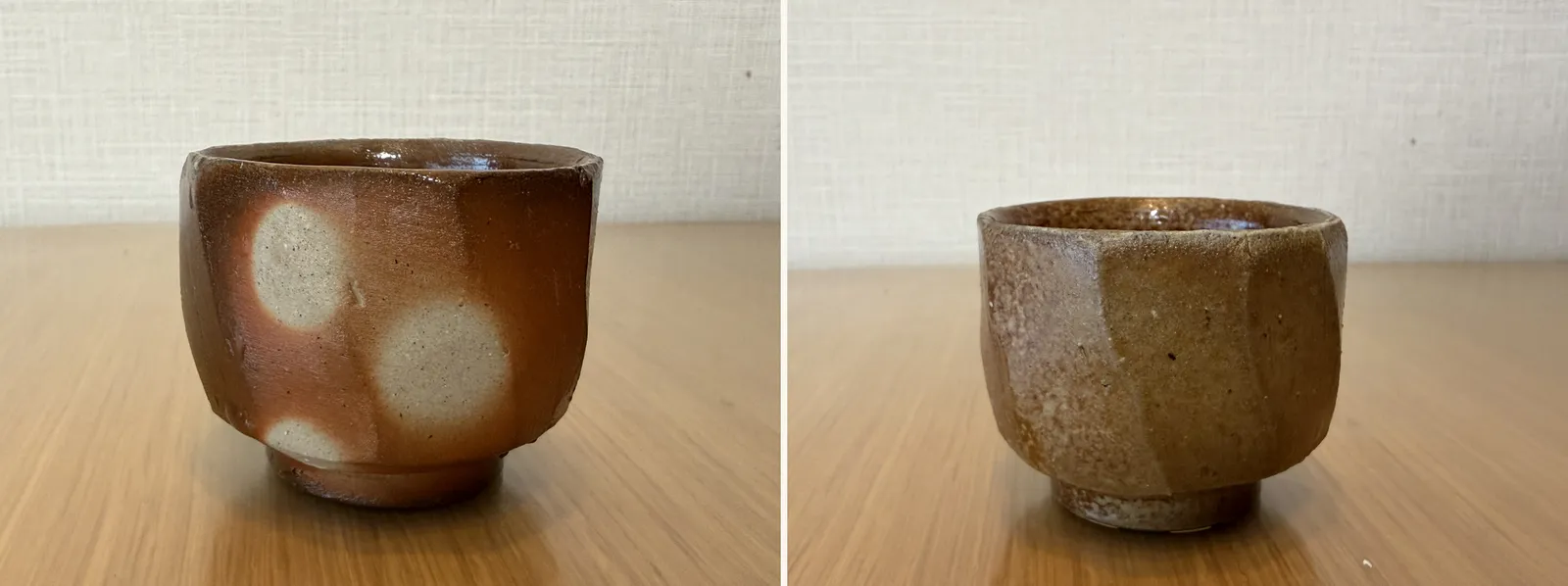
The same cup from two sides. The pale circles appear on only one side.
Why Is This Bizen Cup Brown Rather Than Gray?
This was another question I asked at the booth.
Bizen ware can appear in dramatically different colors. Some pieces are warm red or brown, while others become gray, blue-gray, or almost black.
The explanation involves the atmosphere inside the kiln.
In broad terms, areas exposed to more oxidizing conditions tend to develop the familiar reddish or brown tones associated with iron-rich Bizen clay. When oxygen becomes limited and reduction takes place, gray, dark gray, bluish, or black surfaces can appear.
A classic example is sangiri, in which a piece is buried in ash on the kiln floor and receives little direct flame or circulating air. Bizen City describes this as a reducing, smoldering condition that produces gray, dark gray, and blue colors. Charcoal can also be used to create similar effects.
My guinomi is predominantly warm brown, so visually it sits much closer to the reddish-brown side of Bizen’s range than to gray-blue sangiri.
But the chemistry is more complicated than simply saying “oxidation makes brown and reduction makes gray.”
Scientific studies of Bizen surfaces have found that iron-bearing compounds, wood ash, temperature, and firing conditions all contribute to the final color, and that the brown and black areas of wood-fired Bizen can involve different microscopic mineral structures.
That complexity is part of what makes Bizen so interesting: even a very simple-looking cup can hold a record of many different conditions inside the kiln.
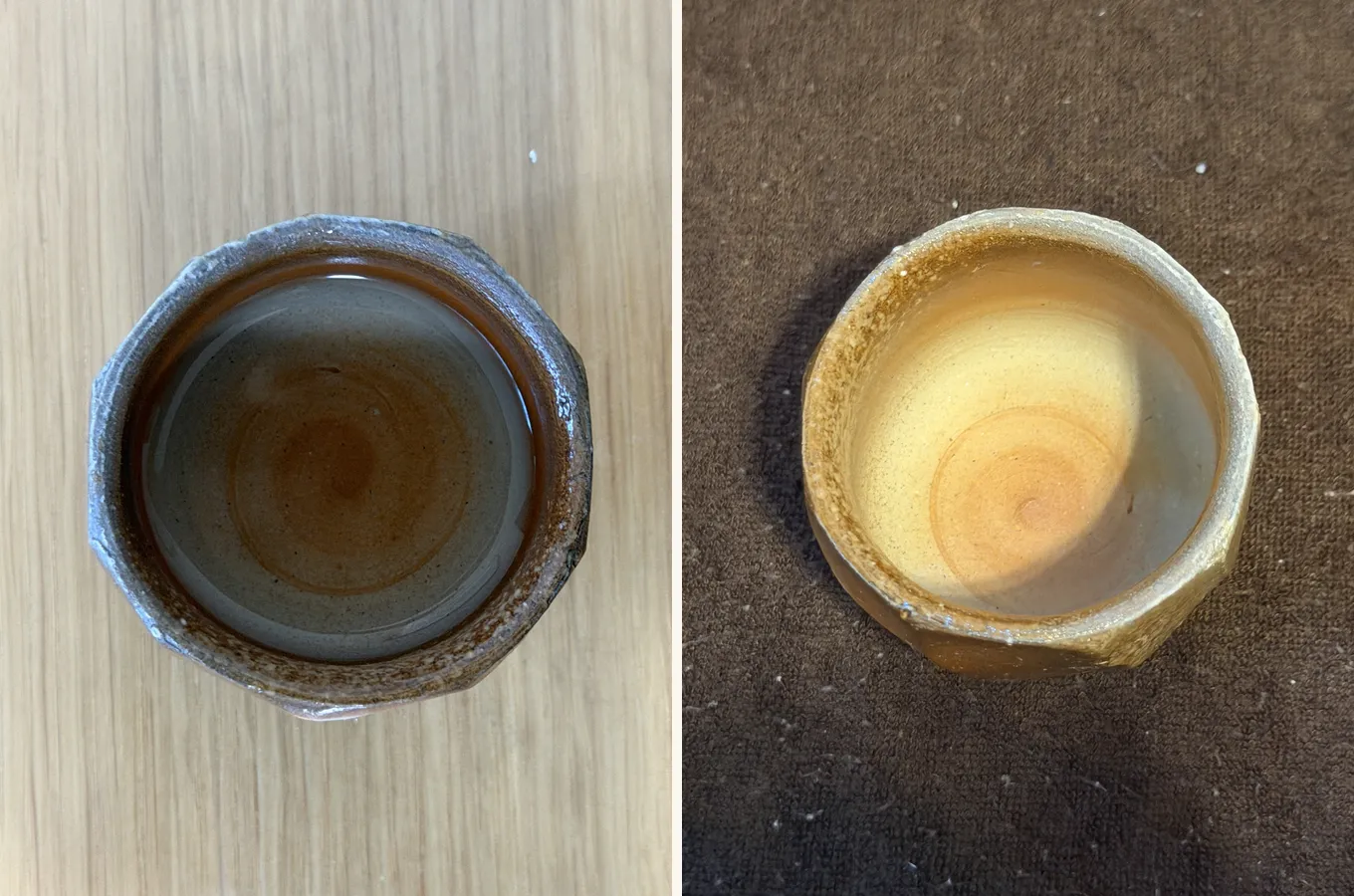
The same empty cup in two different lights. In daylight (left) it reads as deep brown; under warm indoor light (right) it looks lighter and more golden. An unglazed surface like this changes a great deal with the light around it.
An Unglazed Surface You Can Actually Feel
The other thing I noticed immediately was the texture.
This cup is not smooth like glazed porcelain. Running a finger across its exterior, I can feel a fine roughness in the surface.
The leaflet supplied with the cup explains that, because Bizen ware shrinks as it is fired without glaze, small stones in the clay can come to the surface, sometimes leaving small bumps or hollows. It can also show lines where a stone was dragged across the clay on the potter’s wheel.
Those are not defects. The leaflet describes them as part of the keshiki, or “scenery,” of the piece: the natural variations that make every Bizen piece one of a kind.
The same leaflet also says something reassuring: unglazed Bizen may feel rough at first, but it becomes smoother to the touch the more it is used.
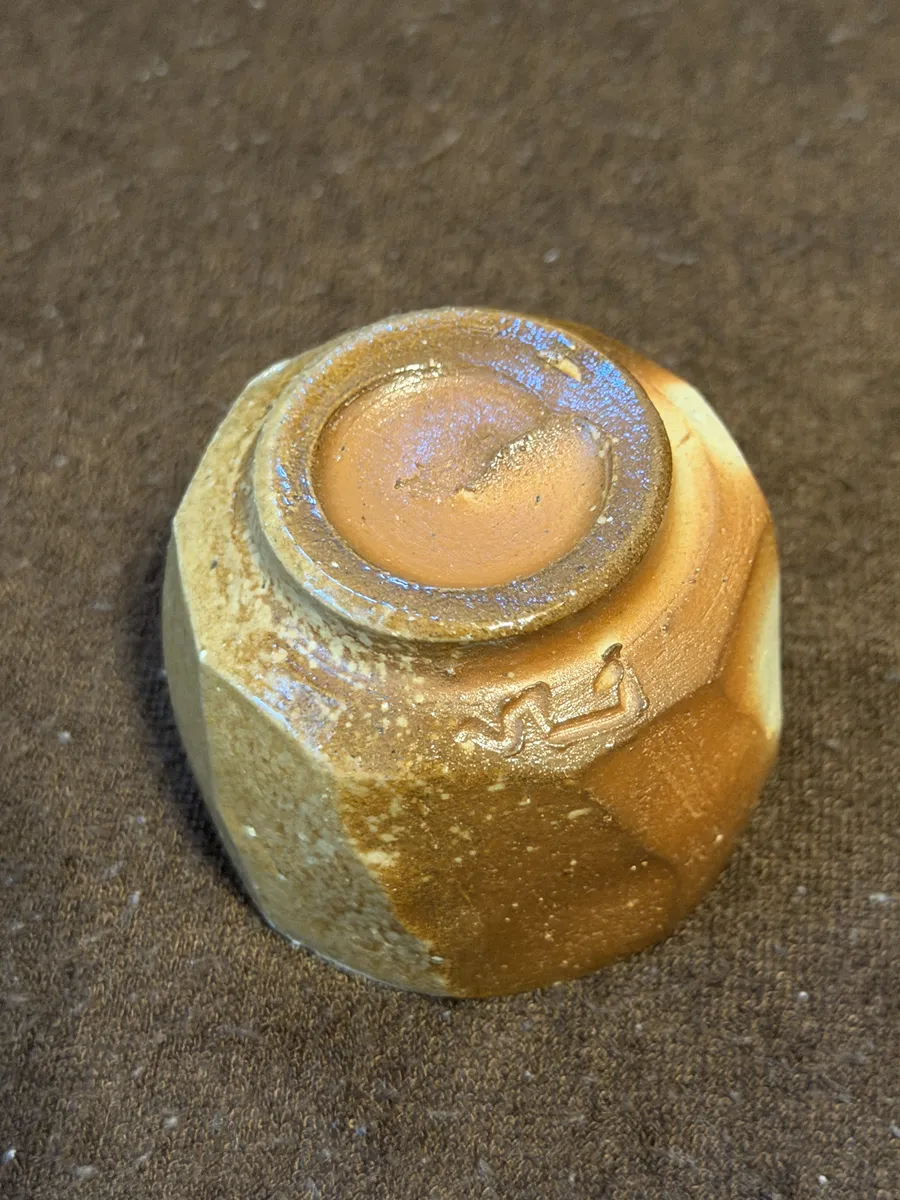
The Mark near the Foot
Turning the cup over, there is a small stamped mark pressed into the clay just above the foot.
Bizen potters often mark their work with a seal like this. Since Sakai made this cup himself, I take it to be his mark. It is a quiet detail, but it is the part of the cup that ties it back to the maker.
That tactile quality raises an interesting question.
Does an unglazed Bizen cup actually change what we drink from it?
Does Bizen Ware Really Make Drinks Taste Better?
At the La Bizen booth, there were suggestions that drinks such as beer and coffee could taste better from Bizen ware.
I asked Sakai about this directly.
He told me that research had been carried out in Okayama, but he was careful not to claim that the mechanism had been fully explained. He suggested that the unglazed surface structure might have something to do with it.
I appreciated that answer.
There are studies suggesting that the material and surface properties of drinking vessels can affect things such as beer foam. One study comparing ceramic and glass vessels found differences in foaming and suggested that vessel material can influence the drinking experience. However, that does not by itself prove that Bizen ware objectively makes every drink taste better.
For sake, I think the more interesting approach is not to repeat the claim as fact, but to test it.
Using the Bizen Guinomi with Sake
For its first proper use, I poured Shichida Junmai Omachi Hiyaoroshi into the cup and served it alongside sashimi.
Shichida is brewed by Tenzan Shuzo in Ogi, Saga Prefecture, in Kyushu. This bottle is made entirely with Omachi rice, a variety closely tied to Okayama, the home of Bizen ware. It felt like a fitting first sake for the cup. Hiyaoroshi is sake that has rested through the summer and is released in autumn.
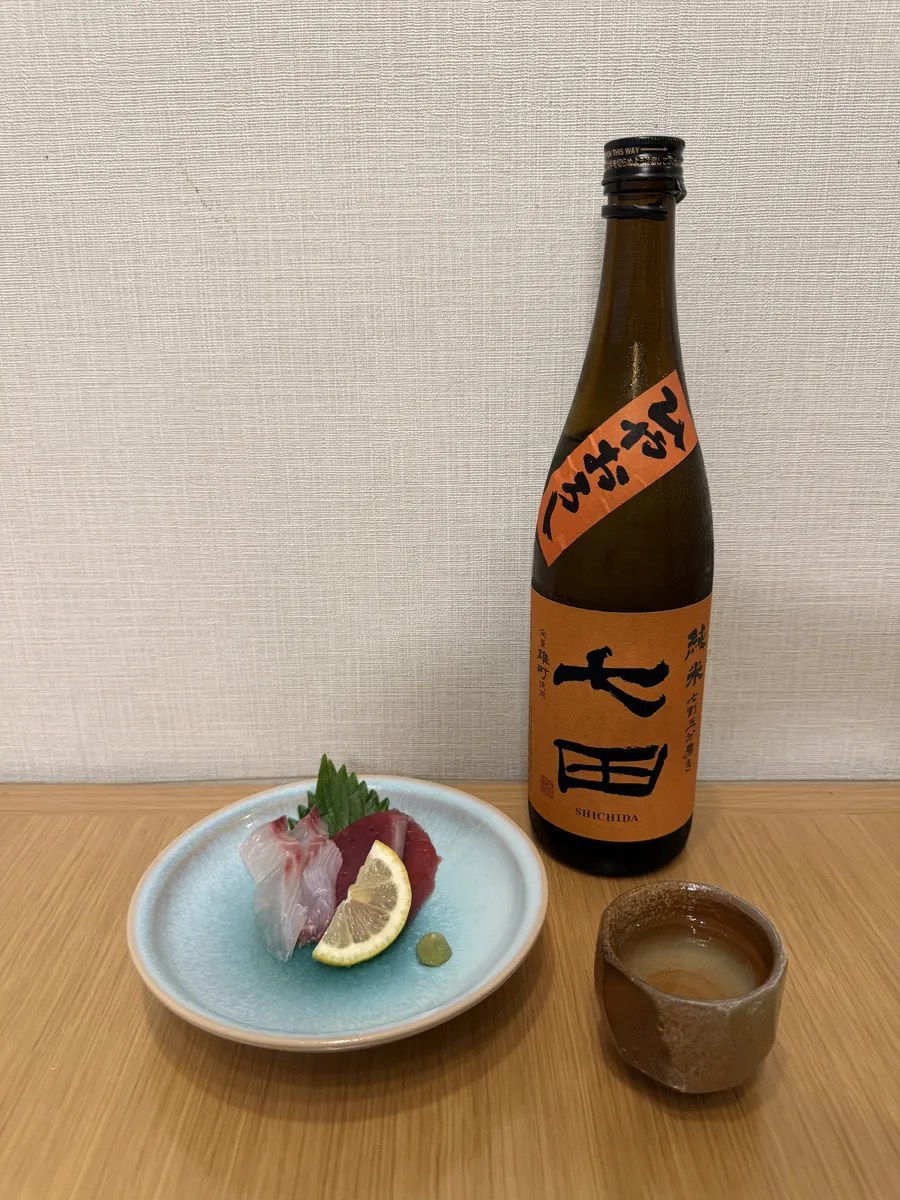
The warm orange-brown label of the Shichida happened to work surprisingly well with the earthy Bizen surface.
More importantly, drinking from the cup felt very different from using a thin glass sake cup.
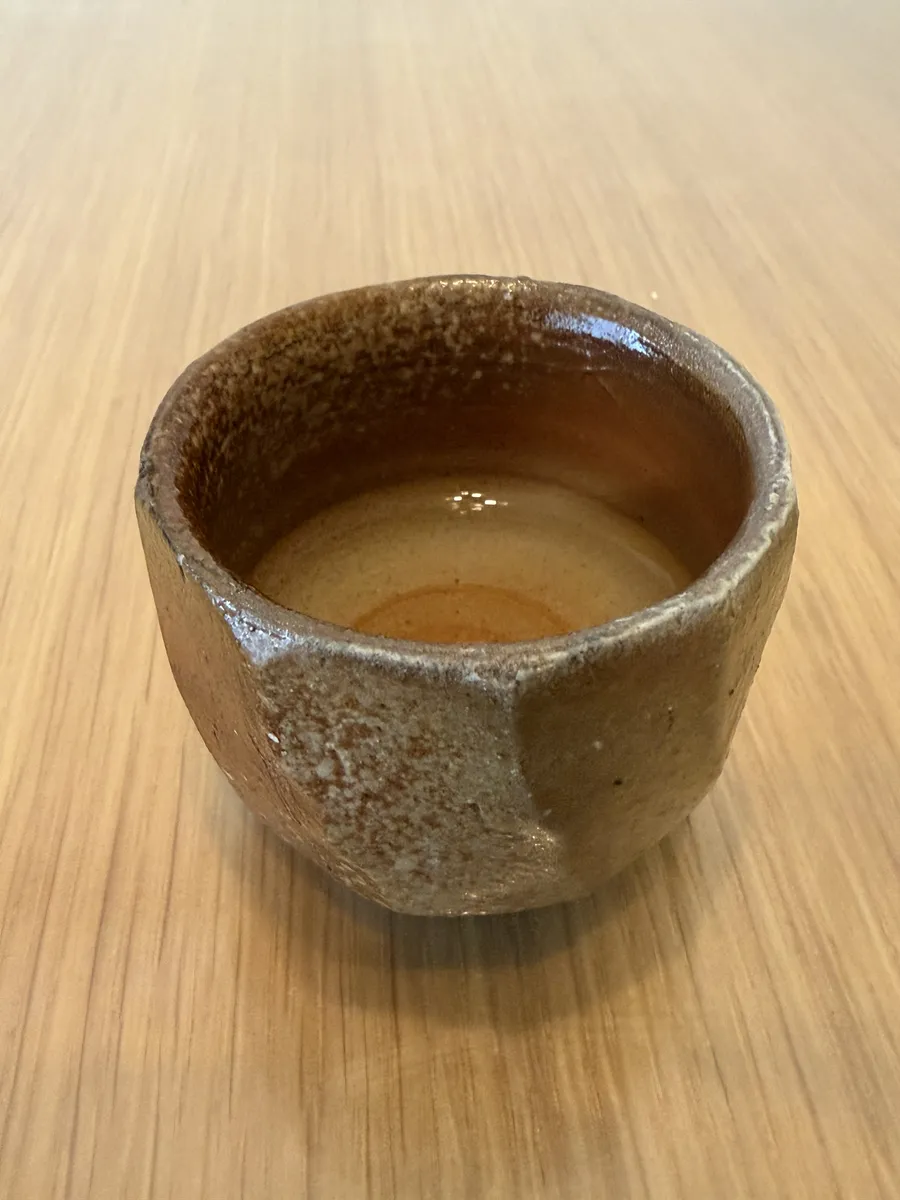
The vessel is relatively substantial in the hand. The rim is irregular rather than perfectly uniform, and the unglazed exterior gives my fingers something to feel.
Compared with drinking from a glass cup, the sake felt softer and rounder to me.
I am not sure how much of that came from the sake itself and how much from the cup. The thicker rim and the texture of the clay against my lips feel completely different from thin, smooth glass, and that alone may be enough to change how a sip comes across.
For now, I would be cautious about saying that Bizen itself “improved” the sake.
But it unquestionably changed the experience of drinking it.
And that distinction may be more interesting.
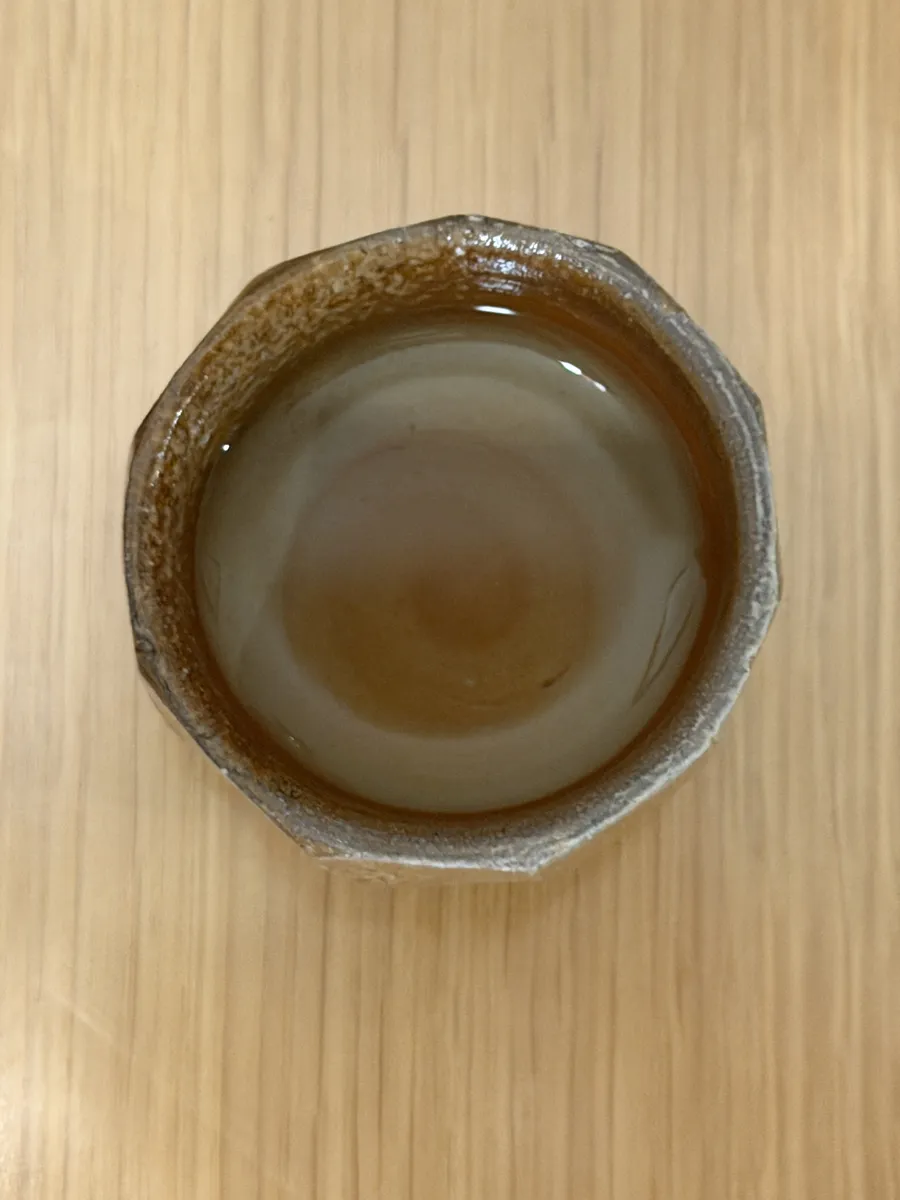
One Thing to Know: The Sake Is Harder to See
The interior of this cup is brown, with a darker ring at the bottom.
That suits the mood of the cup, but it is less practical if you like to examine a sake closely. Against the white porcelain of my Fukagawa Seiji guinomi, I could easily see a sake’s pale color and clarity. In this Bizen cup, the sake takes on the brown of the clay beneath it, and small differences in color or cloudiness are much harder to judge.
If you want to look at a sake before you taste it, a white cup is the better tool.
Compared with My Porcelain Guinomi
My other sake cups are porcelain, so this Bizen guinomi feels very different to use.
| Feature | Bizen ware (La Bizen) | Fukagawa Seiji | Takahama Ware |
|---|---|---|---|
| Material | Unglazed stoneware | Porcelain | Porcelain |
| Surface | Fine roughness you can feel | Smooth and glazed | Smooth and glazed |
| Interior | Brown clay | White | Blue with a dolphin |
| Rim | Irregular | Thin and precise | Medium |
| Decoration | Created by the firing | Cobalt, white, and gold | Blue glaze and dolphin |
| Mood | Earthy, calm, grounded | Elegant, celebratory | Casual, summery |
The Fukagawa cup makes me look at the sake.
The Takahama cup makes me smile at the dolphin.
The Bizen cup makes me pay attention to the cup itself: its weight, its surface, and the marks the fire left on it.
What I Would Try in This Cup Next
I have used this cup with only one sake so far, so this is a starting point rather than a conclusion.
Based on that first pour and on how the cup looks and feels, here is what I would like to try in it next:
- junmai sake with some rice-driven weight
- other autumn hiyaoroshi, and sake that has rested for a while
- sake served at room temperature
- a bottle opened with fish or simple home cooking
Its earthy character feels less suited to moments when I want to study a pale, delicate daiginjo closely. For that, a white porcelain cup still makes more sense to me.
Things to Keep in Mind Before Buying Bizen Ware
Bizen ware is easy to love, but it is not quite as carefree as glazed porcelain. Based on the care leaflet that came with my cup:
- It may feel rough at first. The leaflet says it becomes smoother with use
- Wash it well before the first use, using detergent
- Dry it thoroughly after every use. An unglazed surface can hold moisture, and the leaflet specifically warns about mold
- Oily food can soak in. For tableware used with oily dishes, the leaflet suggests dipping the piece briefly in water and wiping it before use
- Microwave use depends on the piece, because clay blends and firing methods differ
- Never use it in an oven or over direct flame
There is also the nature of Bizen itself: every piece is one of a kind. Even if you visit the same potter, you will not find a cup with exactly the same color, shape, and firing marks as mine.
For me, that is part of the appeal. But if you want a matching set, Bizen may not be the easiest choice.
Price and Where to Find La Bizen
I paid ¥3,200 for this guinomi.
That felt relatively accessible for a handmade piece by a certified Traditional Craftsperson, and a small cup is an easy way to start with Bizen ware.
According to the profile on his leaflet, Sakai has held solo exhibitions in Okayama, Kurashiki, Tsuyama, Sendai, and elsewhere, and has exhibited at department stores including Tenmaya in Okayama, Hankyu Umeda in Osaka, and Matsuzakaya Ueno in Tokyo. I met him at a pottery fair. Because each piece is unique, what is available will change from event to event.
Final Thoughts
This was not the most expensive sake cup I bought at the pottery fair.
At ¥3,200, it was relatively accessible for a handmade piece by an established Bizen potter.
Yet it may be one of the easiest pieces to talk about.
There is no painted image to interpret and no elaborate ornament.
Instead, its story is in the clay itself:
- the rough unglazed surface
- the warm brown firing color
- the pale circles left by korogashi
- the subtle variations left by the kiln
Before buying it, I mainly saw a small brown sake cup.
After speaking with the potter and using it at home, I started seeing the firing process every time I picked it up.
That is probably the most compelling thing about Bizen ware.
It turns fire into decoration without needing to decorate at all.
Sake is an alcoholic beverage. This article is intended for readers of legal drinking age in their country — please drink responsibly.