Takahama Ware Guinomi: A Dolphin Sake Cup from Amakusa's Porcelain Tradition
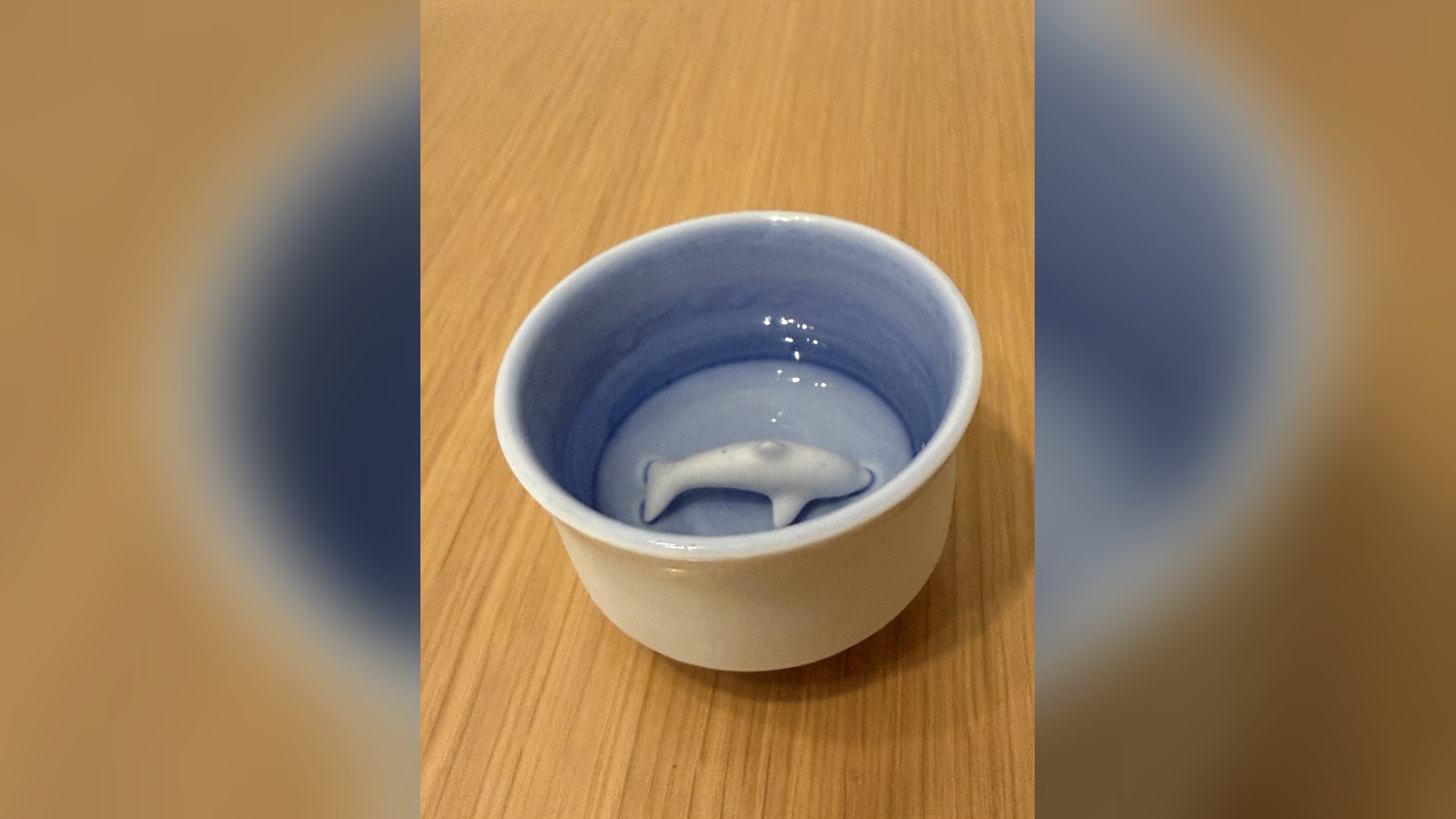
Table of Contents
- A Small Cup That Reminds Me of Amakusa
- Cup Details
- Where in Japan
- What Is Takahama Ware?
- Amakusa Porcelain Stone and Arita Ware
- A Dolphin Hidden Inside the Cup
- What Happens When You Pour Sake
- How the Cup Feels in the Hand
- Drinking Nabeshima from It
- Compared with My Fukagawa Seiji and Satsuma Ware Guinomi
- What Kind of Sake Suits This Cup?
- Visiting the Takahama Ware Juhogama Showroom
- Is Takahama Ware a Good Souvenir from Amakusa?
- Final Thoughts
Disclosure: This article contains links to ceramic makers and travel resources. Unless otherwise noted, these are not affiliate links.
A small white dolphin waits at the bottom of this sake cup.
When I pour sake, it disappears beneath the surface. As I drink, it slowly returns.
The cup was given to me in 2020, when I was living in Amakusa, a group of islands off the western coast of Kumamoto Prefecture.
It is not the most expensive or refined sake cup I own.
But it may be one of the easiest to remember.
This Takahama Ware guinomi brings back the sea, the ceramics of Amakusa, and a period of my life that now feels closely tied to both.
A Small Cup That Reminds Me of Amakusa
I lived in Amakusa for a period of time and often visited places around the islands on my days off.
Amakusa has several pottery and porcelain studios, so visiting a kiln or showroom could easily become part of an ordinary sightseeing trip.
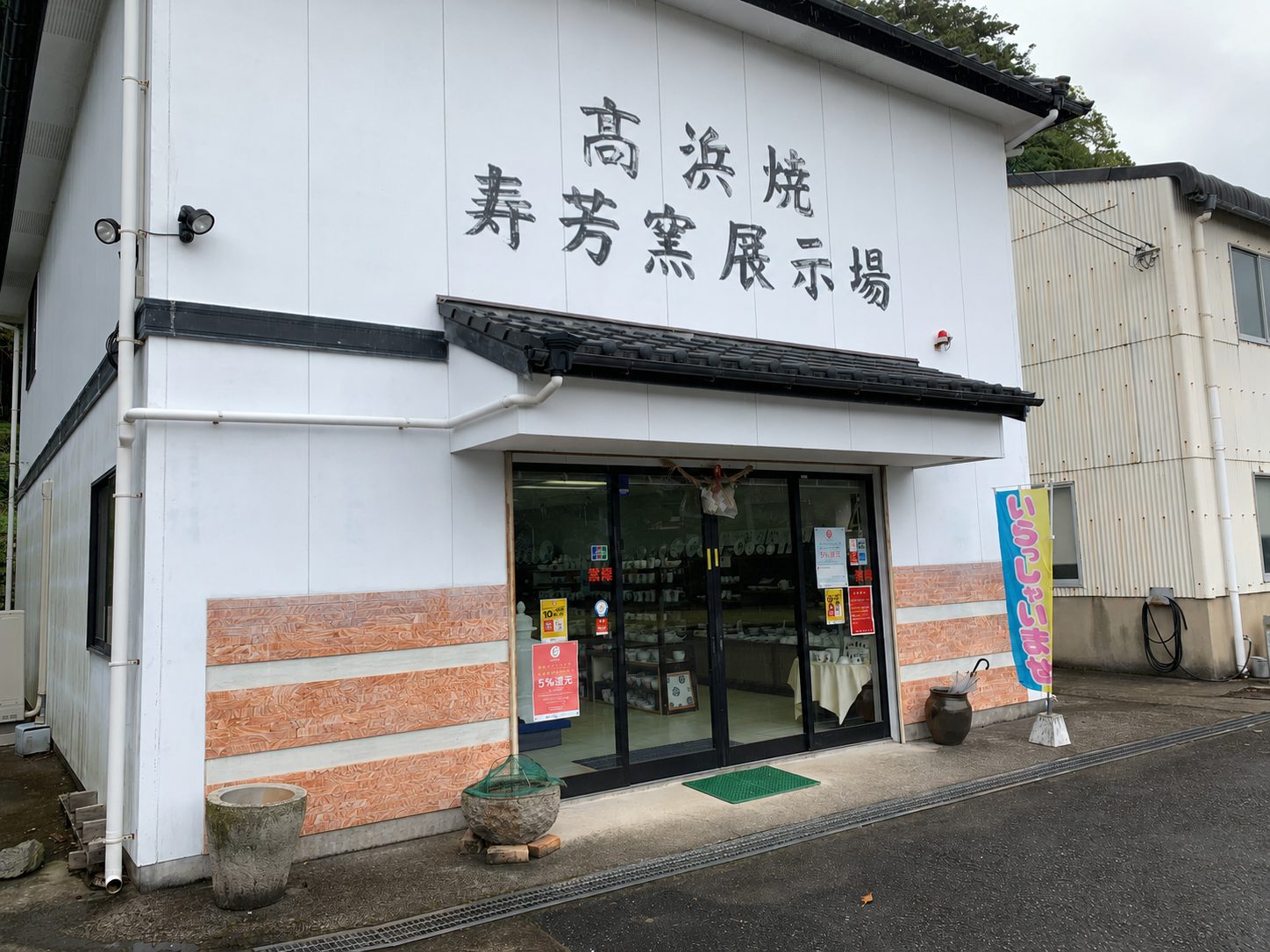
In May 2020, I visited the Takahama Ware Juhogama showroom on the western side of Amakusa.
At the time, I did not buy this particular cup. I simply looked around the showroom and learned a little more about a ceramic tradition made from stone found in the same region where I was living.
A few months later, around September 2020, my mother-in-law came to visit Amakusa and stayed at Hotel Alegria Gardens Amakusa.
She knew that I enjoyed drinking sake.
At the hotel gift shop, she found this Takahama Ware guinomi and gave it to me.
The dolphin apparently made the choice easy: it was charming, unmistakably connected to Amakusa, and suited to someone who drank sake.
Cup Details
| Detail | Information |
|---|---|
| Maker | Takahama Ware Juhogama |
| Item | Dolphin guinomi |
| Material | Amakusa porcelain |
| Received | Around September 2020 |
| Purchased at | Hotel Alegria Gardens Amakusa gift shop |
| Approximate price | Around ¥1,000–2,000 |
| Kiln visit | May 2020 |
| Sake used for this article | Nabeshima Junmai Ginjo Yamadanishiki |
I do not know the exact original price because the cup was a gift, but I remember it being somewhere between ¥1,000 and just under ¥2,000.
That modest price is part of its appeal.
It is distinctive enough to preserve a memory of Amakusa, but approachable enough to use without hesitation.
Where in Japan
This cup connects three places in Kyushu.
The first is Takahama, on the western side of Amakusa Shimoshima in Kumamoto Prefecture. This is where Takahama Ware Juhogama is located and where I visited the showroom in May 2020.
The second is the Hondo area of Amakusa City, where Hotel Alegria Gardens Amakusa stands. The cup was purchased from the hotel gift shop several months after my kiln visit.
The third is Arita in Saga Prefecture. Amakusa porcelain stone has long been supplied as a raw material for porcelain made in Arita and other production centers.
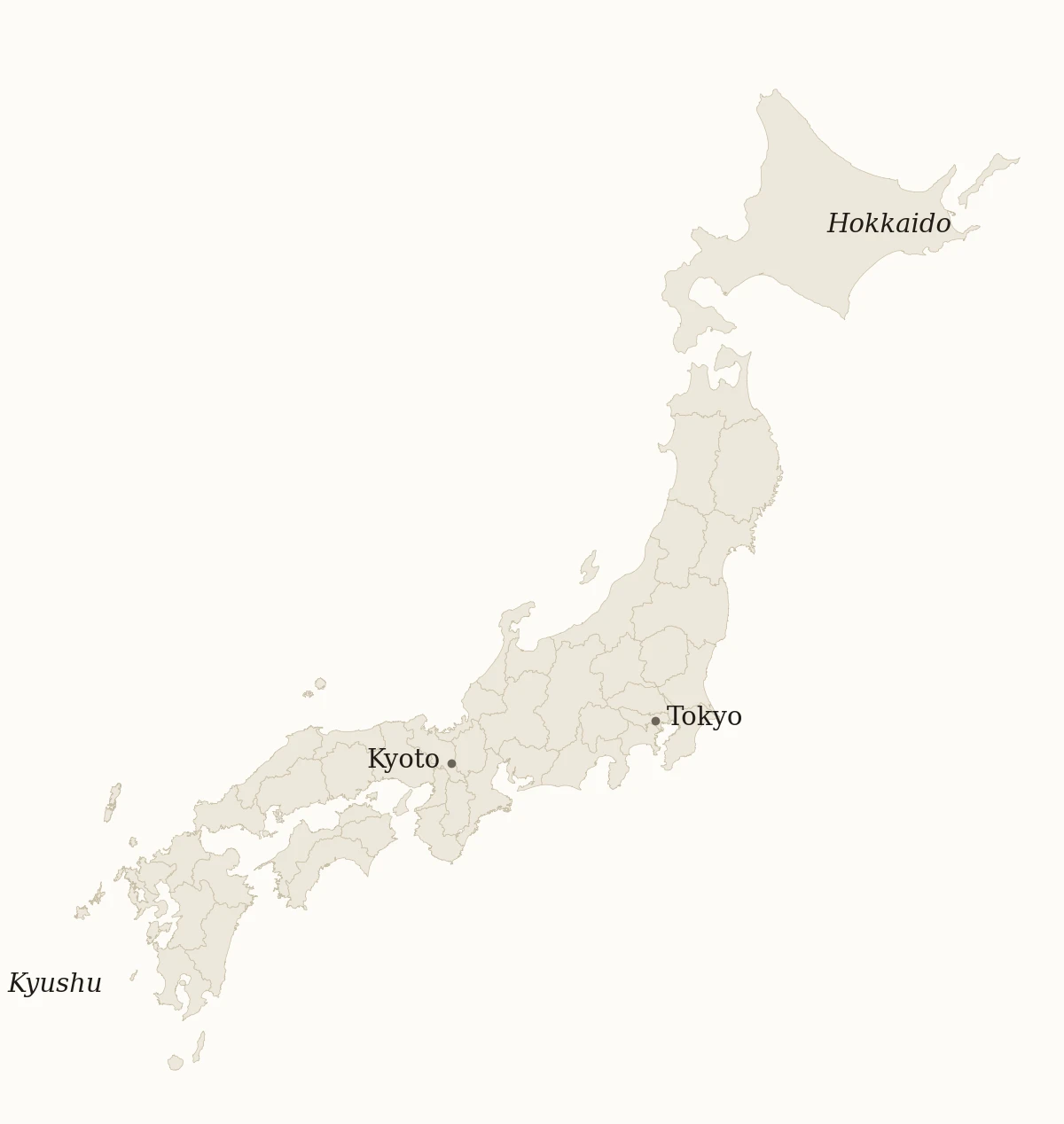
Amakusa lies in Kyushu, the southwestern main island of Japan — well south of both Tokyo and Kyoto.
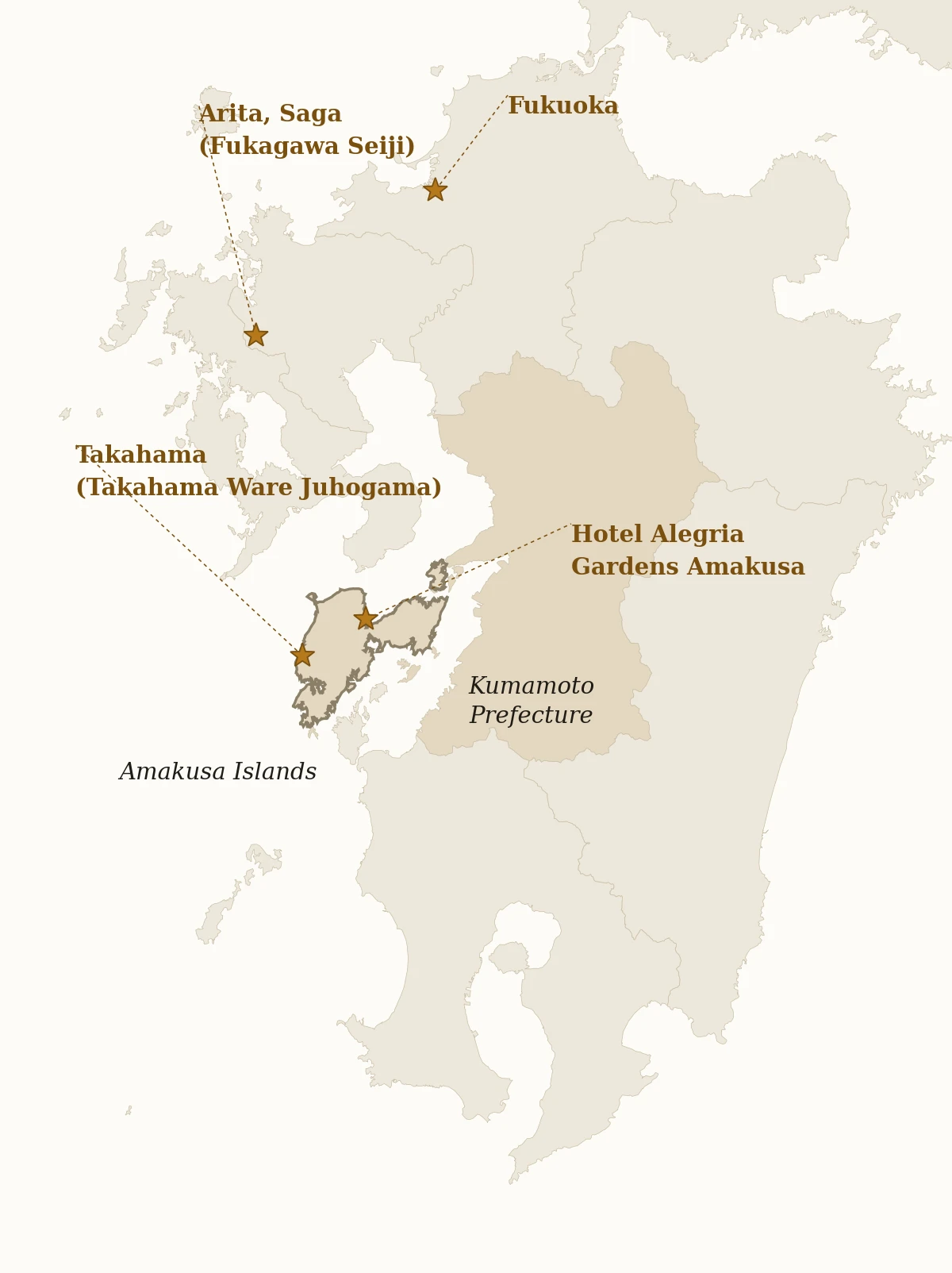
Where in Japan: The cup was made in Takahama and purchased in the Hondo area of Amakusa. Amakusa porcelain stone has also supported porcelain production in Arita, Saga.
What Is Takahama Ware?
Takahama Ware began in 1762, when Ueda Dengoemon Takehiro invited a potter from Hizen-Nagayo and established a kiln in Takahama. The ceramics were made with high-quality porcelain stone found in the surrounding mountains.
The tradition experienced periods of growth, interruption, and revival. Today, Takahama Ware Juhogama continues producing porcelain while also preserving historical materials connected to the kiln and the Ueda family.
The current workshop uses its own Amakusa porcelain stone. Its general production process includes shaping, bisque firing at approximately 900°C, underglaze decoration, glazing, and final firing at approximately 1,300°C.
The official website describes modern Takahama Ware as aiming for porcelain that is white, thin, translucent, and suitable for everyday life. The individual cup I own has a medium-thick rim rather than the especially thin profile of my Fukagawa Seiji guinomi, but it still feels smooth and relatively light in the hand.
You can find more information on the official Takahama Ware Juhogama website.
Amakusa Porcelain Stone and Arita Ware
Amakusa porcelain stone is one of the most important parts of this story.
It is found mainly in western Amakusa Shimoshima and is known as a high-quality raw material for white porcelain. Its low levels of iron and titanium help produce a clear white body, while its strength and workability make it useful for porcelain manufacturing.
The stone has not been used only within Amakusa.
It has also been supplied to porcelain-producing regions such as Arita and Imari in Saga Prefecture. The company behind Takahama Ware currently lists Arita and Hasami-related producers among the destinations for its porcelain stone.
This creates an interesting connection with my Fukagawa Seiji guinomi.
Fukagawa Seiji belongs to the porcelain tradition of Arita. Takahama Ware comes from Amakusa, one of the places supplying the stone that has supported porcelain production in the Hizen region.
The two cups look and feel very different, but their stories are not entirely separate.
Read about my Fukagawa Seiji Botan Kinmiru guinomi →
A Dolphin Hidden Inside the Cup
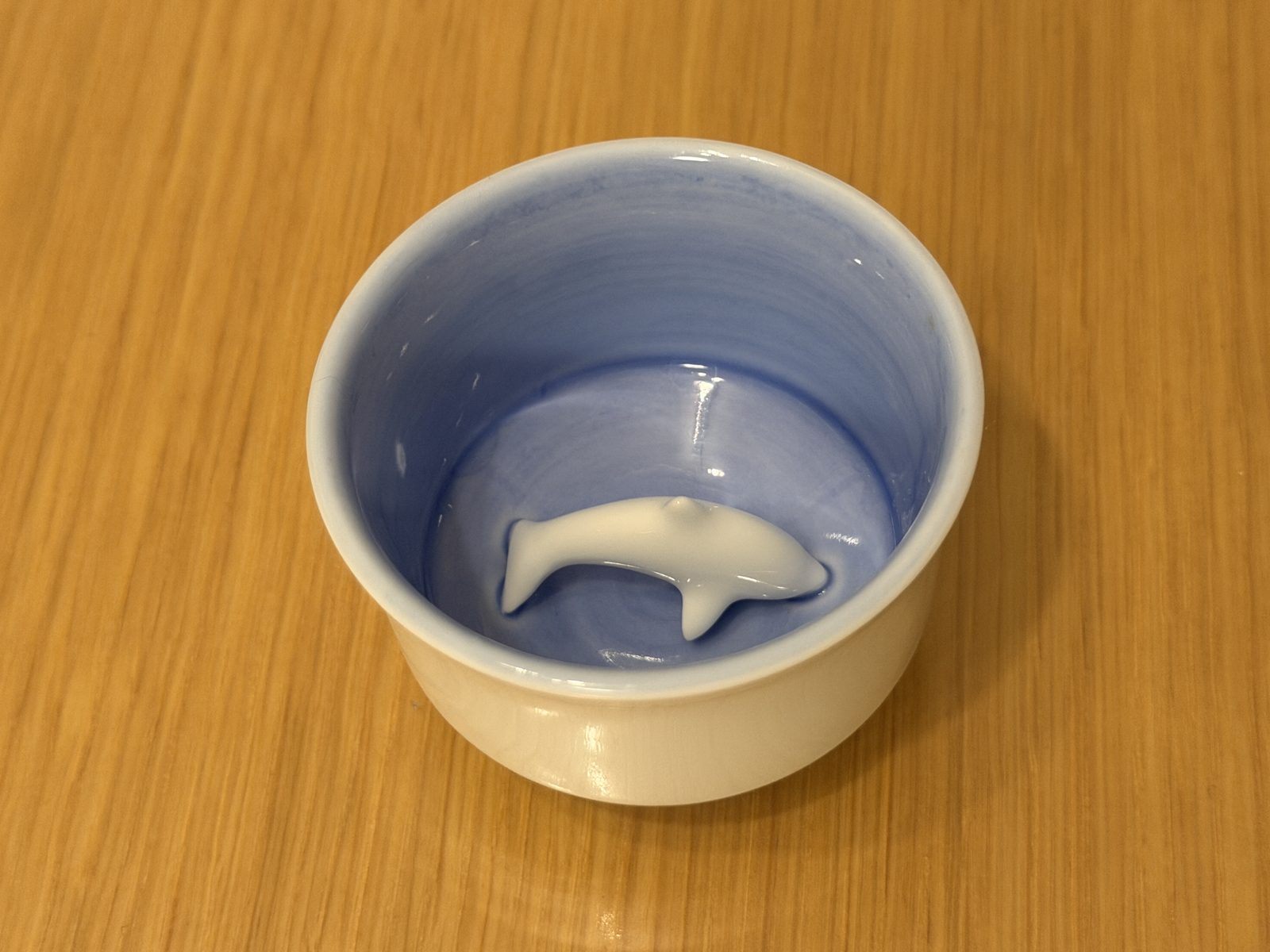
The outside of the guinomi is simple white porcelain.
Most of its personality is hidden inside.
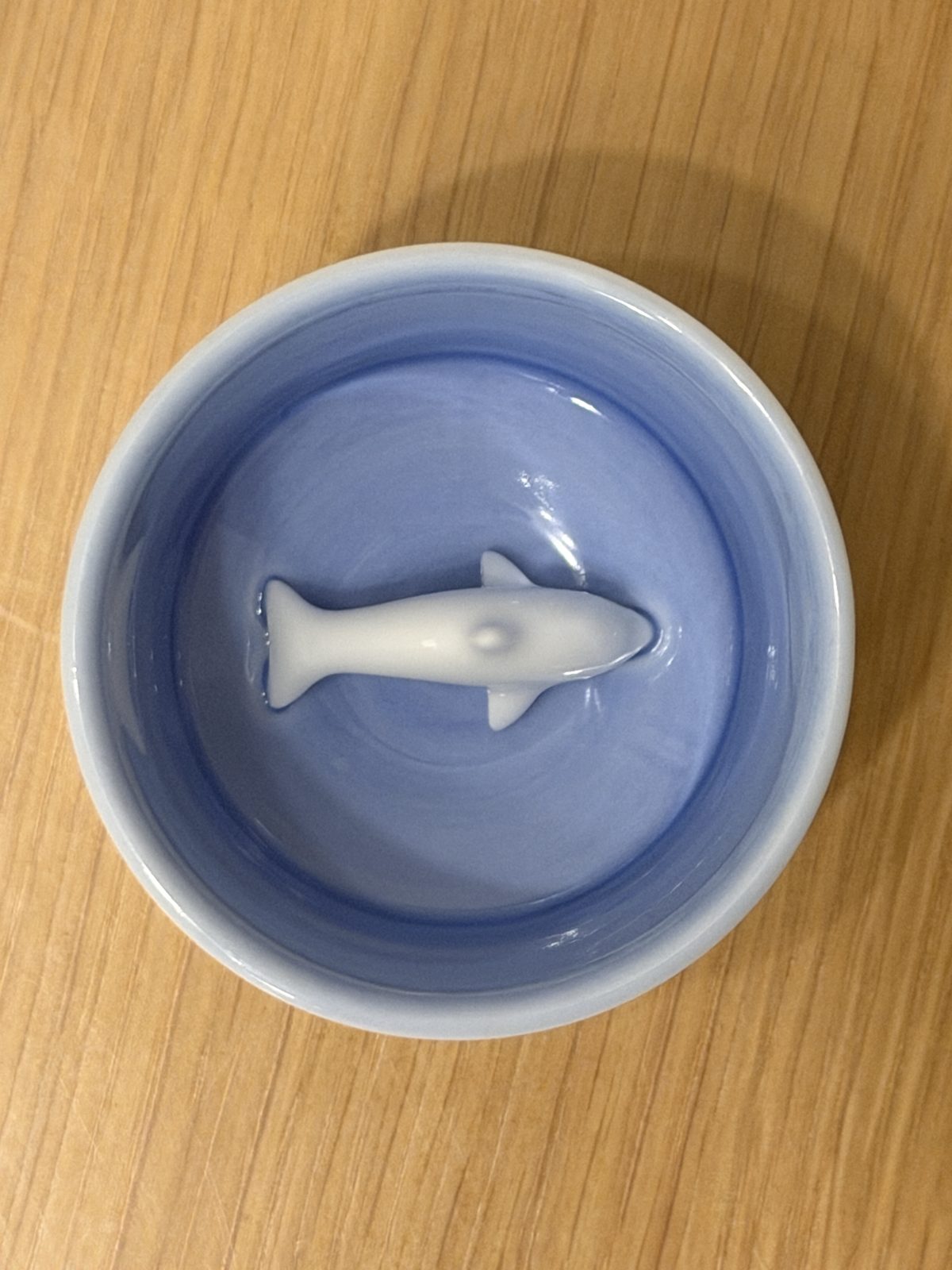
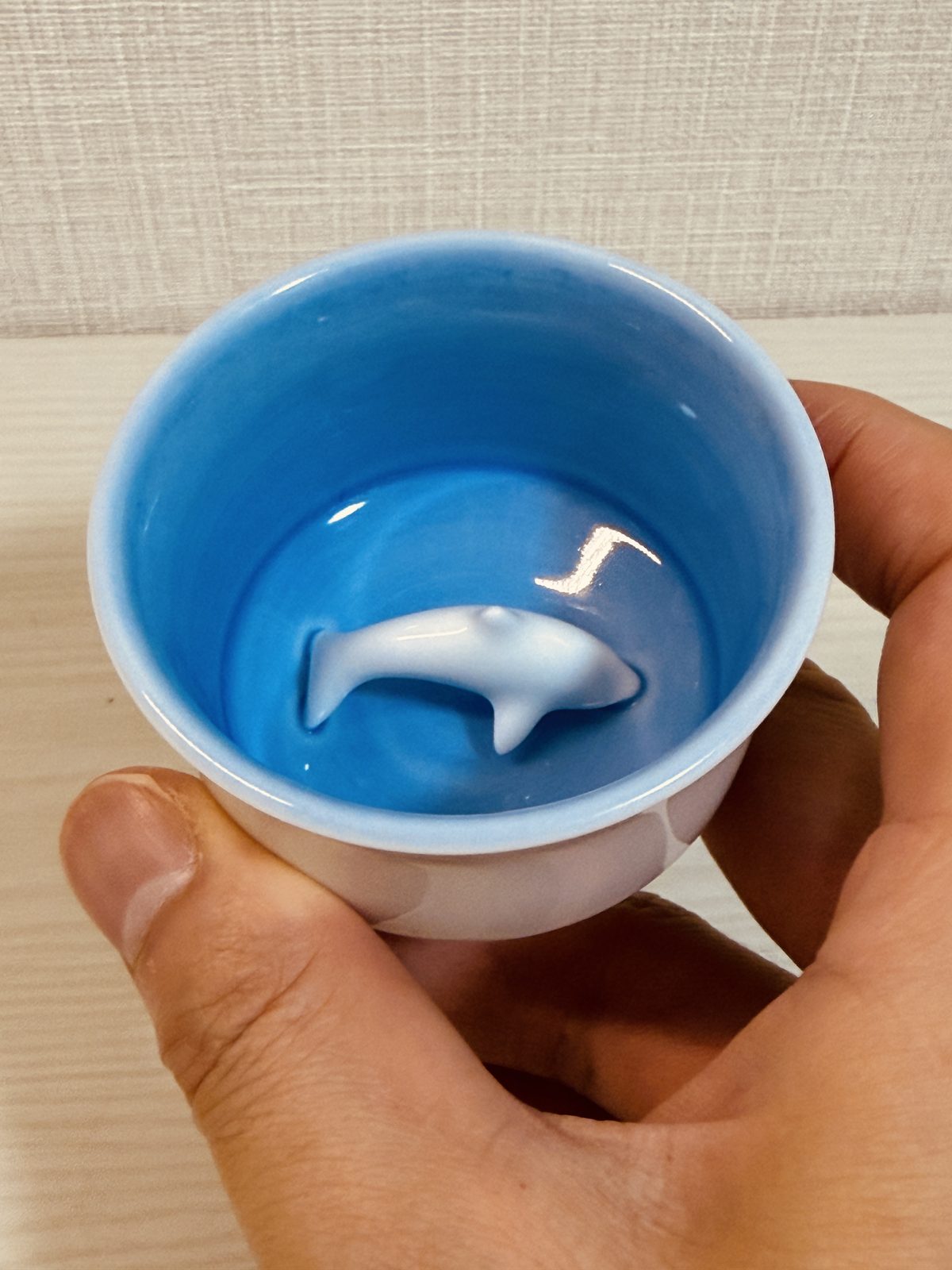
The interior is covered in a softly brushed blue glaze, with visible variations that give it the impression of shallow seawater. At the bottom is a small raised white dolphin.
From directly above, the dolphin appears to be swimming across a calm blue surface.
It is playful without feeling like a novelty item.
The design immediately brings Amakusa to mind. The islands are closely associated with the sea, and dolphin-watching is one of the experiences many visitors connect with the region.
For me, however, the appeal is more personal.
The dolphin is not merely a symbol of a tourist destination. It brings back the period when the sea and islands of Amakusa were part of my daily surroundings.
What Happens When You Pour Sake
The cup changes visually as it is used.
With a generous pour, the dolphin becomes partly hidden beneath the sake. It appears deeper in the blue interior, almost as though it has moved below the surface of the sea.
As the sake level falls, its back and fins become clearer.
Near the end of the pour, the whole dolphin returns.
The dolphin does not make me drink faster or slower. I do not wait impatiently for it to reappear.
Still, seeing it emerge makes the experience a little lighter and more enjoyable.
It gives the cup a small narrative:
- The dolphin waits at the bottom.
- The sake covers it.
- It slowly returns as I drink.
The design becomes complete only when the cup is used.
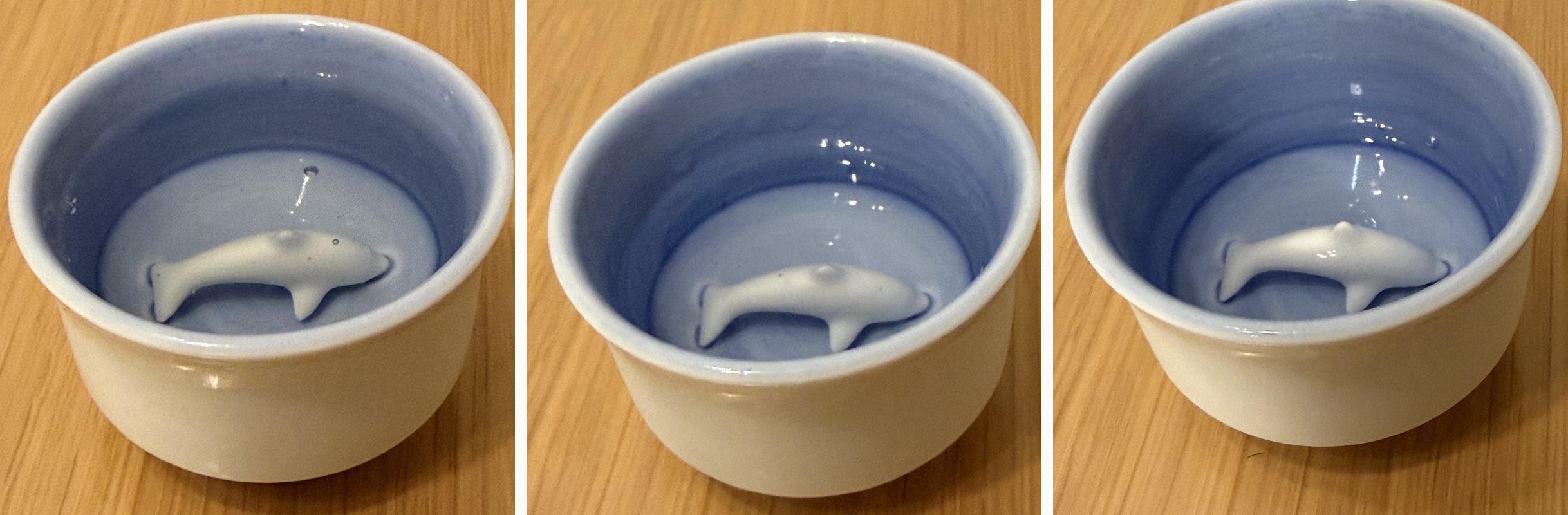
Left to right: a generous pour, the level falling, and the dolphin almost fully returned.
How the Cup Feels in the Hand
This guinomi sits between my Fukagawa Seiji and Satsuma ware cups in several ways.
Its rim is:
- thicker than the Fukagawa Seiji porcelain cup
- thinner than my heavier Satsuma ware guinomi
Its weight also falls between them.
It is heavier than the Fukagawa cup but lighter than the Satsuma ware cup.
The surface feels smooth, and the simple rounded form makes it easy to hold without thinking about it. It has approximately twice the capacity of my smaller Fukagawa Seiji guinomi.
That larger size creates a more casual drinking style.
The Fukagawa cup encourages me to make small, careful pours. The Takahama cup feels more relaxed and suited to ordinary use.
Its mouthfeel is neither especially sharp nor heavy. I would describe it as balanced and unobtrusive.
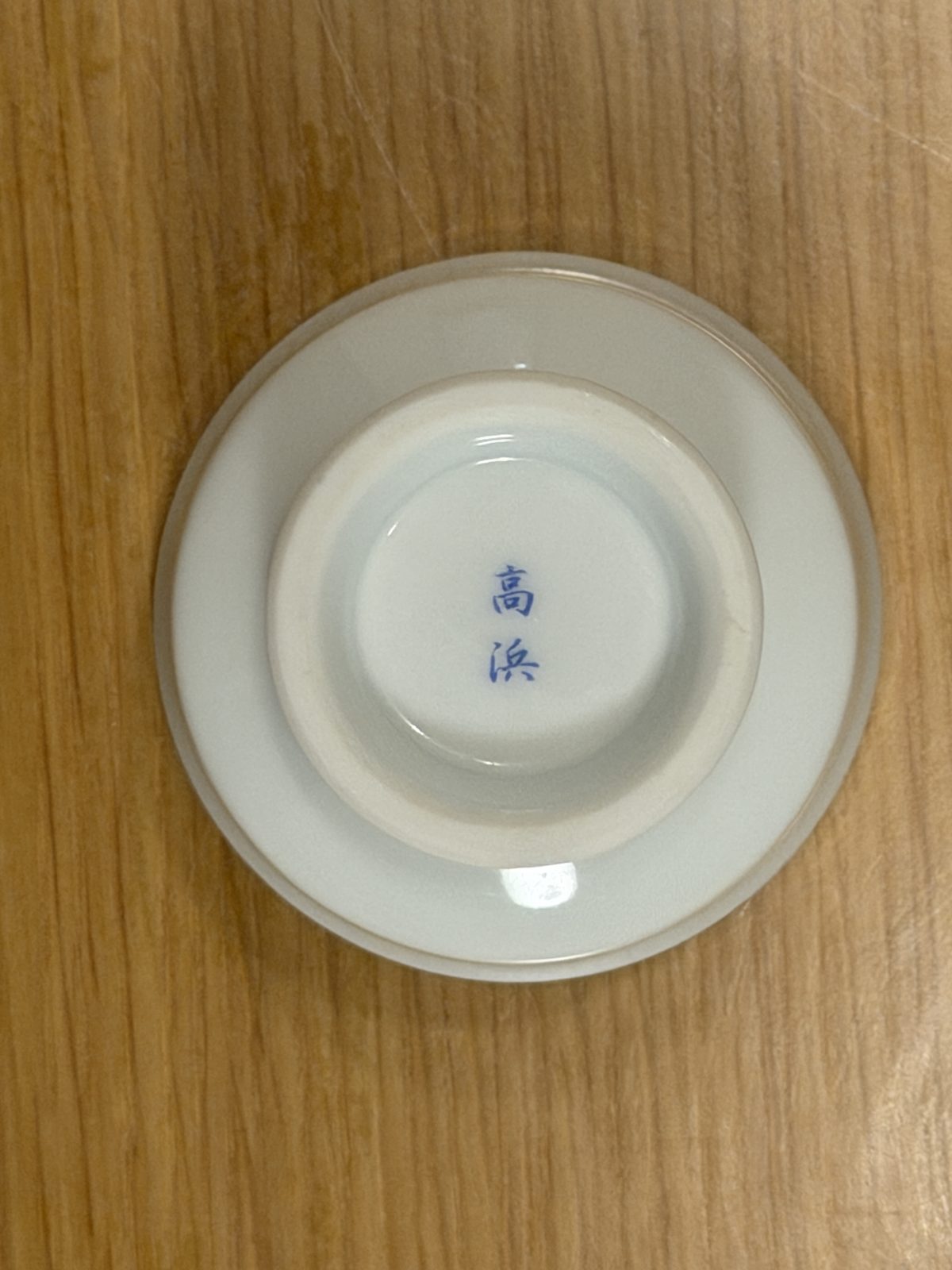
The Mark on the Base
Turning the cup over, the base carries a small hand-painted blue mark reading Takahama.
It is modest compared with the printed marks on more formal porcelain, but it is the detail that ties this everyday cup back to the kiln and to the region its stone came from.
Drinking Nabeshima from It
For these photographs, I poured Nabeshima Junmai Ginjo Yamadanishiki into the cup.
Against the white interior of my Fukagawa Seiji guinomi, the sake had shown a faint pale-gold tone.
Inside this blue cup, the color became less distinct. Instead of examining the sake itself, I found myself seeing a small sea with a dolphin beneath the surface.
The combination felt unexpectedly summery.
The pale sake, blue interior, and dolphin gave the pour a light seasonal atmosphere, even though the flavor of the Nabeshima itself had not changed.
The cup also made me imagine using it with a Nabeshima hiyaoroshi in early autumn.
Hiyaoroshi belongs to the point when summer begins to fade. Serving one in a cup that still carries the sea and brightness of Amakusa could create an appealing transition between the seasons.
Read my Nabeshima Omachi vs Yamadanishiki comparison →
Compared with My Fukagawa Seiji and Satsuma Ware Guinomi
Each of the three cups creates a different mood.
| Feature | Takahama Ware | Fukagawa Seiji | Satsuma ware* |
|---|---|---|---|
| Material | Porcelain | Porcelain | Pottery |
| Rim | Medium | Thin | Thicker |
| Weight | Medium | Light | Heavier |
| Capacity | Relatively large | Small | Medium to large |
| Mood | Casual, summery, playful | Elegant, refined, celebratory | Grounded, warm, relaxed |
| Visual focus | Blue sea and dolphin | White interior and gold decoration | Texture and earthy presence |
| Best setting | Everyday sake, summer, relaxed drinking | Ginjo, daiginjo, special bottles | Richer sake and grilled food |
*The kiln that made my Satsuma ware guinomi has not been identified.
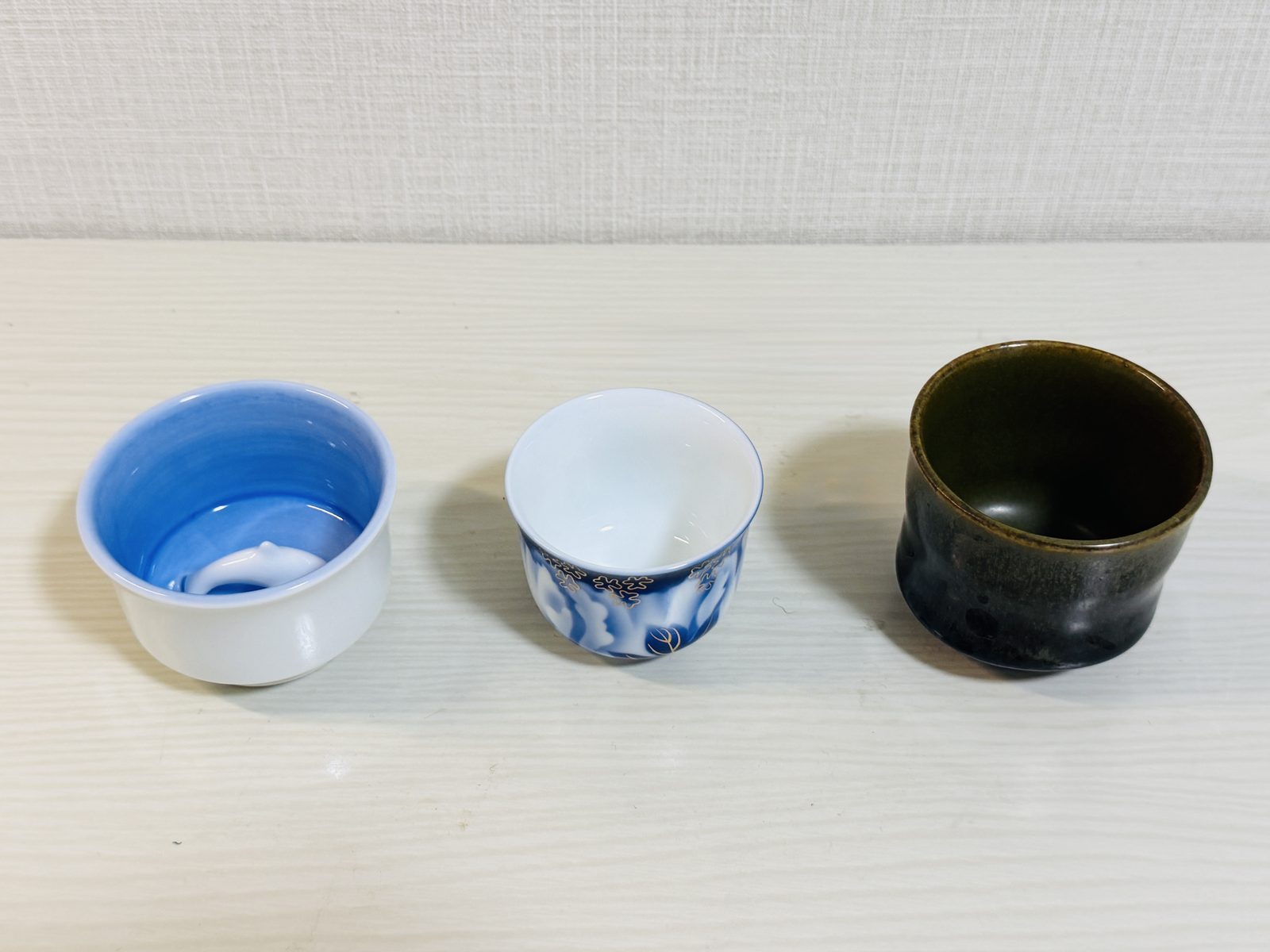
Left to right: the Takahama Ware dolphin cup, my Fukagawa Seiji Botan Kinmiru guinomi, and the Satsuma ware guinomi.
The Fukagawa Seiji cup feels like a piece I choose for an elegant bottle or a deliberate occasion.
The Satsuma ware cup feels natural with grilled food, salt, oil, and a sake with greater weight.
The Takahama cup is the easiest of the three to use casually.
Its visual character is strong, but it does not feel formal or precious. I can reach for it without planning the entire meal around it.
What Kind of Sake Suits This Cup?
I would use this cup with:
- fresh chilled sake
- summer seasonal sake
- lighter junmai or junmai ginjo
- nama sake
- sake shared casually at home
- early-autumn hiyaoroshi
- a bottle connected to Kyushu or the sea
The design does not require an expensive bottle.
In fact, its relaxed character may be better suited to a sake I want to enjoy without too much analysis.
The cup makes the setting feel more playful, while its smooth porcelain keeps it practical.
Visiting the Takahama Ware Juhogama Showroom
I visited the Takahama Ware Juhogama showroom in May 2020 while living in Amakusa.
The showroom stands in Takahama on the western side of Amakusa Shimoshima. The official site lists the address as Takahama Minami 598, Amakusa City, Kumamoto Prefecture. It’s best reached by car rather than as a quick stop from Kumamoto City.
The official website also introduces the production process, the history of Takahama Ware, Amakusa porcelain stone, and opportunities for visitors to try decorating a piece. Current opening information and availability can change, so checking the official site before traveling is advisable.
Is Takahama Ware a Good Souvenir from Amakusa?
This cup demonstrates why a small piece of local tableware can make a meaningful souvenir.
It is:
- directly connected to an Amakusa craft
- practical enough to use regularly
- easy to carry compared with a plate or vase
- distinctive without being expensive
- capable of preserving a memory of a place
My cup was not purchased during my own visit to the kiln.
It reached me later, through a gift from someone who knew I enjoyed sake.
That makes it more personal.
It connects two separate memories: visiting the Takahama showroom while living in Amakusa, and receiving an unexpected gift several months later.
Final Thoughts
This Takahama Ware guinomi is not the most expensive sake cup I own, nor the most refined.
But it may be one of the most memorable.
A dolphin waits at the bottom. When I pour sake, it disappears beneath the surface. As I drink, it slowly returns.
That small movement connects the cup to Amakusa: its sea, its porcelain stone, the time I spent living there, and the family visit that brought the cup to me.
Compared with my Fukagawa Seiji guinomi, it feels more casual and summery.
Compared with my Satsuma ware guinomi, it feels lighter and smoother.
It is a sake cup I can use without hesitation, but not without memory.
Sometimes, the most meaningful sake ware is not the most expensive piece on the table.
Sometimes, it is the cup that brings a place back to you.
Sake is an alcoholic beverage. This article is intended for readers of legal drinking age in their country — please drink responsibly.