Kagura Ruri Sake: The Kyoto Junmai I Chased from My Favorite Sake Bar to Kyoto Station
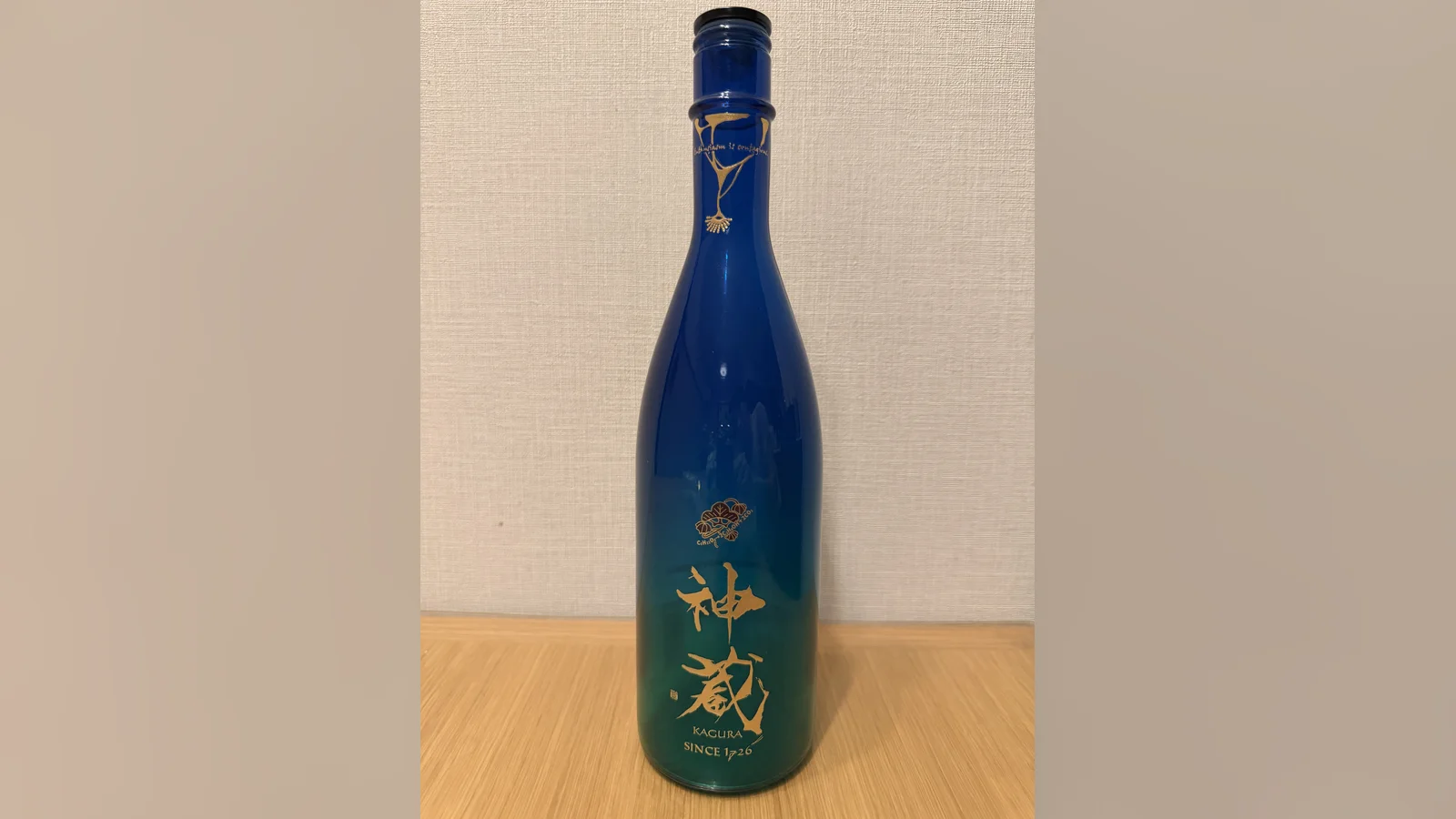
Table of Contents
Some sake you discover. Others keep finding you until you finally pay attention. This is a story about the second kind — and about Kagura “Ruri”, a junmai from Kyoto that I chased from the counter of my favorite sake bar all the way to a department store basement at Kyoto Station.
A bottle that kept appearing
There is a small sake bar I’ve been going to for years — my home base for discovering sake, and the place many future articles on this blog will begin. (I’ll introduce it properly one day, with the owner’s blessing.) Every so often, among the bottles the owner lines up, one from Kyoto would appear: Kagura (神蔵), brewed by Matsui Shuzo. Not always there, and never quite the same expression twice — just frequent enough to make an impression, and rare enough that I never got to know it properly.
That’s a particular kind of relationship you develop at a good sake bar: bottles you’ve met but never really encountered.
Then work took me to Kyoto
This April, work brought me to Kyoto for a few days. Somewhere between meetings, a thought surfaced: Matsui Shuzo is a Kyoto brewery — could I finally track down a bottle of my own?
A friend gave me the tip: try the Isetan department store at Kyoto Station. Japanese department store basements — depachika — are one of the great underrated sake-hunting grounds, and sure enough, there it was: Junmai Kagura “Ruri” — unfiltered, undiluted, unpasteurized. The label even spells those three words out in English, as if the brewery knew this bottle would one day need to introduce itself abroad. I didn’t hesitate for a second.
Kagura Ruri is also labelled as muroka, mukasui, and namazake. I explain those terms in more detail in my guide to muroka, nama, and genshu.
What does Kagura Ruri taste like?
Cold, freshly opened, the first thing Ruri gives you is a faint natural fizz — a gentle prickle left over from fermentation, since the sake is bottled unfiltered, undiluted, and unpasteurized. It makes the sake feel alive, like it was pressed days ago rather than bottled and shipped.
Then comes the part I find hardest to translate into English. “Fruity” is the word reviewers reach for, and it isn’t wrong — but it isn’t enough. There’s a layered sweetness and a deep, savory umami that unfold together, complex in a way that a single adjective flattens. It reminded me of why I fell for sake in the first place: that feeling of a flavor you can’t quite file away.
Ruri is brewed from Iwai, Kyoto’s own heritage sake rice, polished to 65% — a deliberate statement that great sake isn’t only about how much you polish, but how you brew.
That fruit-and-umami balance is something I still measure other unfiltered nama sake against — including Kaze no Mori Akitsuho 657, a bottle from Nara that pushed even further into rice-driven weight than Ruri did.
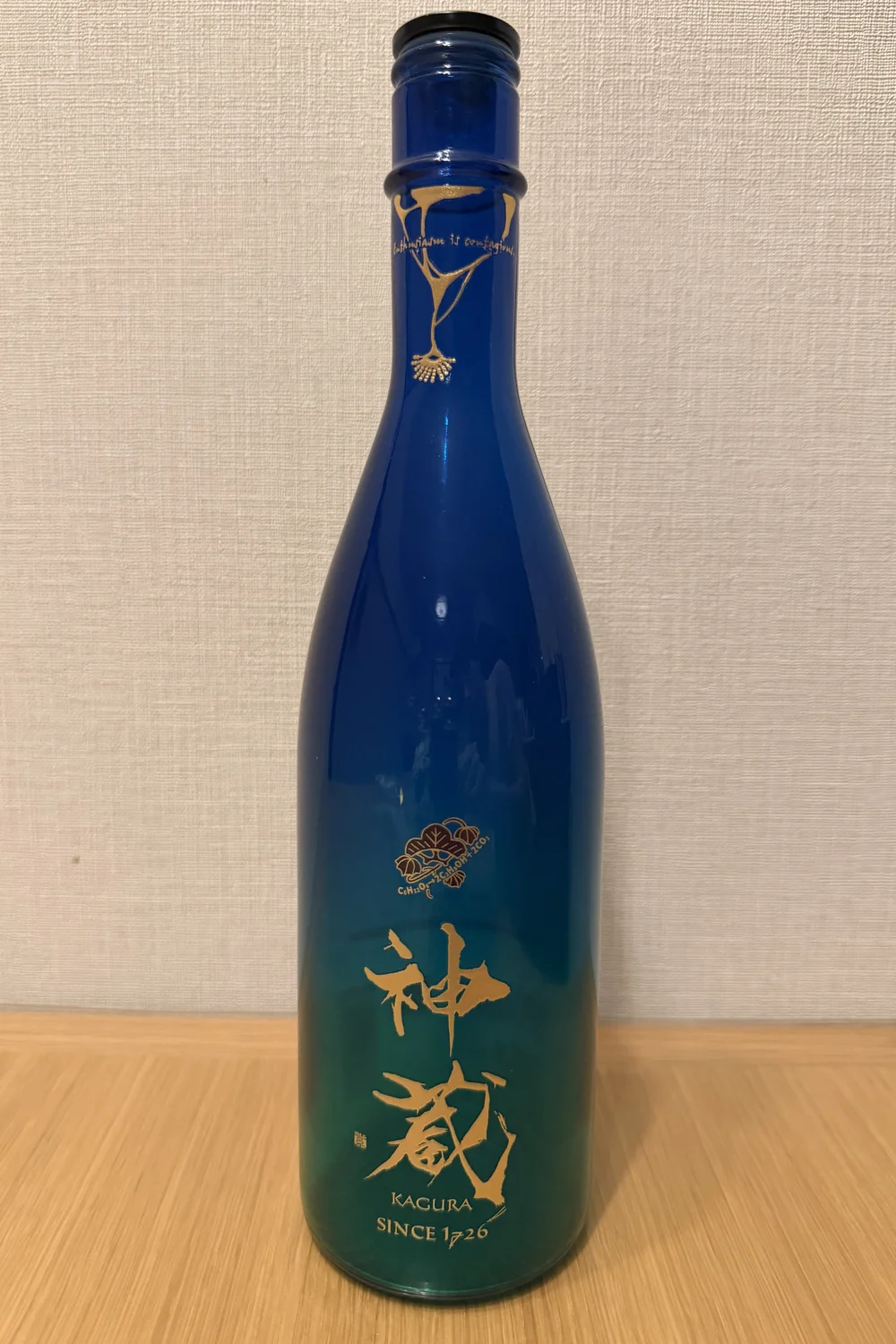
The bottle I brought home from Kyoto — kept long after the last pour. “Ruri” is Japanese for lapis lazuli, and the glass wears the color, fading from deep blue into spring green.
The brewery: 300 years in the middle of Kyoto
Matsui Shuzo was founded in 1726 and is said to be the oldest brewery still making sake in central Kyoto, on a site near the Kamo River with the mountains of Higashiyama beyond. Its story has a modern twist, too: brewing paused for years and was revived in 2009, with the owner himself leading a small team as head brewer. The brewery has long served some of Kyoto’s most famous temples and shrines — the kind of quiet pedigree Kyoto specializes in.
The Kagura lineup is built around one defining idea: no filtration and no added water. What comes out of the press is what goes in the bottle. Ruri, the expression I found, made that idea easy to understand in the glass.
Where in Japan
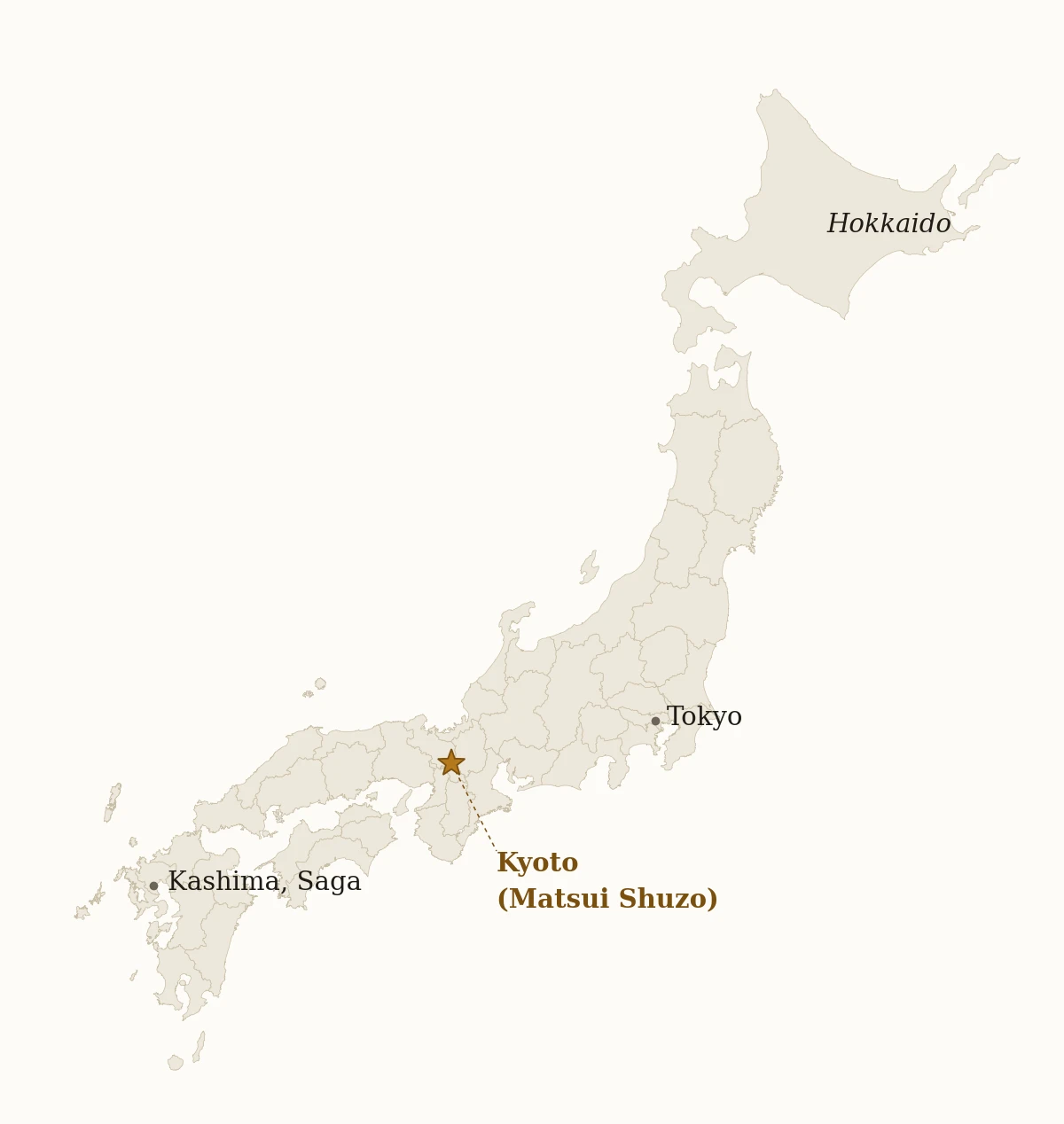
Matsui Shuzo sits in central Kyoto, near the Kamo River — about two and a half hours from Tokyo by shinkansen, and a couple of hours from Kashima, Saga.
The trophy I learned about later
Here’s the part that made me smile. Months after that Kyoto trip, I learned that the exact bottle I’d picked up — Junmai Kagura “Ruri,” unfiltered, undiluted, and unpasteurized — had been awarded the Kyoto Junmai Trophy at the International Wine Challenge 2026, announced in May — a regional trophy in one of the world’s most visible sake competitions. Beneath that regional honour, the brewery says, sat a Gold Medal in the junmai category.
I’d love to claim I knew. I didn’t. I just trusted a bottle that kept showing up at a good bar — which, come to think of it, is its own kind of blind tasting.
Finding Kagura outside Japan
I’ll be honest with you, as always: unlike Nabeshima from my first article, Kagura is not easy to find abroad. A handful of specialist shops overseas carry bottles from the Kagura lineup, and availability comes and goes — it’s worth checking a sake specialist near you or a trusted online sake retailer, but don’t expect to see Ruri itself on the shelf.
And maybe that’s fitting. Some encounters are worth traveling for. If you ever find yourself in Kyoto, the basement food hall of Isetan at Kyoto Station is where my bottle was waiting — five minutes from the shinkansen platform, three hundred years from where the story began.
Approachability
Approachability: 4.5 / 5
A low score reflects difficulty for a newcomer, not quality. How I score this →
Bright fruit, a gentle sparkle and an easy flow. Its nama character carries a little more intensity than the Nabeshima Junmai Daiginjo, which is the only reason it sits just below.
The bar, the bottle, the circle
The best part of this story, for me, is its shape. A bar I love kept introducing me to a sake from Kyoto; Kyoto handed me a bottle of my own; and that bottle turned out to be a trophy winner the world was about to notice. Sometimes the sake finds you first, and the awards catch up later.
Kanpai — to the bottles that keep appearing until you finally listen.
Please enjoy sake responsibly and follow the drinking laws in your country or region.
Sake is an alcoholic beverage. This article is intended for readers of legal drinking age in their country — please drink responsibly.