Muroka, Nama, and Genshu Explained: What These Sake Label Terms Mean
Table of Contents
- The Short Answer
- What Does Muroka Mean?
- Does Muroka Mean Cloudy?
- What Might Muroka Taste Like?
- What Is Nama Sake?
- What Does Nama Sake Taste Like?
- Why Can Nama Sake Feel Fizzy?
- Nama, Nama-Chozo, and Nama-Zume Are Not the Same
- What Does Genshu Mean?
- What Is Mukasui?
- Is Undiluted Sake Always Very Strong?
- Can One Sake Be Muroka, Nama, and Undiluted?
- Real Example 1: Kaze no Mori Akitsuho 657
- First Day: Fresh, Strong, and Rice-Driven
- Muroka Does Not Mean Cloudy
- Second Day: Rounder, Slightly Sweeter, Still Alive
- Real Example 2: Kagura Ruri
- What About Nabeshima and Its Opening Warning?
- How Might These Terms Affect Flavor?
- Which Style Should You Try First?
- How to Recognize the Words on a Japanese Label
- Final Thoughts
This article contains affiliate links. If you buy through my Palate Project link or use my discount code, you may receive a discount, and I may earn a small commission at no extra cost to you — it never changes what I recommend. Full disclosure.
The first time I tasted Kaze no Mori Akitsuho 657, one thought came to mind:
It reminded me of strained amazake—but it was not cloudy.
There was a gentle prickling of natural carbonation, a sweet, faintly fruity aroma, and a distinctly rice-driven weight that stood out even more.
This felt stronger and more substantial.
A little creamy in texture. Almost like makgeolli had been made clearer and sharper, although it was still unmistakably sake.
On the bottle were three words that often confuse people encountering Japanese sake labels for the first time:
Unpasteurized. Unfiltered. Undiluted.
In Japanese, those ideas are often connected with the terms nama, muroka, and genshu—or in some cases, mukasui, meaning no added water.
These words are useful, but they can also create the wrong picture.
Muroka does not necessarily mean cloudy. Nama does not necessarily mean fizzy. Undiluted sake does not always mean extremely high alcohol.
In this guide, I will explain what these terms actually mean, using bottles I have tasted in Japan: Kaze no Mori Akitsuho 657, Kagura Ruri, and two Nabeshima Junmai Ginjo bottles that taught me why label clues should be read carefully.
The Short Answer
| Term | Japanese | Common English | What it tells you |
|---|---|---|---|
| Muroka | 無濾過 | Unfiltered | A later finishing-filtration step was omitted |
| Nama | 生酒 | Unpasteurized | The sake was not heat-treated |
| Genshu | 原酒 | Undiluted | Water was not added to adjust the alcohol level |
| Mukasui | 無加水 | No added water / undiluted | The brewery states that no dilution water was added |
These terms describe production choices, not guaranteed flavors.
They may suggest freshness, weight, intensity, or a higher alcohol level—but two bottles carrying the same words can still taste completely different.
What Does Muroka Mean?
Muroka, written 無濾過, is usually translated as unfiltered.
That translation needs some explanation.
Sake has already been separated from the solid rice mash during pressing. Muroka does not mean that the liquid was never separated from the solids.
Instead, it generally means that the sake did not go through a later finishing-filtration process, such as charcoal filtration.
In simple terms:
Muroka means the sake keeps more of its original post-pressing character.
That can affect color, aroma, texture, and flavor. But it does not automatically tell you exactly how the sake will taste.
Does Muroka Mean Cloudy?
No.
This was one of the clearest lessons from drinking Kaze no Mori.
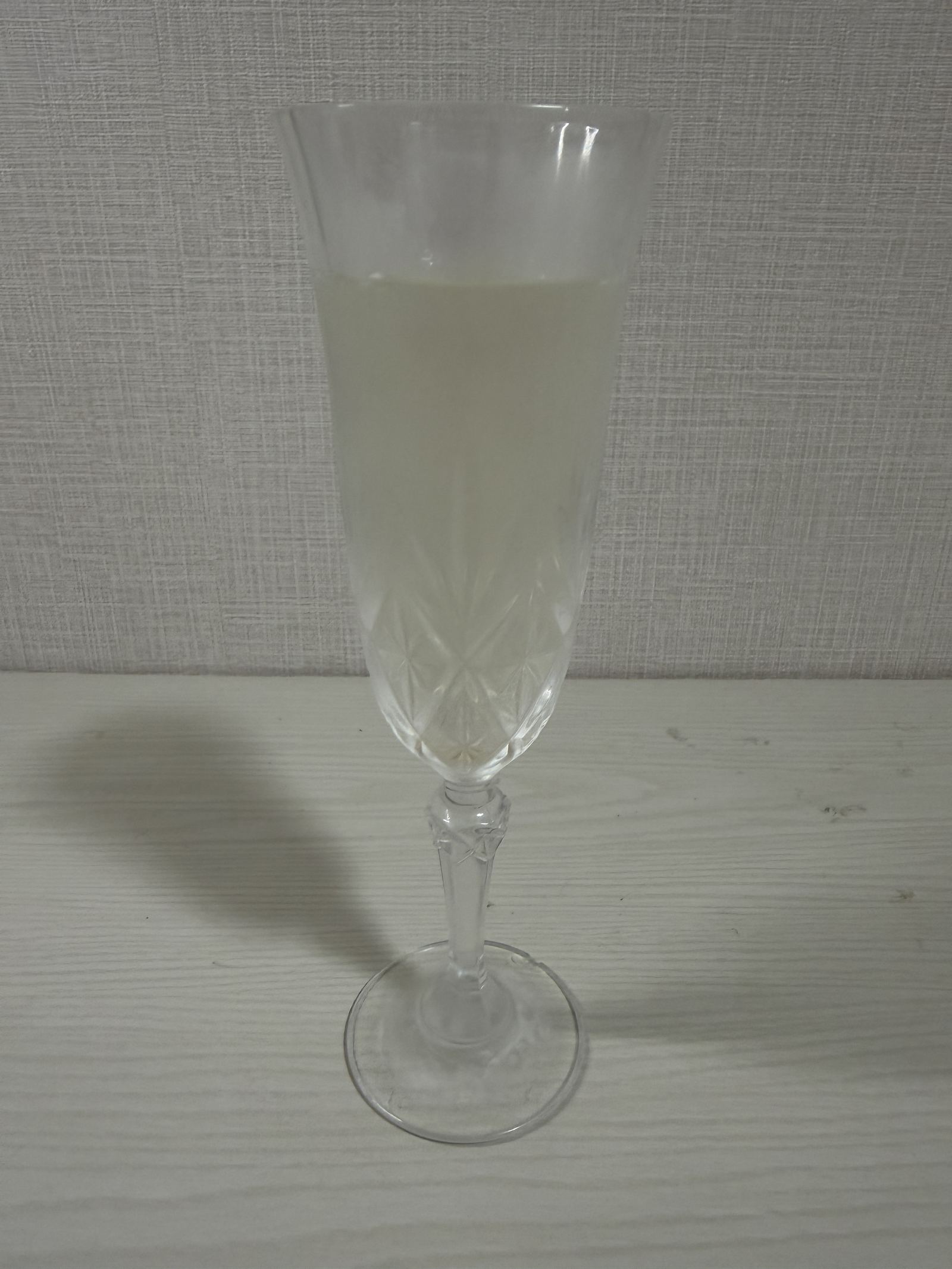
Its texture reminded me slightly of strained amazake: rice-led, rounded, and substantial. But visually, the sake was clear.
Cloudy sake is normally called nigori, where some rice solids remain because the mash was passed through a coarser mesh.
Muroka and nigori describe different things.
A useful rule is:
Muroka may preserve more of the sake’s original character, but it does not automatically make the sake cloudy.
This distinction matters because the English word “unfiltered” can make people imagine a cloudy drink. With sake, that is not always the case.
What Might Muroka Taste Like?
Muroka sake is often described as:
- fuller
- more textured
- more expressive
- slightly less neutral or polished in character
But these are tendencies, not guarantees.
Rice, yeast, water, acidity, alcohol level, storage, and serving temperature may all influence the final experience.
A muroka sake can feel bold and rice-forward. Another can feel clean and precise. The label gives you a clue, not a conclusion.
What Is Nama Sake?
Nama sake, written 生酒 or simply 生, means the sake has not been pasteurized.
Most sake is heated for stability, commonly after pressing and again around bottling. Nama sake skips those heat-treatment stages.
This is why nama sake normally needs refrigeration.
Both bottles used as main examples in this guide state this clearly:
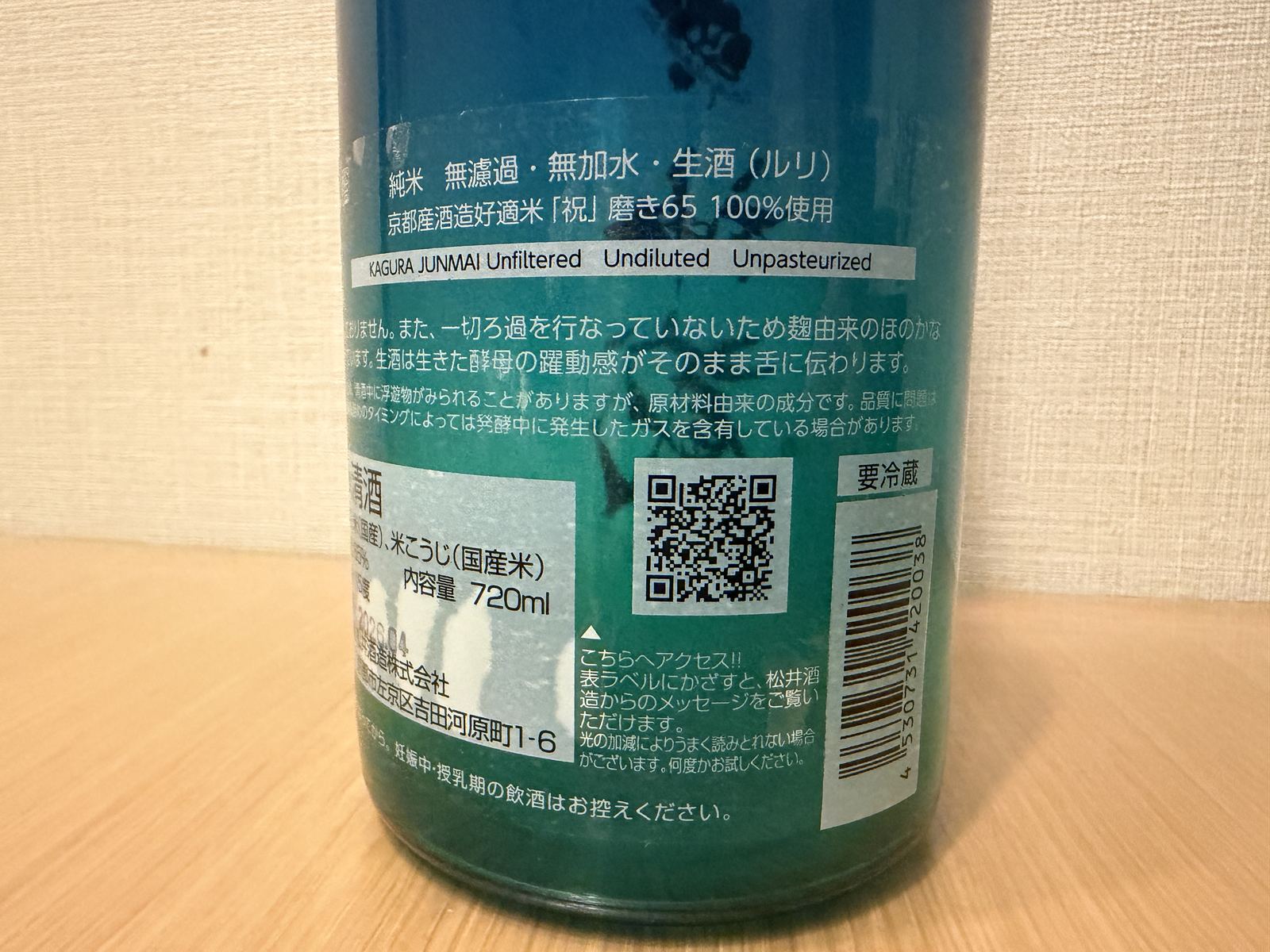
- Kagura Ruri: 生酒 / Unpasteurized / 要冷蔵
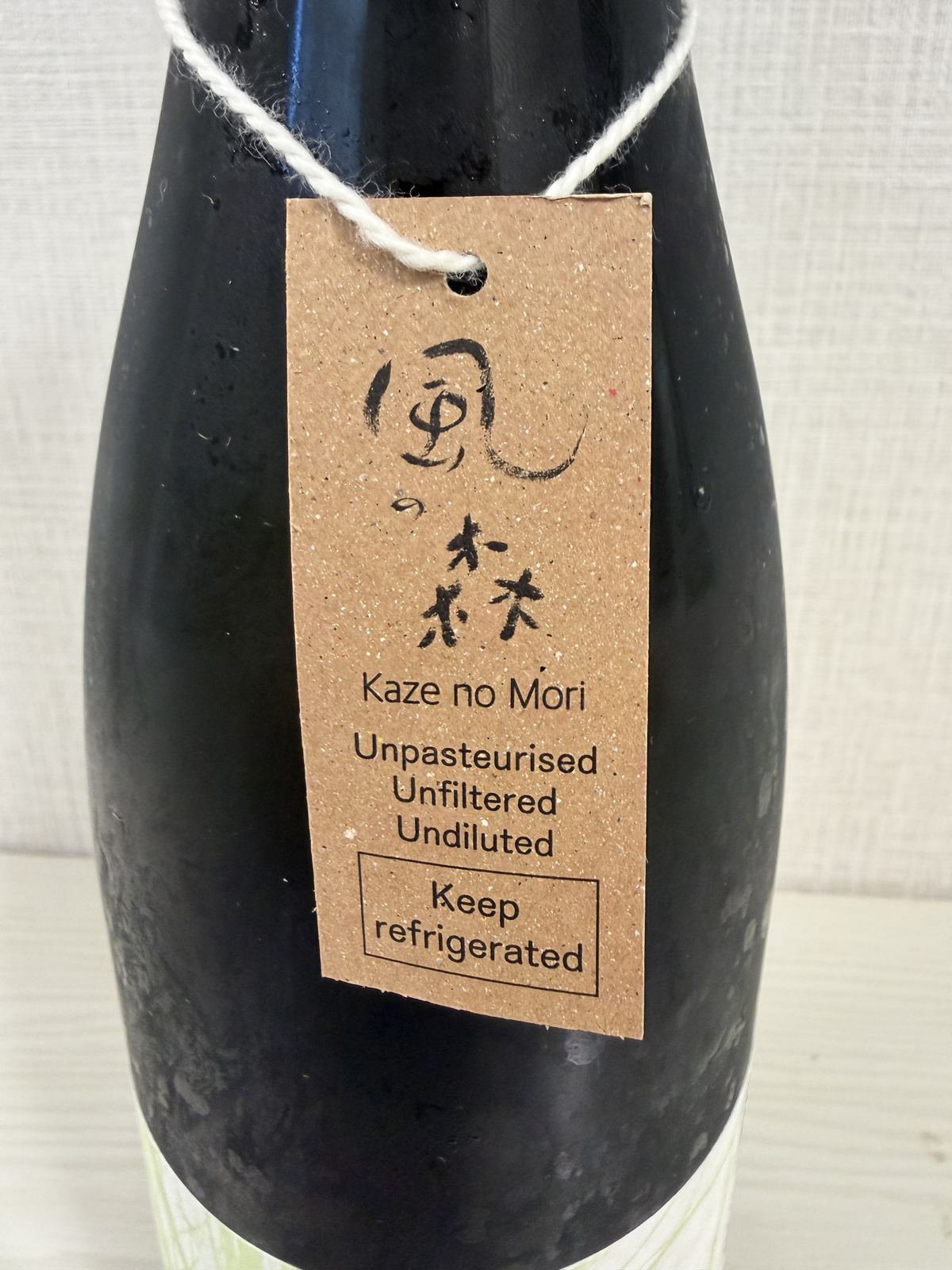
- Kaze no Mori Akitsuho 657: 生酒 / Unpasteurised / Keep refrigerated
What Does Nama Sake Taste Like?
Nama sake is often associated with:
- freshness
- liveliness
- vivid aromas
- a youthful or energetic impression
- noticeable changes after opening
Some nama sake also retains fermentation-derived carbon dioxide, creating a fine prickling sensation on the tongue.
However:
Nama does not automatically mean sparkling.
A nama sake may be completely still. A sake may also have some gas without being labelled nama.
It is better to describe what you experience directly:
- gentle natural fizz
- fine carbonation
- a light prickling texture
- a lively mouthfeel
Those are tasting impressions. The label term is a production category.
Why Can Nama Sake Feel Fizzy?
Carbon dioxide is naturally created during fermentation. Depending on brewing, bottling, and storage, some of that gas may remain in the bottle.
The rear label of Kagura Ruri specifically notes that the bottle may contain gas generated during fermentation, depending on the timing of bottling. Kaze no Mori showed the same fine, prickling quality I described above.
That is why I would describe bottles like this as having a gentle natural fizz, rather than automatically calling them sparkling sake.
Nama, Nama-Chozo, and Nama-Zume Are Not the Same
A sake label may contain other words beginning with nama, but they do not all mean completely unpasteurized sake.
Namazake
Never pasteurized.
Nama-chozo
Stored without pasteurization, then pasteurized once at bottling.
Nama-zume
Pasteurized once after pressing, but not pasteurized at bottling.
The distinction matters, especially when buying sake that must be transported or stored for a long time.
If a bottle says 生酒 and 要冷蔵, treat it as something that should be kept cold.
For an overview of these label terms, see the Japan Sake and Shochu Makers Association’s guide to reading sake bottle labels.
What Does Genshu Mean?
Genshu, written 原酒, is commonly translated as undiluted sake.
After fermentation, sake can naturally reach a relatively high alcohol level. Brewers often add water before bottling to adjust the final strength.
Genshu is sake for which that alcohol-adjustment water was not added.
This often results in a stronger or fuller-bodied sake, but not always.
What Is Mukasui?
The bottles photographed for this article use the wording 無加水, read mukasui, rather than 原酒.
無加水 literally means:
No water added.
Kagura translates it on its label as Undiluted. Kaze no Mori also uses Undiluted on its English neck tag.
For this guide, I discuss mukasui alongside genshu because both relate to the absence of dilution water. However, I do not automatically treat the two label terms as interchangeable. When describing an individual bottle, I use the brewery’s exact wording.
Is Undiluted Sake Always Very Strong?
No.
The two main bottles here are useful examples:
| Bottle | Alcohol |
|---|---|
| Kagura Ruri | 15% |
| Kaze no Mori Akitsuho 657 | 16% |
Both state that they are undiluted, yet neither is dramatically stronger than ordinary premium sake.
This demonstrates an important point:
“Undiluted” describes what the brewery did not do. It does not tell you the final alcohol percentage by itself.
A brewery may design fermentation so that the sake reaches a lower final strength without needing dilution.
Can One Sake Be Muroka, Nama, and Undiluted?
Yes.
Both Kagura Ruri and Kaze no Mori Akitsuho 657 combine all three ideas:
- no finishing filtration
- no dilution water
- no pasteurization
Their English labels make the combination especially easy to recognize.
Kagura Ruri
Unfiltered · Undiluted · Unpasteurized
Kaze no Mori Akitsuho 657
Unpasteurised · Unfiltered · Undiluted
(The spelling above follows each bottle’s own English label — British “Unpasteurised” on Kaze no Mori versus American “Unpasteurized” on Kagura Ruri.)
But the fact that both bottles share these production terms does not mean they taste alike.
That is where the labels stop—and the encounter begins.
Real Example 1: Kaze no Mori Akitsuho 657
I opened this bottle of Kaze no Mori Akitsuho 657 on July 25, 2026, after keeping it in a regular home refrigerator.
The bottle I tasted was:
| Detail | Kaze no Mori Akitsuho 657 |
|---|---|
| Classification | Junmai sake |
| Rice | Akitsuho |
| Rice origin | Gose, Nara |
| Polishing ratio | 65% |
| Alcohol | 16% |
| Treatment | Muroka, mukasui, nama |
| Brewing | 2026 winter brewing |
| Storage | Refrigerated |
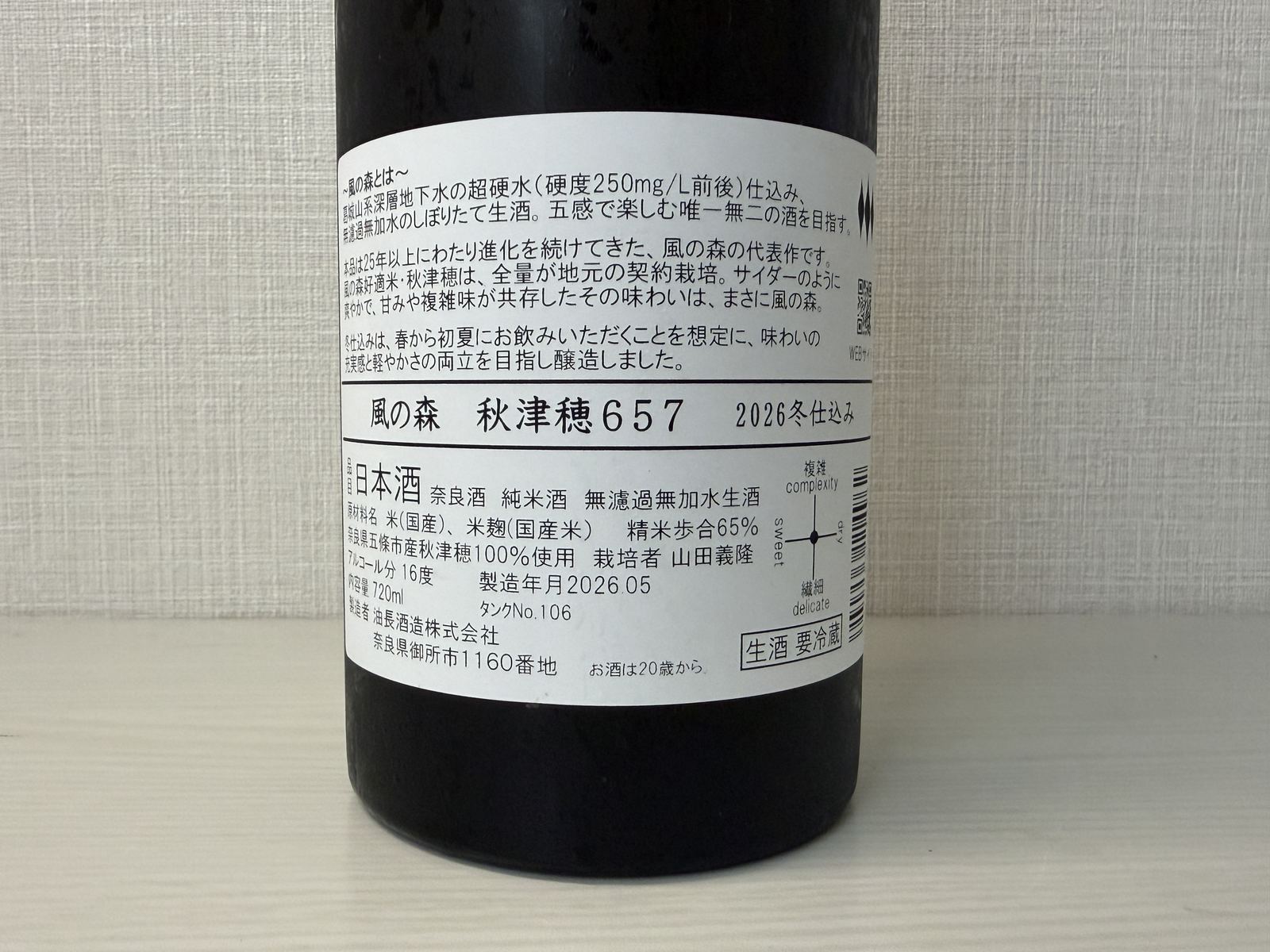
Yucho Shuzo, the brewery behind Kaze no Mori, explains that the label specializes in unfiltered, unpasteurized sake made without adding water after pressing — matching what I found on the bottle in front of me. You can see more on Yucho Shuzo’s official Kaze no Mori product page.
First Day: Fresh, Strong, and Rice-Driven
The sake did have a sweet, gently fruity aroma that suggested pear or other pale fruit. However, fruitiness was not the strongest part of the experience for me.
What stood out more was its firm, rice-driven body, sweetness, umami, and slightly creamy texture. The texture reminded me a little of strained amazake, although the sake itself was not cloudy.
There was also a fine, prickling carbonation—what I would describe in Japanese as chiri-chiri.
It was not a fully sparkling sake. It was more like a quiet natural fizz that gave the sake energy without making it feel light.
The sake felt:
- sweet and gently fruity
- rice-driven
- rich in umami
- substantial
- slightly creamy
- gently fizzy
- somewhere between modern and classic
At one point, I found myself thinking of makgeolli—but made clearer, sharper, and unmistakably Japanese.
That is not a technical comparison. It was simply the closest sensory image that came to mind.
Muroka Does Not Mean Cloudy
Kaze no Mori made this idea real. Despite the amazake-like texture and rice aroma, the sake in the glass was completely clear — a reminder that muroka describes a missing filtration step, not the sake’s appearance.
Second Day: Rounder, Slightly Sweeter, Still Alive
On the second day, the fine carbonation was still there. It had not changed dramatically.
What did change was the first impression.
The alcohol felt softer than on the first day, and the sake seemed rounder and easier to drink. I also felt the sweetness had become slightly more noticeable.
As the temperature rose in the glass, the rice aroma became more apparent.
This is one of the reasons I like tasting nama sake over more than one day. The label tells you that the sake is unpasteurized, but the bottle itself teaches you how lively that can feel.
The change was not dramatic.
But it was enough to remind me that nama sake is not static.
Its rice-driven weight worked particularly well with salted yakitori, and I preferred serving it in a Satsuma ware guinomi with food. I cover the full day-by-day tasting notes, serving vessels, and pairings in my complete review.
Read my full Kaze no Mori Akitsuho 657 review →
Real Example 2: Kagura Ruri
Kagura Ruri is a junmai sake from Matsui Shuzo in Kyoto.
Its label states:
| Detail | Kagura Ruri |
|---|---|
| Classification | Junmai |
| Rice | Iwai |
| Rice origin | Kyoto |
| Polishing ratio | 65% |
| Alcohol | 15% |
| Treatment | Muroka, mukasui, nama |
| Storage | Refrigerated |
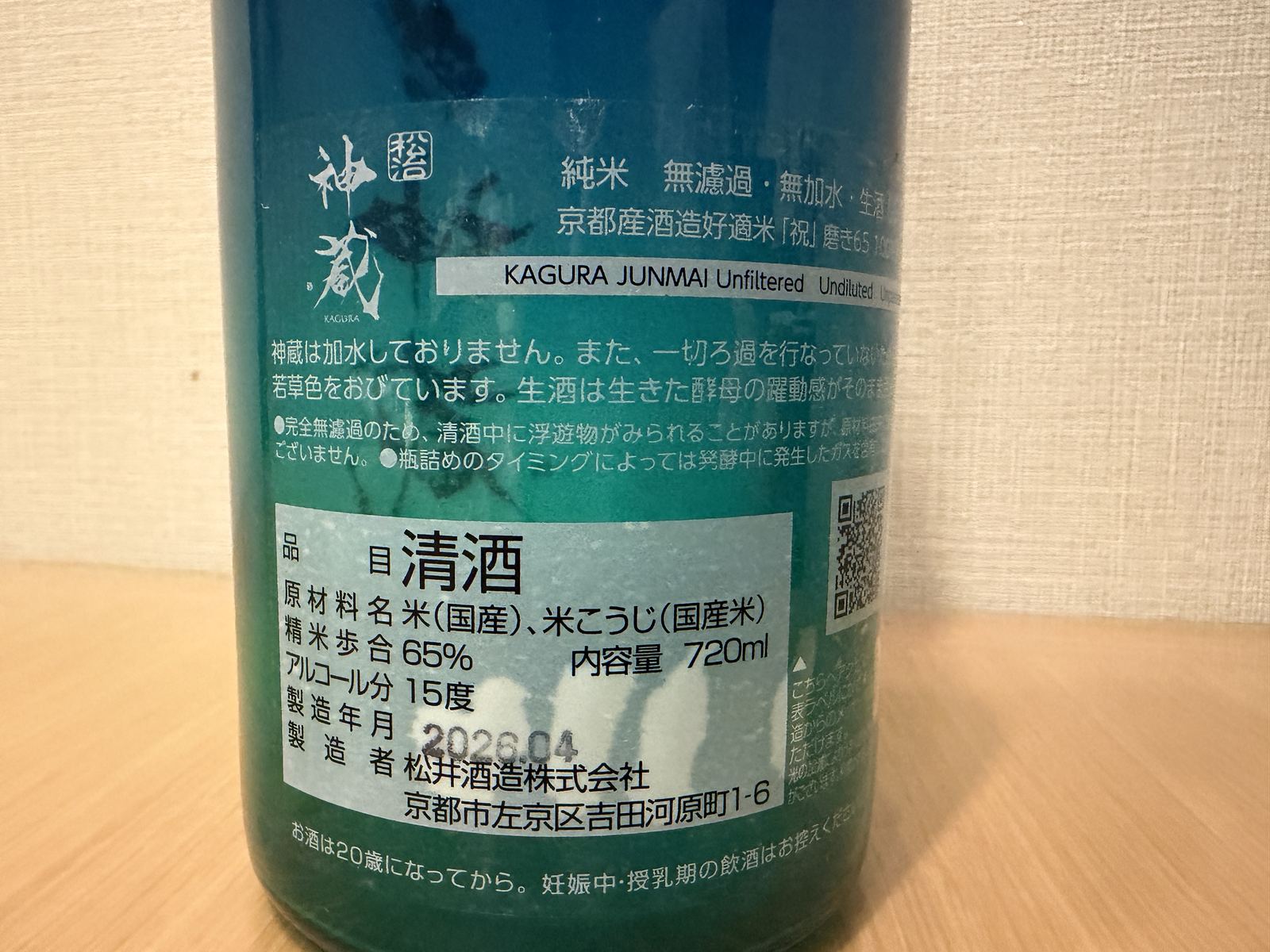
My own impression was of a fresh, gently fizzy sake with layered sweetness and umami.
It was difficult to explain with the word “fruity” alone.
Compared with Kaze no Mori, Kagura Ruri felt more intricate and composed. Kaze no Mori felt more rice-forward, weighty, and forceful.
The two bottles demonstrate why these label terms should not be treated as flavor categories.
Muroka, nama, and undiluted tell you how the sake was handled—not exactly how it will taste.
Read my full Kagura Ruri story →
What About Nabeshima and Its Opening Warning?
The two Nabeshima Junmai Ginjo bottles I compared both carried a clear warning to take care when opening.
However, their rear labels did not identify them as muroka, nama, or genshu.
In my experience, Nabeshima bottles that are sold as nama sake usually carry a separate “nama” label or sticker. These two bottles did not have that sticker. For that reason, I would not describe them as nama sake in this article.
At the same time, I would avoid making a broader rule from this single example. A sake can carry an opening warning even when it is not labelled as nama. The warning simply tells the drinker to open the bottle carefully, often because some gas may remain inside.
That makes Nabeshima a useful counterexample.
A slight fizz, or a warning to open carefully, can suggest that some fermentation-derived gas remains in the bottle. But it does not tell you the sake’s formal production category by itself.
Read the label first.
Then describe what you actually experience in the glass.
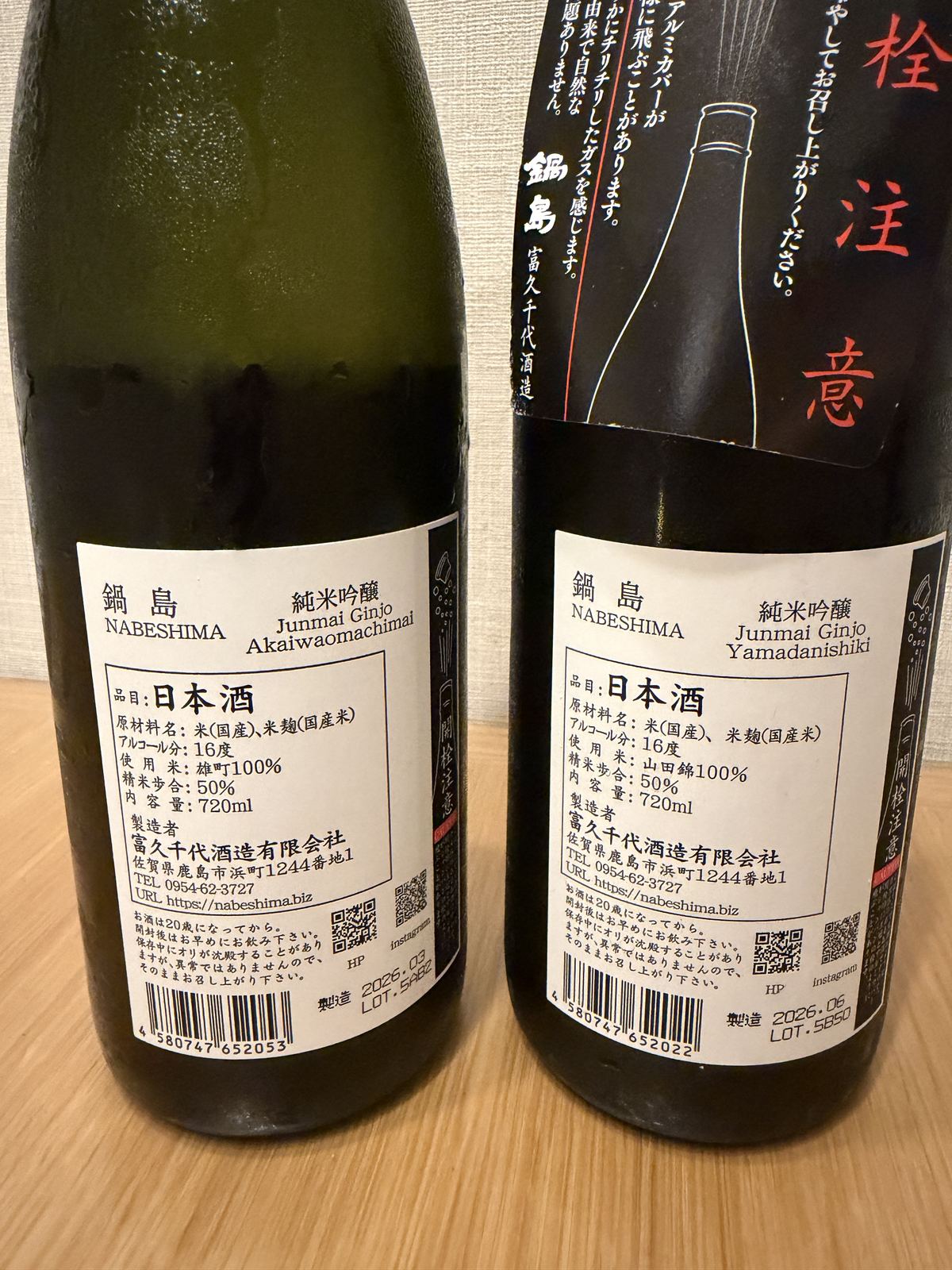
Read my Nabeshima Omachi vs Yamadanishiki comparison →
How Might These Terms Affect Flavor?
The simplest way to think about the three terms is this:
Muroka may preserve more character
You may notice more color, texture, or intensity because a later filtration step was omitted.
Nama may preserve more freshness
You may notice brighter aromas, youthfulness, fine carbonation, or more rapid changes after opening.
Genshu or mukasui may preserve more weight
You may notice a fuller body, stronger alcohol, or a more concentrated impression because no dilution water was added.
But none of these outcomes is guaranteed.
A 15% undiluted sake may feel more delicate than a 16% diluted sake. A nama sake may be completely still. A muroka sake may be crystal clear.
The words are clues—not tasting notes.
Which Style Should You Try First?
Try nama if you enjoy:
- fresh, youthful drinks
- vivid aromas
- a lively texture
- noticing how a bottle changes over several days
- sake that may feel slightly different on the second day
Kaze no Mori reminded me that nama sake is not always delicate. It can also feel powerful, rice-driven, and substantial.
Try muroka if you enjoy:
- texture
- rice character
- less neutral or polished flavors
- sake with a little more personality
Try genshu or mukasui if you enjoy:
- fuller-bodied drinks
- concentrated flavors
- stronger food pairings
- a more substantial mouthfeel
A bottle combining all three may be an exciting place to start—but it may also feel more intense than a light, clean, pasteurized sake. If you want a general sense of how demanding a bottle is likely to feel before you open it, here’s how I score approachability on every sake I review.
How to Recognize the Words on a Japanese Label
Look for these characters:
| Japanese | Reading | Meaning |
|---|---|---|
| 無濾過 | muroka | No finishing filtration |
| 生酒 | namazake | Unpasteurized sake |
| 生 | nama | Unpasteurized |
| 原酒 | genshu | Undiluted sake |
| 無加水 | mukasui | No water added |
| 要冷蔵 | yo-reizo | Keep refrigerated |
| 開栓注意 | kaisen chui | Open with caution |
For refrigerated bottles, 要冷蔵 is one of the most important phrases to recognize.
If you see 開栓注意, open the bottle carefully—but do not assume from that warning alone that the sake is nama, muroka, or genshu.
Final Thoughts
Muroka, nama, and genshu may look like technical vocabulary, but they become much easier to understand when you connect them to a real bottle.
Kaze no Mori taught me that muroka does not mean cloudy.
Its fine carbonation showed why nama sake can feel alive without becoming fully sparkling.
Its second-day change reminded me that nama sake can continue to move after opening: not dramatically, but enough for the alcohol to soften, the sweetness to become a little more noticeable, and the rice aroma to open as the temperature rises.
It also taught me that not every modern sake wants a wine glass.
For this bottle, a Satsuma ware guinomi and salted yakitori felt more natural than delicate pairings.
Kagura Ruri showed something else: even when two bottles share the same production terms, they can express completely different personalities.
And Nabeshima reminded me not to overread a single clue. An opening warning or a little gas does not automatically define a sake as nama.
Labels tell us what happened before the bottle reached us.
This is only part of what a Japanese sake label can tell you — rice polishing ratios, brewery names, and more are still to come in a future guide on how to read a sake label from front to back.
The rest is the encounter.
If you’d like to start exploring muroka, nama, or genshu sake for yourself and you are in the United States, you can browse Japanese sake through Palate Project. My referral link may give you a 10% discount, and I may earn a commission if you make a purchase.
You can also use the discount code FRIEND-BZXDMXW for 10% off.
This article contains affiliate links. If you buy through one, I may earn a small commission at no extra cost to you. It never changes what I honestly think.Full disclosure here.
Sake is an alcoholic beverage. This article is intended for readers of legal drinking age in their country — please drink responsibly.