
Zuiyo Hojun Junmai Review | A Kumamoto Junmai That Lands Smoothly with Hot Pot
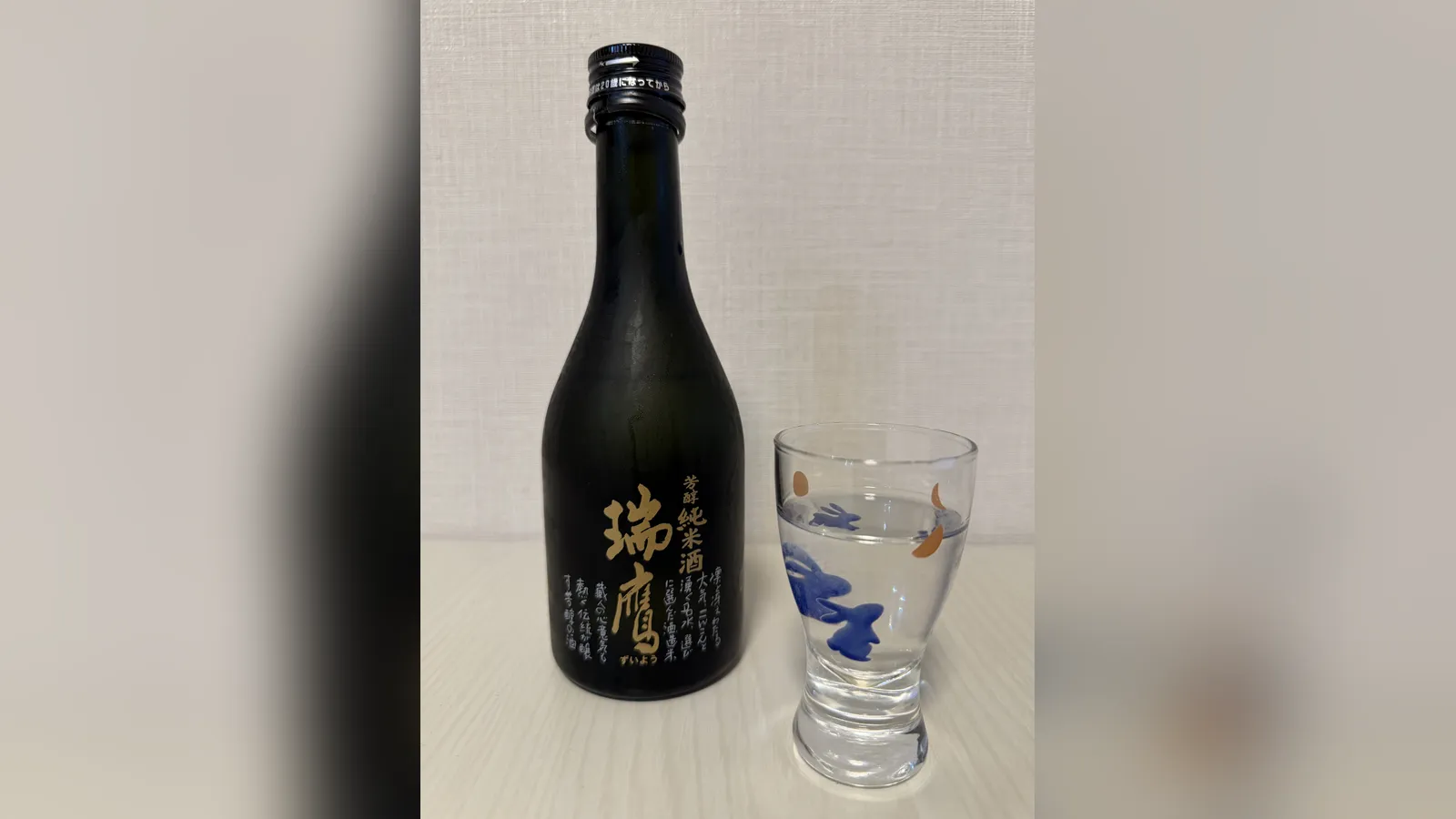
Table of Contents
This article contains affiliate links. If you buy through my Palate Project link or use my discount code, you may get 10% off as a first-time customer, and I may earn a small commission at no extra cost to you — it never changes what I recommend. Full disclosure.
Some sakes make a big entrance. This one makes a smooth landing.
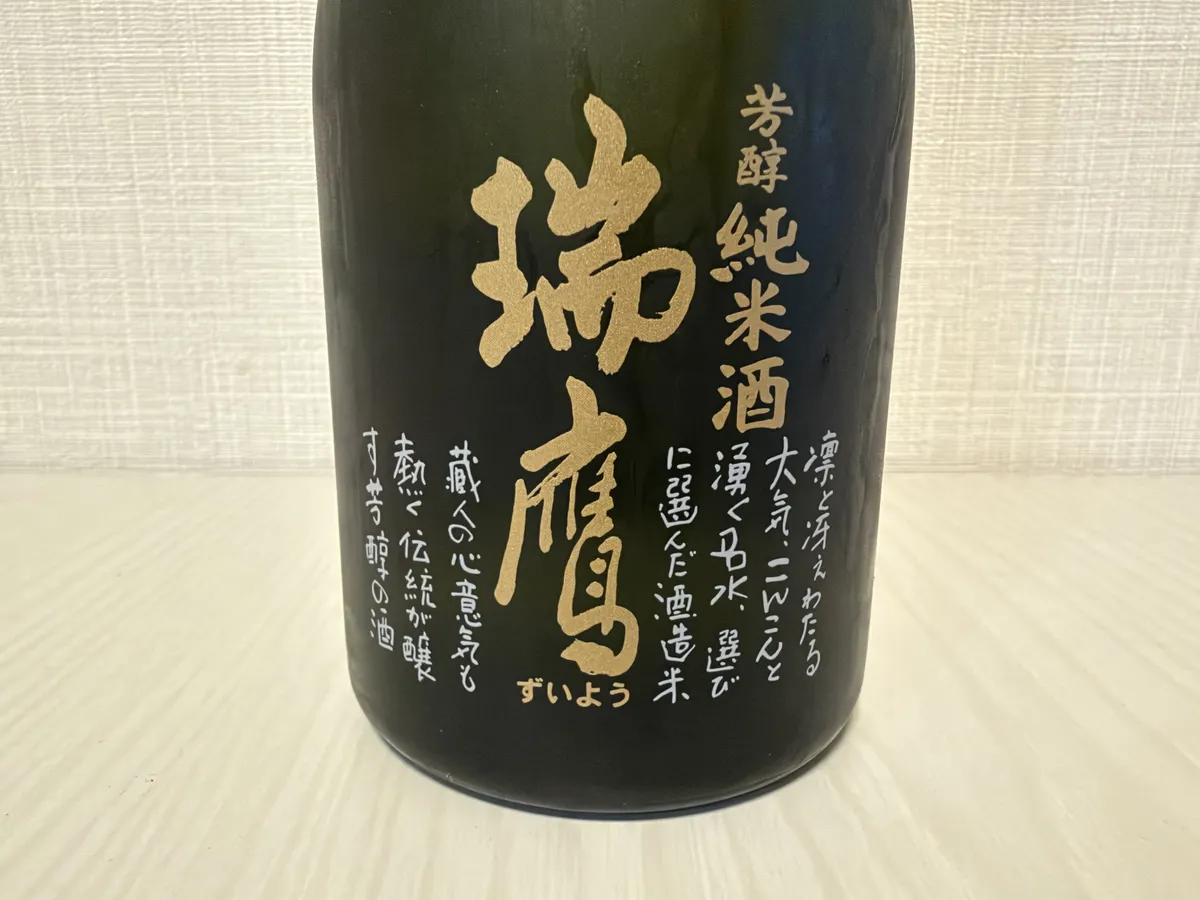
Zuiyo Hojun Junmai is an everyday junmai from Zuiyo, a brewery in the Kawashiri district of Kumamoto City. Hojun (芳醇) means “rich and full-flavored,” and that is how it begins: sweetness and umami first. But instead of lingering, the flavor glides down and settles, followed by a drier, warming finish.
It isn’t the easiest sake I’ve reviewed for a complete beginner. But next to a hot pot, it made a lot of sense.
What Is Zuiyo Hojun Junmai?
Zuiyo (瑞鷹) was founded in 1867, according to its back label, and brews in Kawashiri, in the south of Kumamoto City. I first met the brewery at the Kumamoto Autumn Sake Festival, where I tasted its seasonal Nananama.
The Hojun Junmai is one of its standard bottles. According to the brewery’s product page, it is brewed with traditional Kumamoto yeast, and it is meant to be enjoyed across a wide range of temperatures—from on the rocks and chilled all the way up to hot.
| Item | Detail |
|---|---|
| Brewery | Zuiyo |
| Prefecture | Kumamoto |
| Classification | Junmai |
| Rice | Hananishiki and other rice (per the brewery’s product page) |
| Yeast | Kumamoto yeast (per the brewery’s product page) |
| Polishing ratio | 65% |
| Alcohol | 15% |
| Sake meter value | +6 (per the brewery’s product page, as of September 2026) |
| Volume | 300 ml |
| Production date | October 2026 |
| Price | 620 yen including tax (at the shop where I bought it) |
Ingredients (rice and rice koji), polishing ratio, alcohol, and production date are from the bottle’s back label.
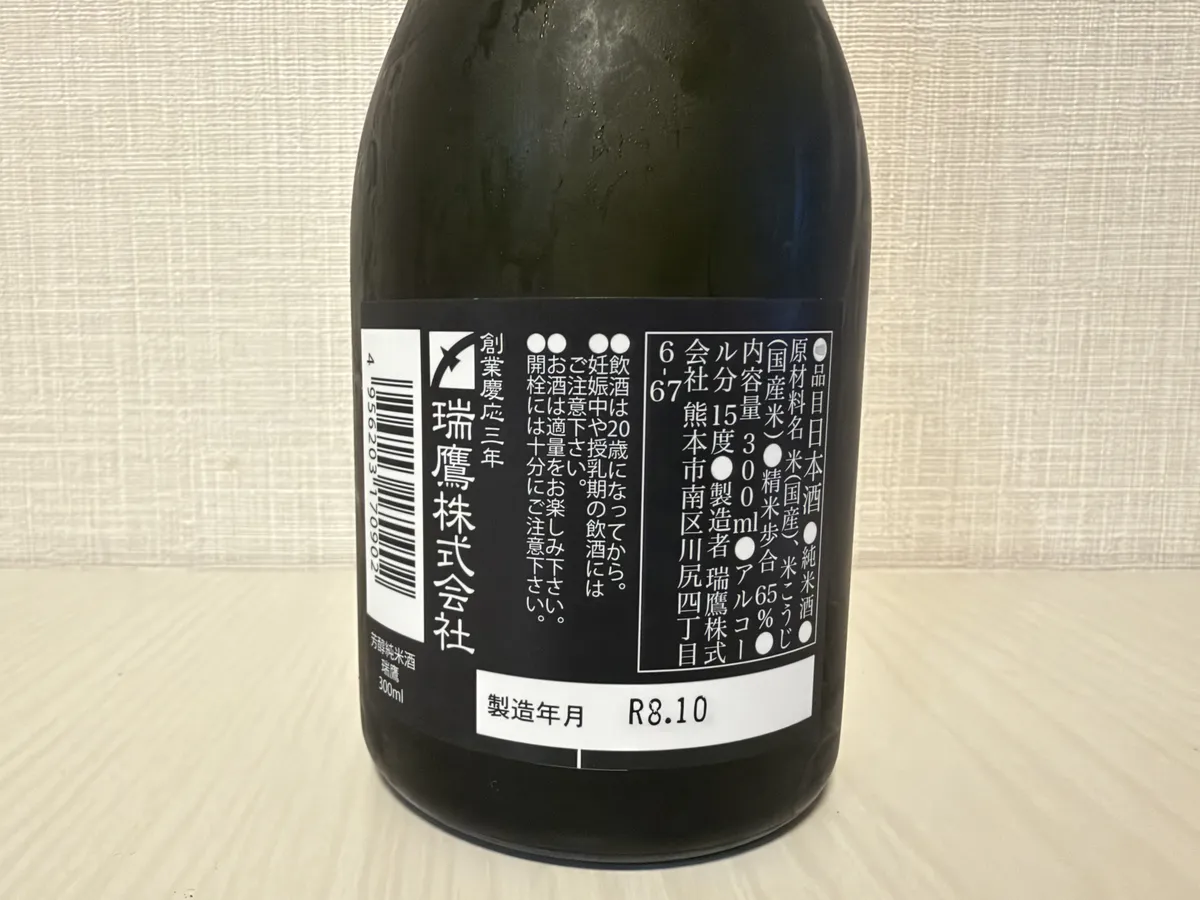
The brewery lists a sake meter value of +6 on its product page (as of September 2026), while Palate Project lists +5. The exact value for my October 2026 bottle was not confirmed. My tasting impression was of a sake with noticeable sweetness at first, followed by a distinctly drier finish.
Where I Bought It
I bought this 300 ml bottle on November 3, 2026, at Ushijima Saketen (うしじま酒店) inside JR Kumamoto Station, for 620 yen including tax.
It’s a convenient place to pick up Kumamoto sake before getting on a train, and a 300 ml bottle is an easy size to carry home or to try a new brewery without committing to a full bottle.
How I Tasted It
I opened the bottle at home on November 15, 2026. It had been kept in the refrigerator, and I poured it straight from the fridge, without food at first.
I drank it from a small clear glass cup decorated with rabbits and a moon—one of the pair my mother-in-law brought back from Nagasaki years ago, which I also used in my Nabeshima Omachi vs Yamadanishiki comparison.
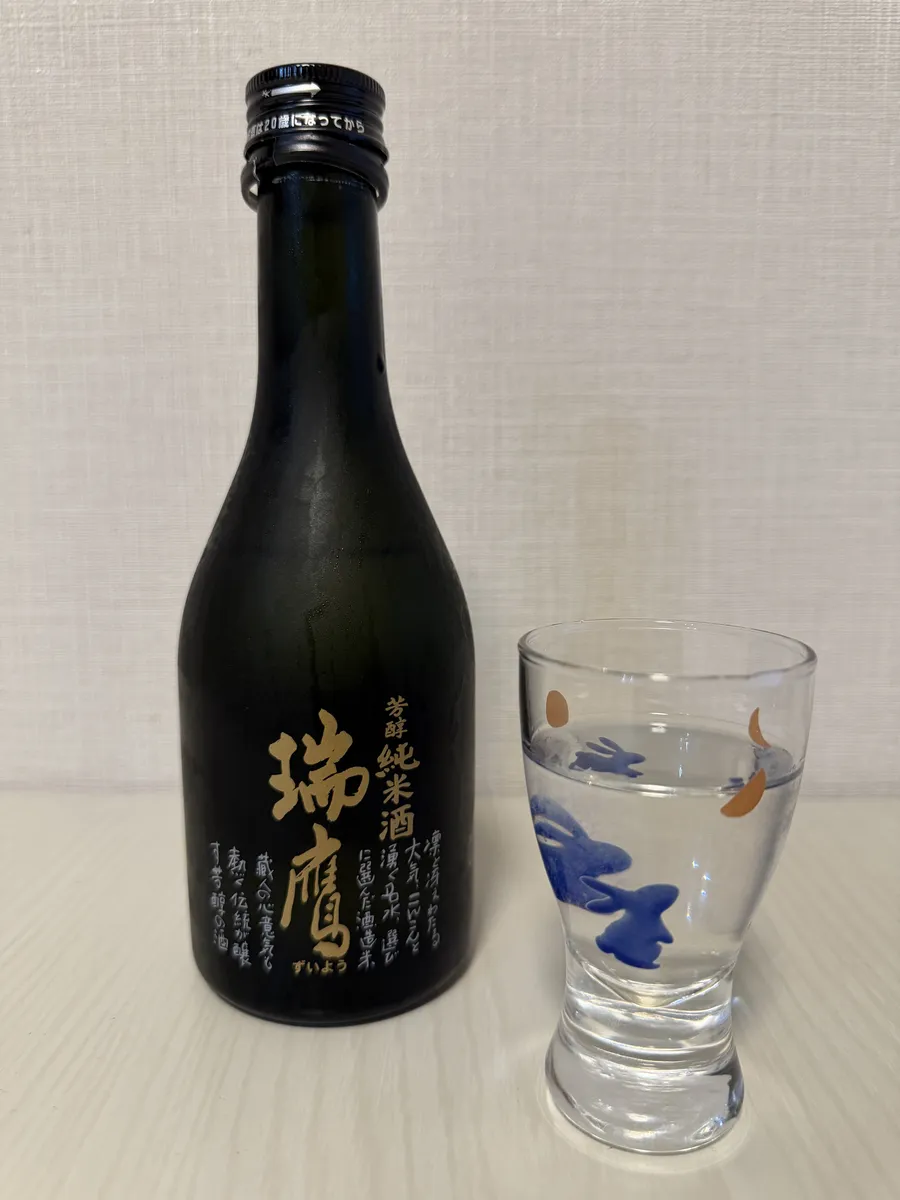
I tasted it straight from the refrigerator, again after ten to fifteen minutes, again as it warmed further, with a hot pot dinner, and once more the next day.
First Impression
Sweet-leaning at first—and then it glides down and lands smoothly. That sense of the flavor settling, rather than hanging around, stayed with me the whole time.
Tasting Notes
Appearance
Clear, with a very faint pale yellow tint—close to colorless. Normal viscosity.
Aroma
The aroma is moderate in intensity, led by rice, with a gentle alcoholic note. Unlike a fruity ginjo-style sake, it has little noticeable fruit aroma.
Palate
The sweetness is fairly noticeable, the acidity is gentle, and umami is the main character. The body is medium.
Sweetness and umami arrive first. The acidity stays in the background, so the sake never feels sharp. As it goes down, the flavor shifts from sweet and savory toward something drier.
Texture
Almost no gas. The alcohol is noticeable—at 15%, it isn’t aggressive, but it shows up toward the end.
Finish
The finish is medium in length. Umami, gentle acidity, bitterness, and a touch of alcohol warmth linger together, with just a faint fruity impression before fading cleanly.
How Temperature Changed the Sake
This was one of the most consistent bottles I have tasted.
Straight from the refrigerator, after ten to fifteen minutes, and as it warmed further, my notes were essentially the same each time. The sweetness, gentle acidity, umami, and aroma all held steady, and my overall impression did not change.
One caveat: I only tasted it on the cooler side. The brewery recommends everything from on the rocks to hot sake, so warming it may show a different side that I didn’t try this time.
And the Next Day
The next day, there was no major change. If anything, the acidity, umami, and sweetness felt more unified, as if the sake had settled into itself.
With Food: Hot Pot
I drank it with a Japanese hot pot (nabe), and the pairing worked well.
The sake didn’t compete with the food. It blended in, and each brought out the best in the other. Because the flavor doesn’t drag, I think it would suit many kinds of everyday meals, not only hot pot.
Overall Character
Zuiyo Hojun Junmai is an umami-driven sake with noticeable sweetness at first, gentle acidity, and a moderately full flavor despite its medium body.
Rather than emphasizing freshness or pronounced fruit aromas, it offers a settled, savory character. The flavors come together smoothly before giving way to a drier finish with some alcohol warmth.
What stood out most was its consistency. The overall impression changed very little as the sake gradually warmed in the glass or when I returned to it the following day.
For me, its greatest strength is how naturally it fits alongside everyday Japanese food.
Compared with Shichida Omachi Hiyaoroshi
The closest comparison in my notes is Shichida Junmai Omachi Hiyaoroshi, another junmai I tasted in a similar way.
| Element | Zuiyo, compared with Shichida |
|---|---|
| Sweetness | Slightly lower to similar |
| Acidity | Similar |
| Umami | Similar |
| Body | Lighter |
| Finish | Longer |
| Dryness at the end | Stronger |
| Gas | Similar (almost none) |
| Approachability | Similar to slightly lower (both 3 / 5) |
Both are umami-driven junmai sakes that work well at the table. Zuiyo is lighter in body, but its finish lasts longer and turns drier.
Approachability: 3 / 5
I rate Zuiyo Hojun Junmai 3 out of 5 on my approachability scale. A lower score here reflects difficulty for a newcomer, not quality.
What makes it easy:
- The body is not heavy
- The acidity is gentle, never sharp
- There is noticeable sweetness at first
- It is very easy to pair with food
What holds it back:
- After the sweetness, the alcohol and a drier, slightly hot finish come through. Someone new to sake may notice that more than the sweetness.
Compared with Shichida Omachi Hiyaoroshi, I’d place it at about the same level, or slightly lower, because of that drier finish.
Availability
In Japan, the brewery’s suggested retail prices are 583 yen for 300 ml, 1,430 yen for 720 ml, and 2,750 yen for 1.8 L, tax included (per the brewery’s product page). I paid 620 yen for the 300 ml bottle at the shop.
Want to try it in the U.S.? Palate Project lists Zuiyo Hojun (720 ml) as a junmai with Hananishiki and other rice, a 65% polishing ratio, and 15% alcohol—the same sake I tasted, in a larger bottle. Palate Project lists the sake meter value as +5, while the brewery’s page shows +6 as of September 2026, so small differences between production years are possible.
First-time Palate Project customers can use the discount code FRIEND-8V4N8XZ for 10% off one-time purchases (not subscriptions). The code can be used once per customer and can’t be combined with other discount codes.
This is an affiliate link. If you buy through it, I may earn a commission at no extra cost to you.
Where in Japan
- Zuiyo, Kawashiri, Kumamoto City — The brewery. Official website
- Ushijima Saketen, JR Kumamoto Station — Where I bought this bottle. Instagram
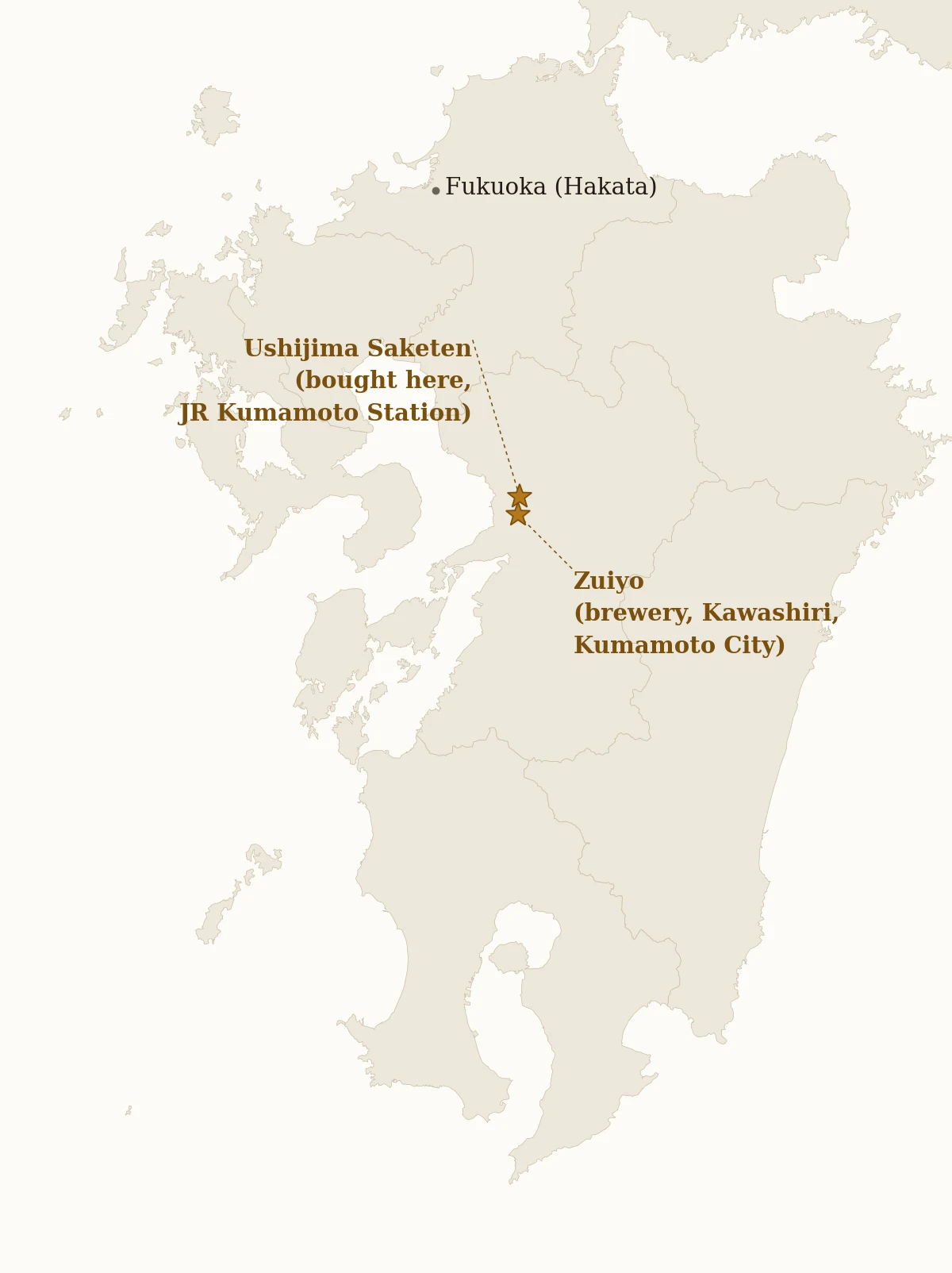
Kawashiri is only a few kilometers south of Kumamoto Station, so the brewery and the shop almost overlap on the map. Kumamoto is about 35–50 minutes from Hakata Station by shinkansen, depending on the train.
Final Thoughts
Zuiyo Hojun Junmai works on its own and at the table. Sweetness and umami come first, then a drier, warming finish follows. The flavor changes smoothly and lands without dragging, which makes it easy to match with many kinds of food.
It isn’t the easiest sake for a complete beginner, but it is a satisfying, food-friendly junmai at an everyday price.
I’d like to drink it again next year to see how the next batch compares.
Approachability: 3 / 5
Flavor impressions are personal, and other bottles may differ. Please enjoy sake responsibly.
Related Reading
- Shichida Junmai Omachi Hiyaoroshi Review — the junmai I compared it with
- Kumamoto Autumn Sake Festival 2026 — where I first tasted Zuiyo
- Nabeshima Omachi vs Yamadanishiki — the same rabbit-and-moon glass cups
- What Does Sake Taste Like?
This article contains affiliate links. If you buy through one, I may earn a small commission at no extra cost to you. It never changes what I honestly think.Full disclosure here.
Sake is an alcoholic beverage. This article is intended for readers of legal drinking age in their country — please drink responsibly.