
Fukagawa Seiji Tokkuri Review | Making 40°C Nurukan with Autumn Sake
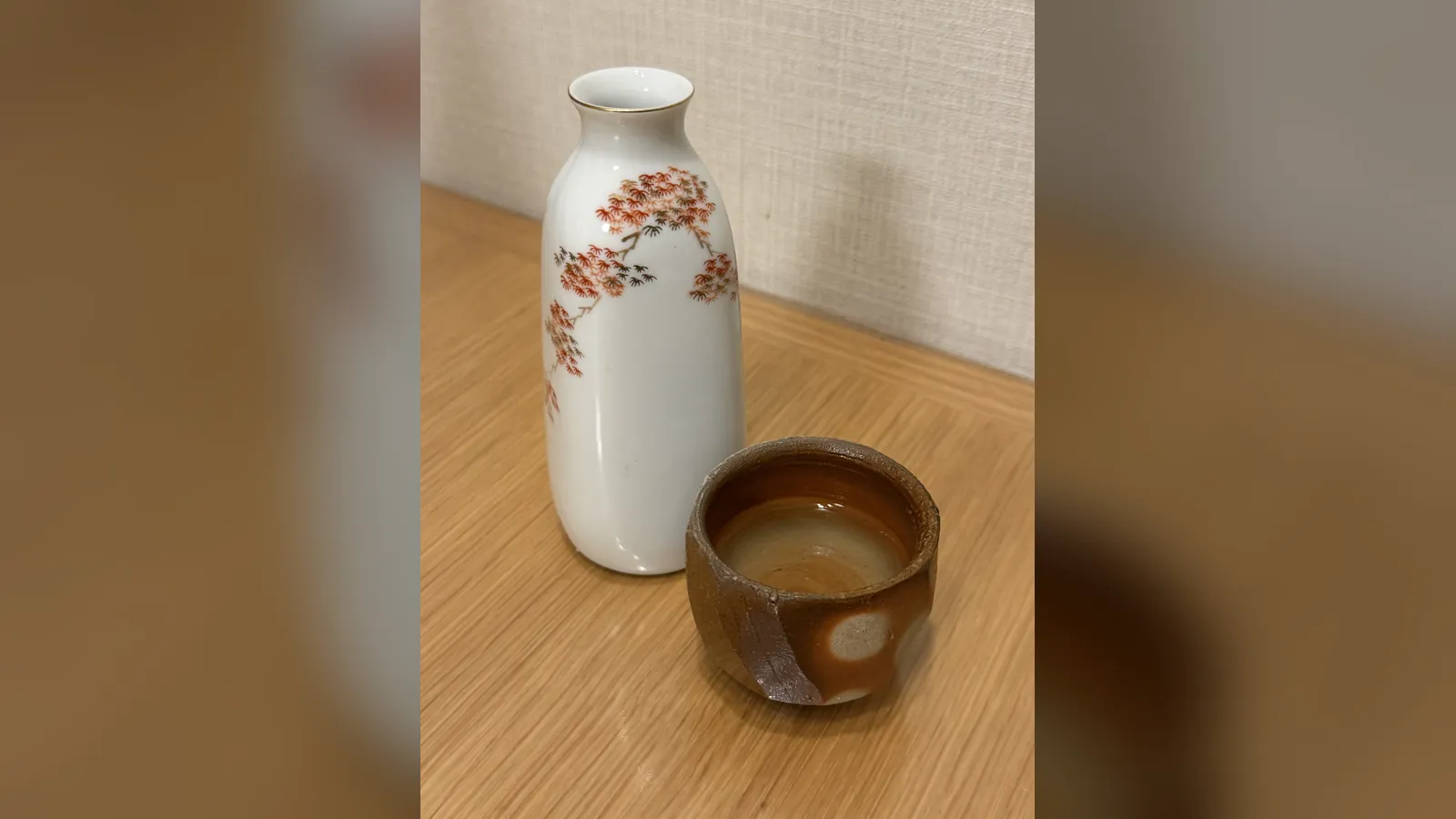
Table of Contents
- At a Glance
- What Is a Tokkuri?
- My Fukagawa Seiji Tokkuri
- What Is Nurukan?
- How I Made Nurukan at Home
- Tasting Amabuki Omachi Hiyaoroshi: Chilled vs. 40°C
- Choosing a Guinomi: Bizen Ware or Fukagawa Seiji?
- Using and Caring for the Tokkuri
- Where in Japan
- Final Thoughts: A Tokkuri Worth Using Again
- Related Reading
There is something special about bringing an old piece of Japanese tableware back to the table.
This white porcelain tokkuri, decorated with delicate red and orange maple leaves, came from my grandparents’ home. A mark underneath identifies it as Fukagawa Seiji, a porcelain maker based in Arita, Saga Prefecture. With autumn arriving, its maple-leaf design seemed a fitting match for hiyaoroshi, a seasonal sake associated with this time of year.
I had already reviewed Amabuki Junmai Omachi Hiyaoroshi, a dry and relatively restrained sake from Saga. When I bought it, the staff at Tobu Shuhan recommended trying it gently warmed—nurukan. This time, I wanted to go further: use the old tokkuri, measure the heating temperature, and compare the sake straight from the refrigerator with the same sake warmed to 40°C.
The result was not quite what you might expect if you think warming simply makes sake softer.
At a Glance
| Detail | My Experience |
|---|---|
| Vessel | Fukagawa Seiji porcelain tokkuri |
| Decoration | Autumn maple leaves and a gold-trimmed rim |
| Age | Unknown; in my family for at least ten years |
| Full capacity | Approximately 200 mL |
| Likely serving size | One go (180 mL) |
| Sake | Amabuki Junmai Omachi Hiyaoroshi |
| Sake used | 100 mL |
| Water-bath temperature | Approximately 65°C (149°F) |
| Heating time | Approximately 3 minutes 30–40 seconds |
| Final sake temperature | 40°C / 104°F (nurukan) |
| Sake cups | Bizen ware and Fukagawa Seiji Botan Kinmiru |
These are measurements and observations from one home experiment, not universal heating instructions for every tokkuri.
What Is a Tokkuri?
A tokkuri is a traditional Japanese flask used to serve sake. Its narrow neck and wider body set it apart from other drinking vessels, and it comes in many shapes and materials, including porcelain, glazed pottery, and unglazed stoneware. Some are meant for serving chilled or room-temperature sake; others are also used for warming sake in a water bath.
A common serving size is one go, about 180 mL. Mine holds approximately 200 mL when filled to the brim, so it was likely intended as a one-go flask, although I have not confirmed its original specifications.
Unlike a sake cup, a tokkuri is designed for pouring rather than drinking directly. It shapes the experience through the way sake is presented, warmed, held, and poured. For me, choosing one is as much about the occasion as it is about function.
My Fukagawa Seiji Tokkuri
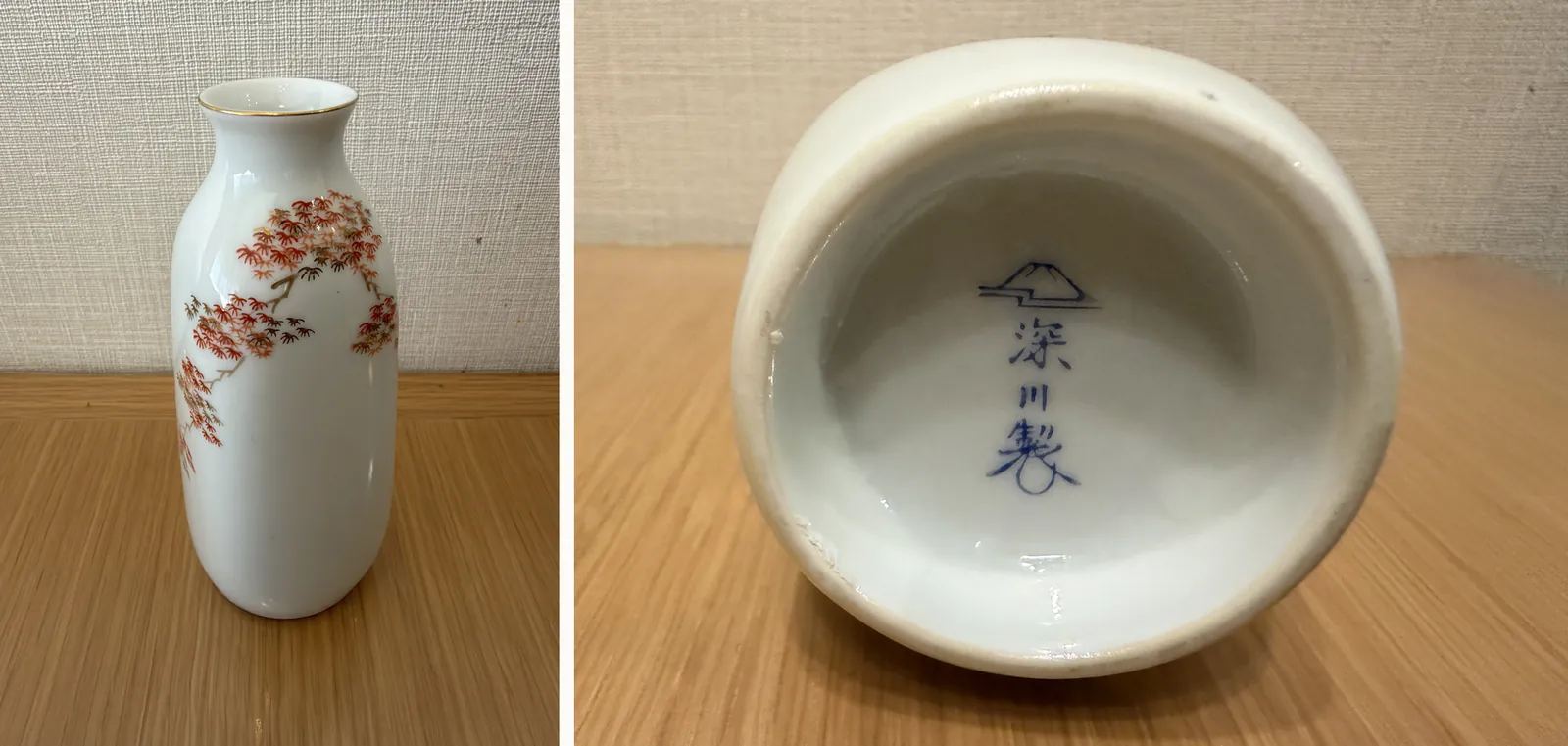
Left: The tokkuri from my grandparents’ home. Right: The Fukagawa Seiji mark underneath.
Autumn Maple Leaves on White Porcelain
The first thing I notice about this tokkuri is the amount of white space. Fine branches of red, orange, and brown maple leaves stretch diagonally across the body, leaving much of the white porcelain visible.
The narrow neck opens into a slightly flared lip finished with a thin gold-colored rim. The shape is tall and relatively slender, with a rounded body that sits comfortably on a flat surface. The overall effect is understated but elegant.
An Old Family Piece
Both of my grandparents have passed away, so I do not know when or where they acquired this tokkuri, and I have neither its original packaging nor its product name. All I know is that it has been in the family for at least ten years. It may be older, but I cannot date it from that information alone.
That uncertainty is part of its story. I did not choose this piece from a shop specifically for autumn sake. It was already there, waiting to be used again.
The Fukagawa Seiji Mark
The underside carries a blue maker’s mark with the familiar mountain-and-stream emblem associated with Fukagawa Seiji, together with Japanese characters identifying the maker.
Founded in Arita in 1894, Fukagawa Seiji is known for its porcelain, particularly its white surfaces, blue decoration, and fine ornamental details. I introduced the maker in more detail in my review of the Fukagawa Seiji Botan Kinmiru guinomi, which I purchased at its Hakata store. That cup’s deep cobalt-blue and gold design is very different from this autumn-toned tokkuri, yet both show how decorative porcelain can become part of everyday sake drinking.
What Is Nurukan?
Nurukan (ぬる燗) is sake gently warmed to approximately 40°C (104°F). It is one of several traditional temperature categories used to describe warm sake.
| Japanese term | Approximate temperature |
|---|---|
| Hinatakan | 30°C / 86°F |
| Hitohadakan | 35°C / 95°F |
| Nurukan | 40°C / 104°F |
| Jokan | 45°C / 113°F |
| Atsukan | 50°C / 122°F |
| Tobikirikan | 55°C / 131°F or higher |
Temperature classifications: Japan Sake and Shochu Makers Association.
These names describe serving temperatures, not grades of sake. Warming can bring out aromas and change how sweetness, acidity, umami, bitterness, and alcohol are perceived—but it does not automatically make sake smoother. Some styles benefit from gentle warming; others lose the freshness or delicate aroma that makes them enjoyable chilled. The right temperature depends on the sake, and on personal preference.
How I Made Nurukan at Home
For this experiment, I used the Fukagawa Seiji tokkuri, a shallow pan, water, and a digital kitchen thermometer.
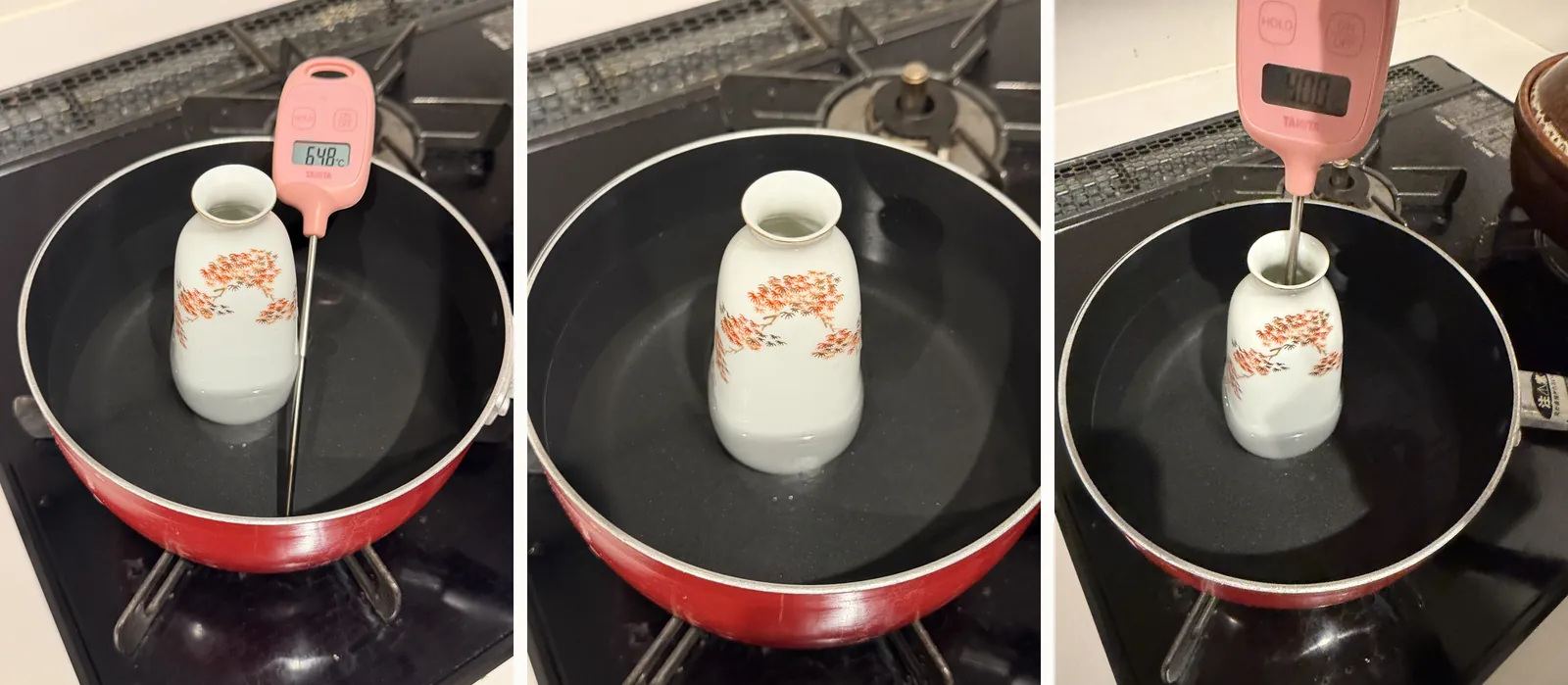
Left: Water bath: 64.8°C. Center: Warming in the water bath. Right: Sake at 40.0°C.
Step 1: Pour 100 mL of Chilled Sake into the Tokkuri
The tokkuri had been stored at room temperature. I took the sake from a typical household refrigerator and poured 100 mL into the flask.
I did not measure the sake’s temperature immediately before heating, so I cannot give an exact starting temperature. Using 100 mL also left plenty of space below the rim, making the flask easier to handle.
Step 2: Prepare a Water Bath at Approximately 65°C
I heated water in a pan to approximately 65°C (149°F), keeping the water level below the flask’s opening. A water bath warms the sake gently through the vessel, without applying direct flame to its base.
Step 3: Warm the Tokkuri in the Water Bath
I placed the tokkuri in the warm water and monitored the sake’s temperature. The aim was not to make the sake hot, but to bring it gently to nurukan.
Step 4: Stop at 40°C
After approximately 3 minutes and 30–40 seconds, the sake reached 40.0°C (104°F).
Heating times will vary with the quantity of sake, its starting temperature, the vessel, and the amount and temperature of the water. Rather than relying on a fixed number of minutes, I recommend checking the sake itself with a thermometer.
Step 5: Pour and Enjoy
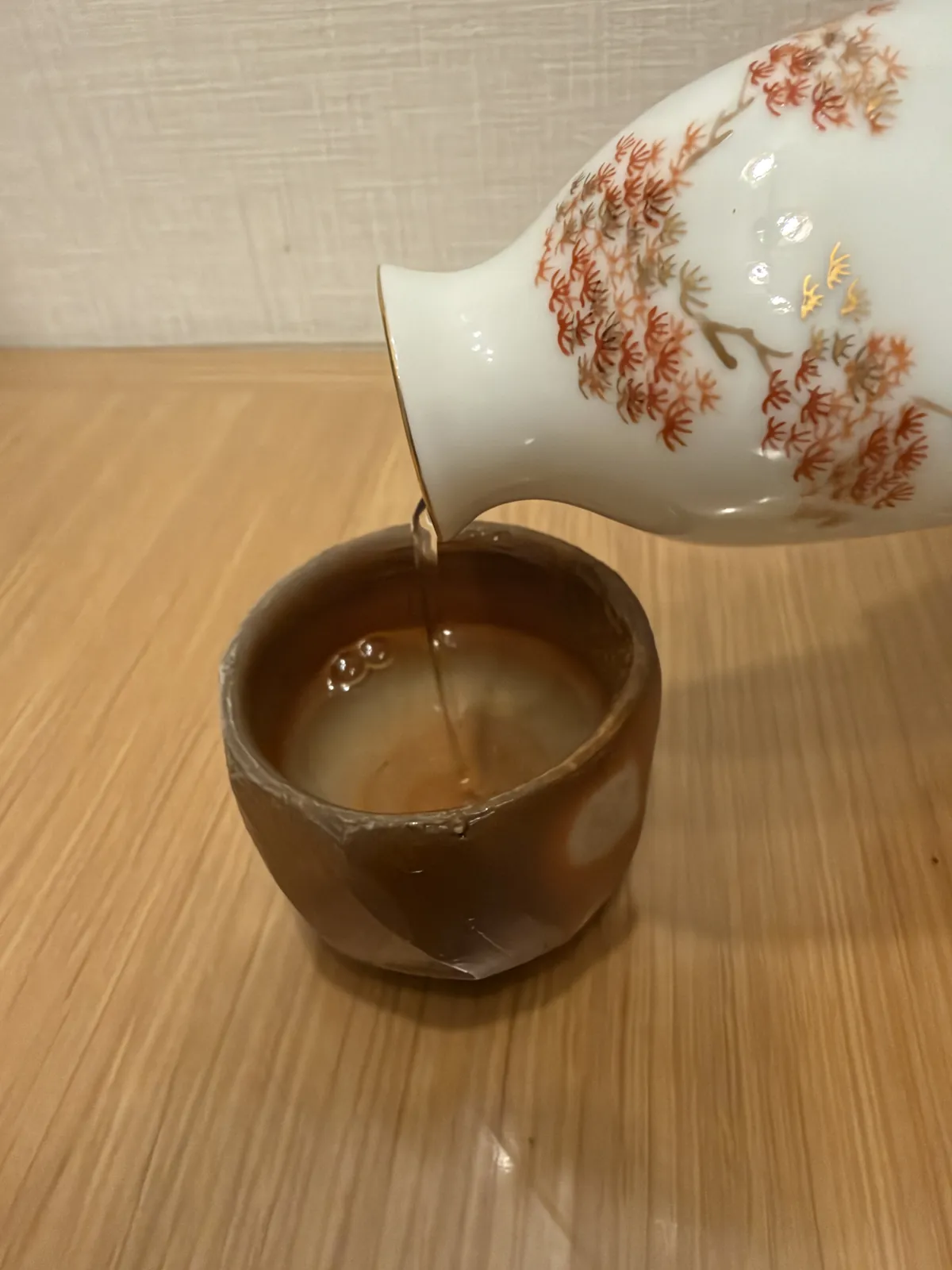
Pouring nurukan into the Bizen guinomi
I removed the tokkuri and poured the sake into a Bizen ware guinomi. The autumn-colored porcelain and earthy brown pottery made a pleasing contrast.
This was the moment the old family tokkuri felt less like an object kept in storage and more like a vessel meant to be used.
Tasting Amabuki Omachi Hiyaoroshi: Chilled vs. 40°C
I tasted the sake twice: straight from a typical household refrigerator, and warmed to 40°C. I did not measure the temperature of the chilled sake. These are personal tasting impressions, not measurements of chemical composition.
Straight from the Refrigerator: Cleaner, Brighter, and Drier
Chilled, the sake felt composed and refreshing. Acidity was the most prominent element, while sweetness was restrained and the finish was dry. Aroma and umami were moderate, bitterness stayed in the background, and alcohol warmth and finish length were comparatively contained. The flavors felt more compact and integrated.
At 40°C: More Expansive, but Not Gentler
Warming changed the experience considerably. The aroma became more expressive, and sweetness and umami spread across the palate. Acidity, so prominent when chilled, receded into the background, and the finish lingered longer.
At the same time, bitterness showed one of the most noticeable increases in my tasting notes, and alcohol warmth rose as well. Rather than becoming softer or easier to drink, the sake felt broader and more vivid, with a firmer, more assertive finish. I enjoyed that expansion of flavor, but I would not recommend the warm version as an easier introduction for someone new to sake.
Which Temperature Did I Prefer?
I appreciated both for different reasons. Straight from the refrigerator, the sake felt cleaner, drier, and more tightly balanced. At 40°C, the extra sweetness and umami made me imagine it alongside nabe (Japanese hot pot) or other warm, savory winter dishes—a pairing I would like to explore further, rather than one I tested during this session.
My earlier Amabuki Junmai Omachi Hiyaoroshi review covers the sake itself in more detail, including its flavor, a comparison with Shichida, and its approachability for beginners. For background on the style, see What Is Hiyaoroshi?
Choosing a Guinomi: Bizen Ware or Fukagawa Seiji?
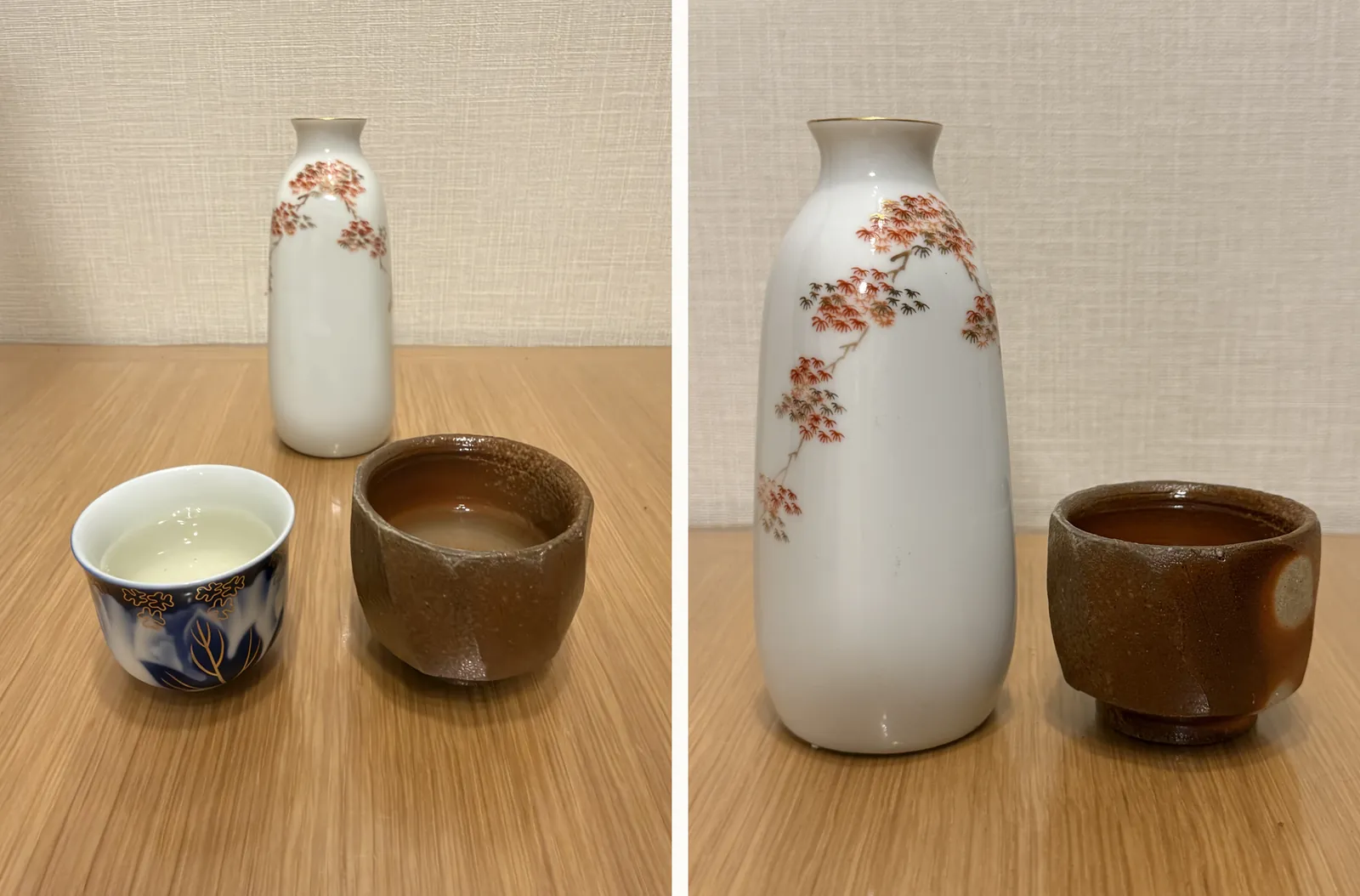
Left: Two cups to choose from. Right: The Bizen pairing I chose.
I had two sake cups available: a rustic Bizen ware guinomi with earthy brown tones and pale firing marks, and my Fukagawa Seiji Botan Kinmiru guinomi in cobalt blue, white, and gold.
Bizen Ware: A Natural Match for Autumn
For the main serving photographs, I chose the Bizen cup. Its reddish-brown pottery felt naturally connected to the orange and brown maple leaves, and its rugged surface contrasted nicely with the smooth white porcelain.
I purchased this guinomi at the West Japan Ceramics Fair. Its distinctive firing marks and irregular surface make it quite different from the refined porcelain pieces in my collection. I introduced it in more detail in my Bizen ware guinomi review.
Fukagawa Seiji: A Different Kind of Harmony
The Botan Kinmiru guinomi offered a more decorative pairing. Its deep blue contrasts with the warm autumn colors of the tokkuri, while the shared gold details and porcelain surfaces create another kind of visual connection.
I would not say one pairing is objectively better. This was a comparison of appearance and serving experience, not a controlled test of how each cup changes the flavor. For this particular autumn setting, however, the Bizen cup felt more natural to me.
Using and Caring for the Tokkuri
Beyond its appearance, I appreciated several practical points:
- Size: Its approximately 200 mL brimful capacity suits a small serving, potentially around one go.
- Pouring: The narrow neck and flared mouth pour neatly into a small guinomi.
- Look: The white porcelain shows off the autumn decoration without overwhelming the table.
- Warming: It worked well for a 100 mL water-bath nurukan at home.
A few care notes. As with any older ceramic vessel, I check for cracks or damage before warming. Because of its gold decoration, I would not put it in a microwave, and I handle the gold-trimmed rim gently. The narrow mouth takes some care to clean and dry; I wash it by hand with a soft sponge and avoid abrasive cleaning. I have not confirmed the original model specifications or the manufacturer’s care instructions for this older piece.
Where in Japan
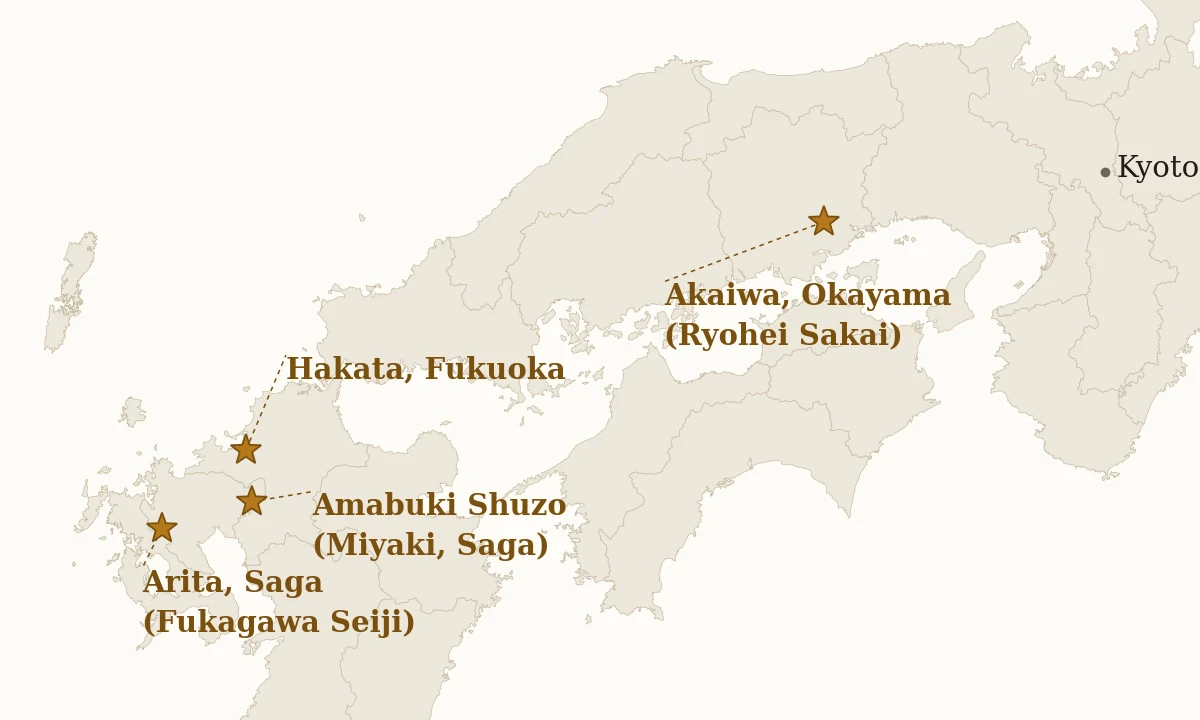
Where in Japan: Fukagawa Seiji is based in Arita, Saga Prefecture, and Amabuki Shuzo is in Miyaki Town, Saga Prefecture. I bought my Botan Kinmiru guinomi in Hakata, Fukuoka; my Bizen ware guinomi was made in Akaiwa, Okayama Prefecture.
- Arita, Saga Prefecture — Home of Fukagawa Seiji, the maker of my tokkuri and Botan Kinmiru guinomi.
- Amabuki Shuzo, Miyaki Town, Saga Prefecture — The brewery behind Amabuki Junmai Omachi Hiyaoroshi.
- Hakata, Fukuoka — Where I bought my Botan Kinmiru guinomi at the Fukagawa Seiji store.
- Akaiwa, Okayama Prefecture — Home of Ryohei Sakai’s studio, where my Bizen ware guinomi was made.
Final Thoughts: A Tokkuri Worth Using Again
I started with a porcelain flask from my grandparents’ home. Its history was uncertain, but the maker’s mark, maple-leaf decoration, and slender shape made it worth a closer look—and using it for nurukan gave it a new place in my experience of Japanese sake.
The method was simple. The change in the sake was not. Warmth brought out more aroma, sweetness, and umami, but also made bitterness and alcohol more pronounced. Nurukan was not automatically better or easier to drink than the chilled version. It was different—and worth trying.
Warming sake is not always about making it smoother. Sometimes, it is about discovering a different side of the same bottle.
Perhaps your next sake encounter will begin with a vessel you already own.
Related Reading
- Amabuki Junmai Omachi Hiyaoroshi Review|A Drier Side of Omachi
- What Is Hiyaoroshi?
- Bizen Ware Guinomi by Ryohei Sakai: Clay, Fire, and a Sake Cup with No Glaze
- Fukagawa Seiji Botan Kinmiru Guinomi — A Cobalt-and-Gold Sake Cup
For reference on traditional sake serving temperatures, see the Japan Sake and Shochu Makers Association’s guide, How to Enjoy and Choose Sake.
Sake is an alcoholic beverage. This article is intended for readers of legal drinking age in their country. Please drink responsibly.
Sake is an alcoholic beverage. This article is intended for readers of legal drinking age in their country — please drink responsibly.