
Oribe Ware Guinomi by Tatsunaga Yamamoto|A ¥1,100 Sake Cup in Deep Green
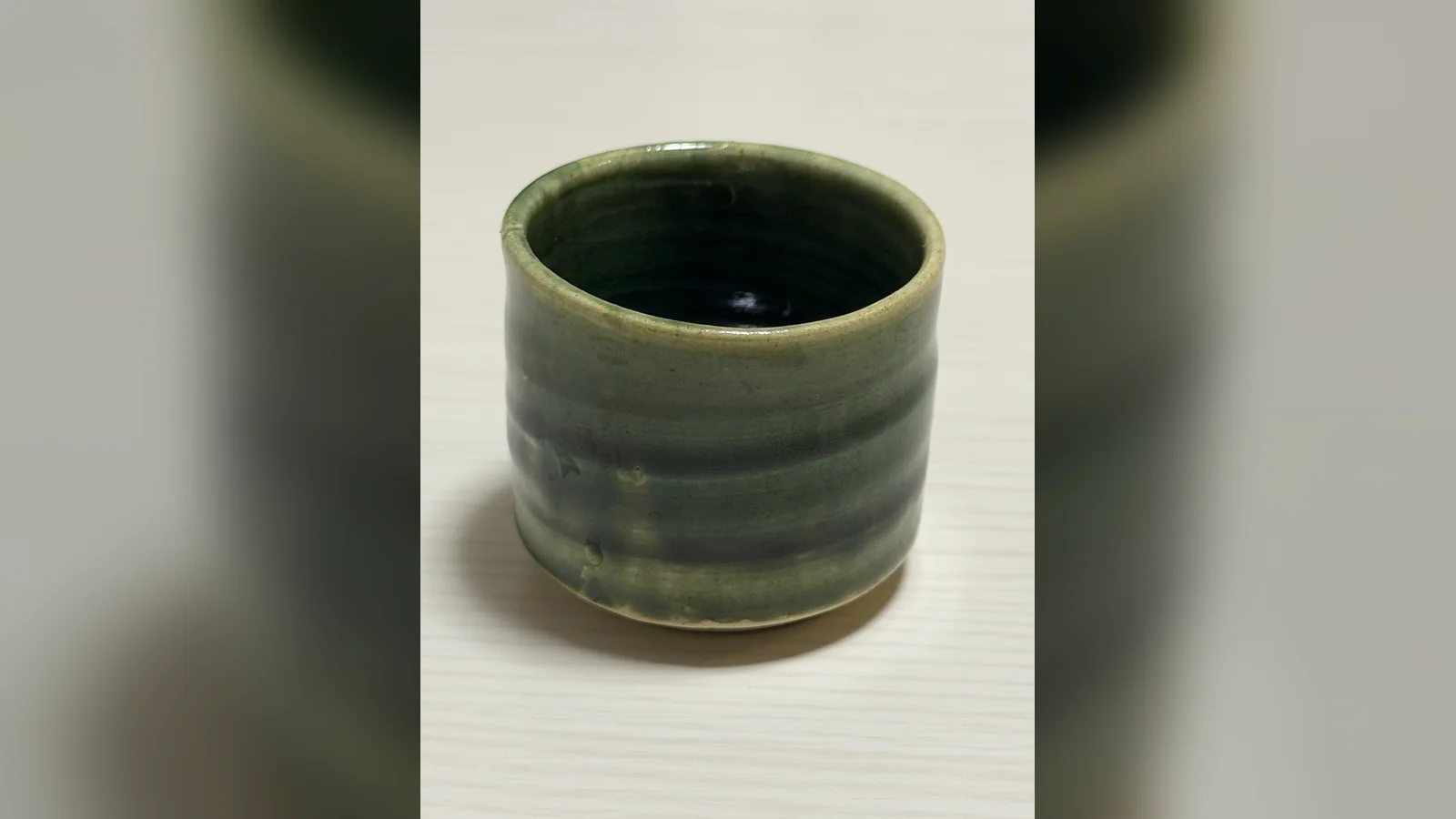
Table of Contents
- Cup Details
- Where in Japan
- What Is Oribe Ware?
- Green, but Not One Green
- Who Is Tatsunaga Yamamoto?
- Finding the Cup at the Pottery Fair
- Using It with Amabuki Junmai Omachi Hiyaoroshi
- Oribe vs Bizen: Two Very Different Sake Cups
- One Limitation: It Hides the Color of the Sake
- Later, with Nabeshima Harvest Moon Classic
- Caring for the Cup
- Where to Find Tatsunaga Yamamoto's Work
- Final Thoughts
- Related Reading
I went to the pottery fair looking for sake ware.
Among the many cups, bowls, and plates on display, I found a small green guinomi at the booth of Tatsunaga Yamamoto, a potter based in Izumo, Shimane Prefecture.
It cost ¥1,100.
What caught my attention first was the color. At first glance, it looked like a simple green cup. The longer I looked at it, the less simple it became.
Cup Details
| Detail | Information |
|---|---|
| Maker | Tatsunaga Yamamoto |
| Kiln | Shisuigama (Izumo, Shimane Prefecture) |
| Item | Oribe ware guinomi |
| Purchased at | 48th West Japan Ceramics Fair, Kokura, Kitakyushu (2026) |
| Price paid | ¥1,100 |
| Diameter | Approx. 5.5 cm |
| Height | Approx. 5 cm |
| Capacity | Approx. 45 ml |
| First sake used | Amabuki Junmai Omachi Hiyaoroshi |
At around 45 ml, it feels clearly like a guinomi rather than a larger drinking cup. It holds enough for a few small sips without encouraging me to pour too much at once.
Where in Japan
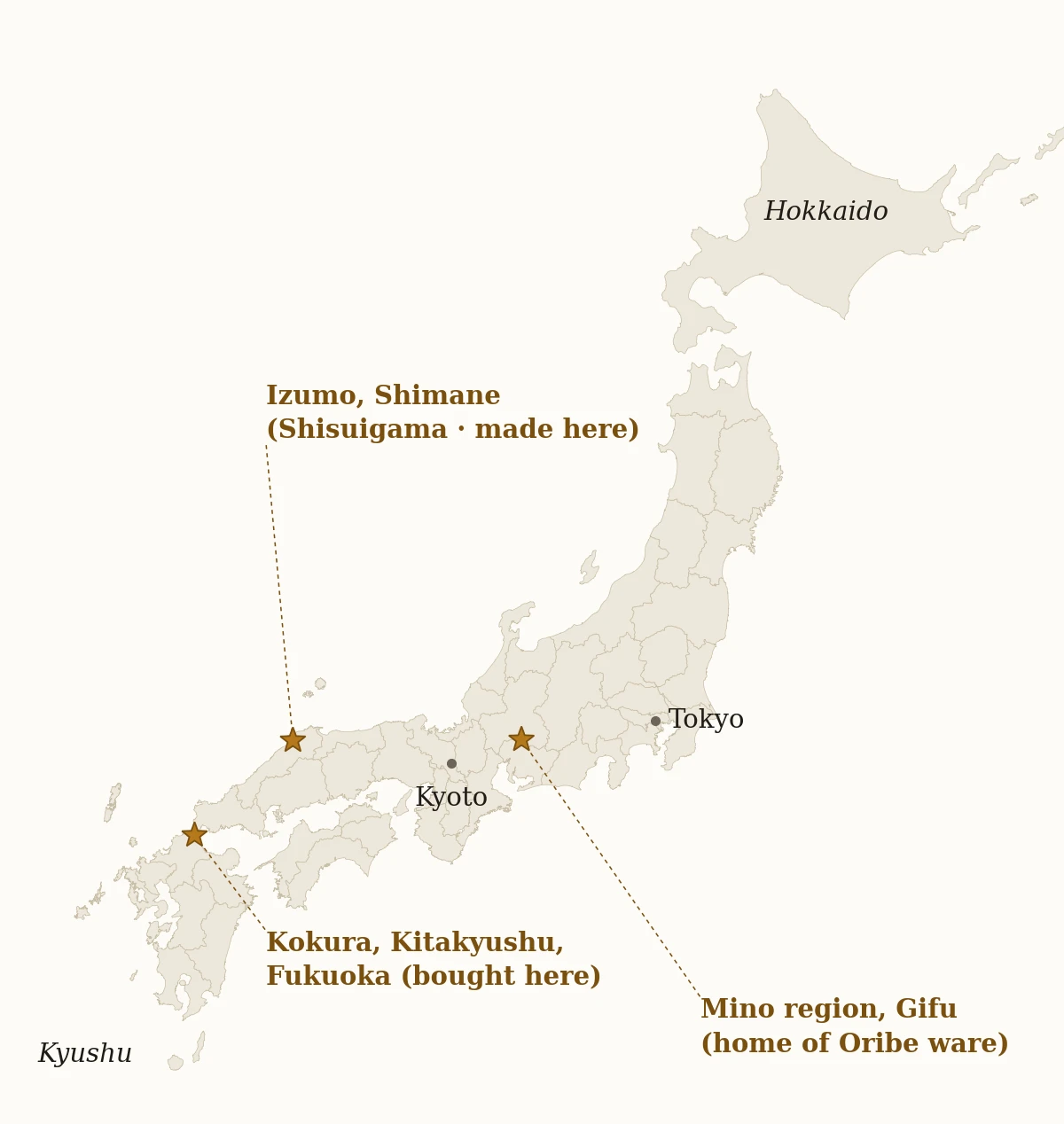
Where in Japan: This cup was made by Tatsunaga Yamamoto in Izumo, Shimane Prefecture, whose training in Gifu’s Mino region shaped his work. I bought it at the West Japan Ceramics Fair in Kokura, Kitakyushu.
This small cup connects three places in Japan.
Izumo, Shimane Prefecture — where the cup was made. Izumo sits on the Sea of Japan side of western Honshu, and it is where Tatsunaga Yamamoto has worked since establishing his kiln in 2007.
Gifu Prefecture — the historic home of Mino ceramics and Oribe ware, and where Yamamoto trained before returning to Izumo.
Kokura, Kitakyushu — at the northern tip of Kyushu, where I found the cup at the West Japan Ceramics Fair.
So although I bought the guinomi in Kyushu, its story stretches north to Izumo and east to the Mino tradition that shaped Yamamoto’s training.
What Is Oribe Ware?
Oribe ware developed in the Mino region of present-day Gifu Prefecture around the beginning of the 17th century.
It is associated with the tea master and daimyo Furuta Oribe, and it stood apart from many earlier tea ceramics through its bold shapes, unusual patterns, and strong use of color.
The best-known Oribe is the vivid green variety. That green traditionally comes from a glaze that uses copper as its coloring agent. Historical Oribe includes several styles — Ao-Oribe, Kuro-Oribe, Aka-Oribe, and others — and pieces covered extensively in green glaze are associated with the So-Oribe, or all-green Oribe, tradition.
I would not label my cup definitively as So-Oribe unless the maker himself describes it that way. But visually, it clearly belongs to that all-green side of the tradition.
There is no painted motif. The glaze itself is the decoration.
Green, but Not One Green
Calling this simply “a green cup” does not really describe what I see.
The rim is pale and slightly yellow-green. The outside is softer and more muted, moving between olive, gray-green, and darker horizontal bands.
Inside, the glaze becomes much deeper. In some light, the lower interior looks almost emerald green. In other light, it becomes so dark that it approaches black.
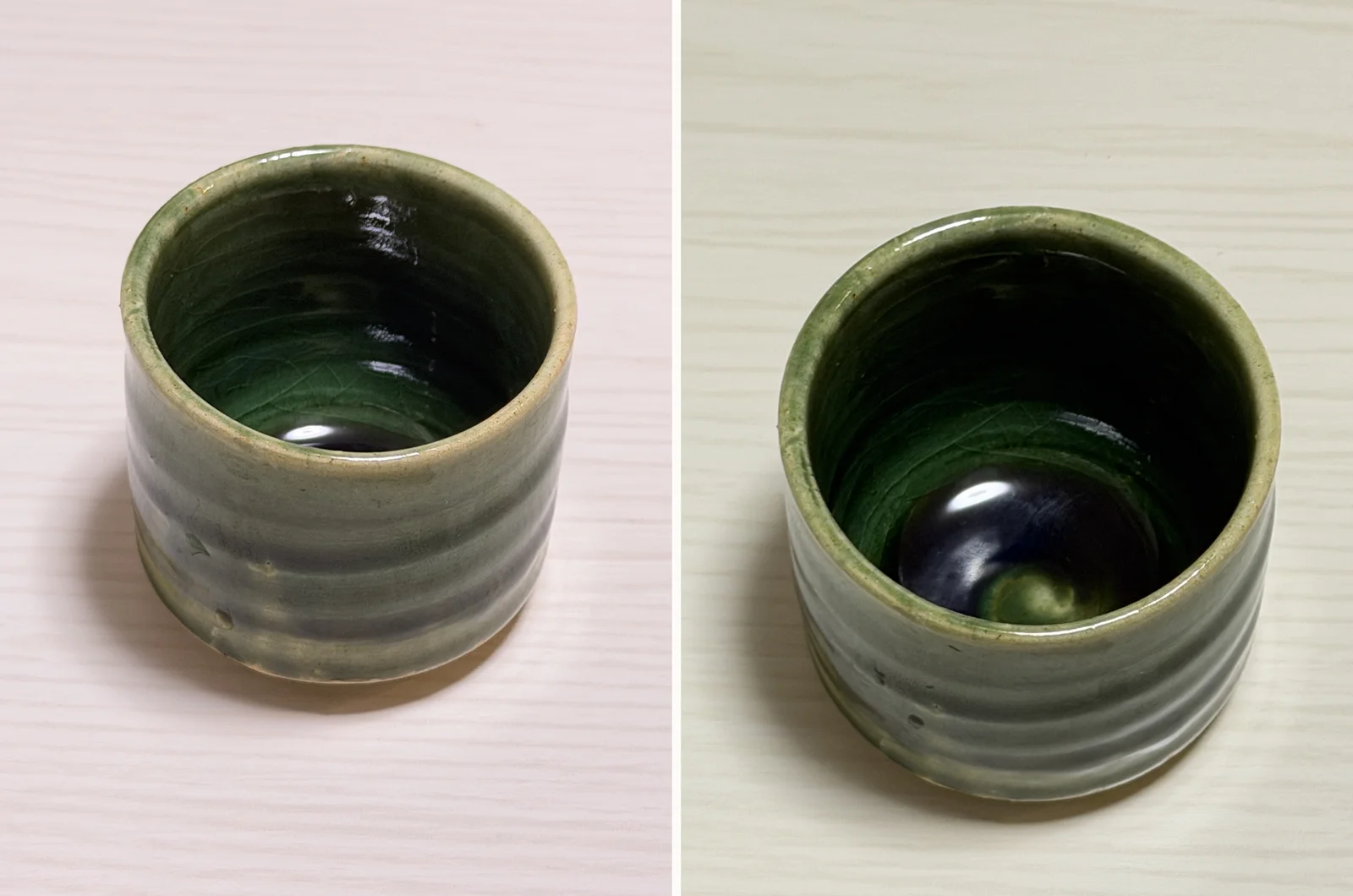
The glaze makes the cup feel smooth, but it does not hide how the cup was formed. Horizontal throwing lines remain visible around the body and continue into the interior.
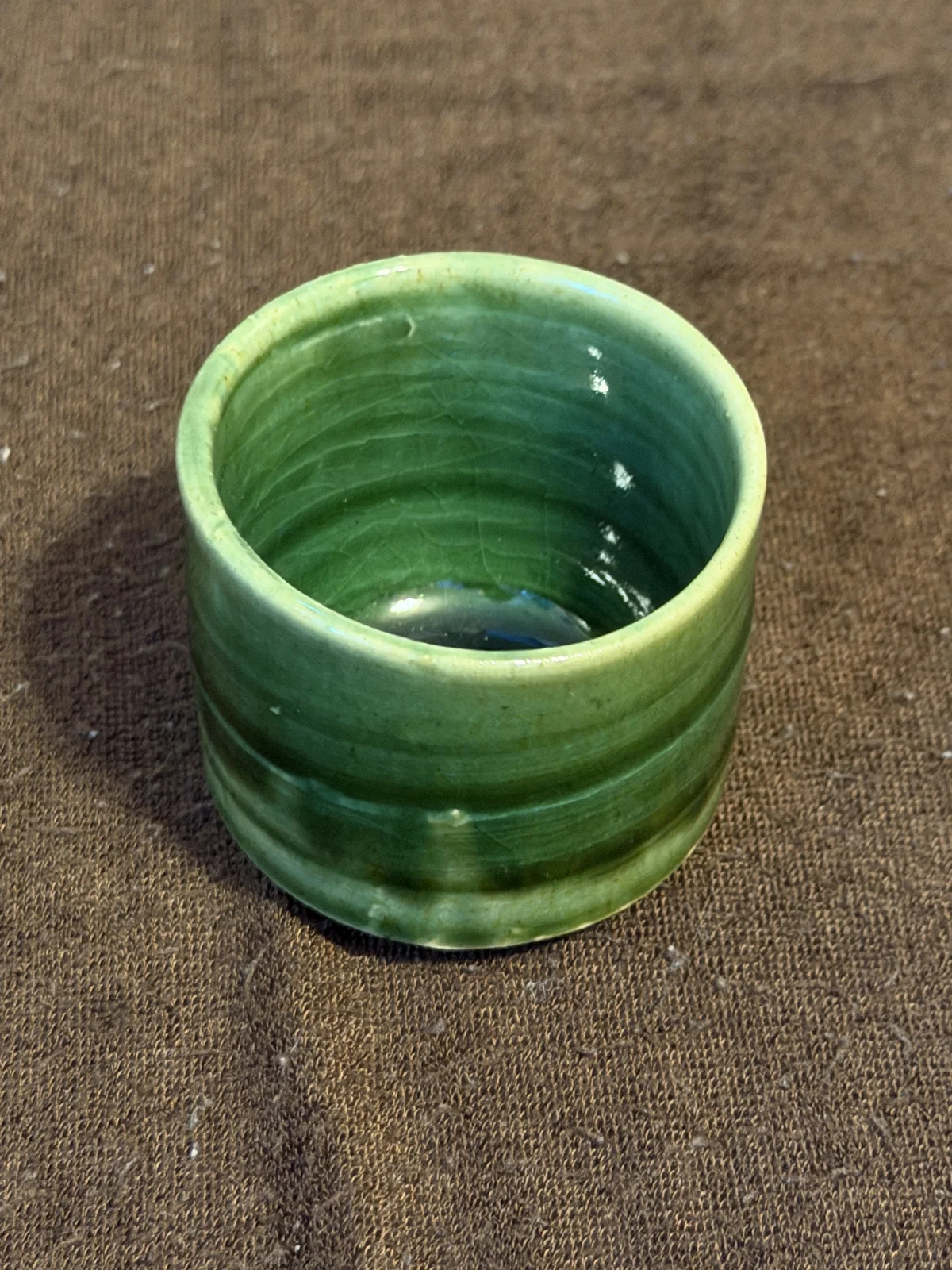
I like that balance. The surface is glossy and finished, but not mechanically perfect. My porcelain cups feel precise and controlled; my Bizen guinomi feels rough and earthy. This Oribe cup sits between them — smooth and glazed, but unmistakably handmade.
Who Is Tatsunaga Yamamoto?
Tatsunaga Yamamoto was born in Izumo, Shimane Prefecture, in 1979.
After university, he began training in 2003 under Oribe potter Kiheiji Takiguchi in Gifu Prefecture. Takiguchi was recognized by Kani City for his mastery of Oribe techniques, which were designated as an important intangible cultural property.
Yamamoto trained there for four years. In 2007, he returned to Izumo and built his own kiln beside a tea room his grandfather had built, naming it Shisuigama. He has since worked mainly in Oribe ware, exhibiting and selling his work around Japan.
What interested me most was his approach to tradition. In an interview, he described traditional technique as a foundation, while not letting it rigidly limit new ideas — calling his work a hybrid of tradition and the present day.
That feels right for this cup. It clearly looks like Oribe, but it feels like an everyday object rather than something made to imitate a museum piece.
Finding the Cup at the Pottery Fair
I bought the guinomi at the West Japan Ceramics Fair in Kokura.
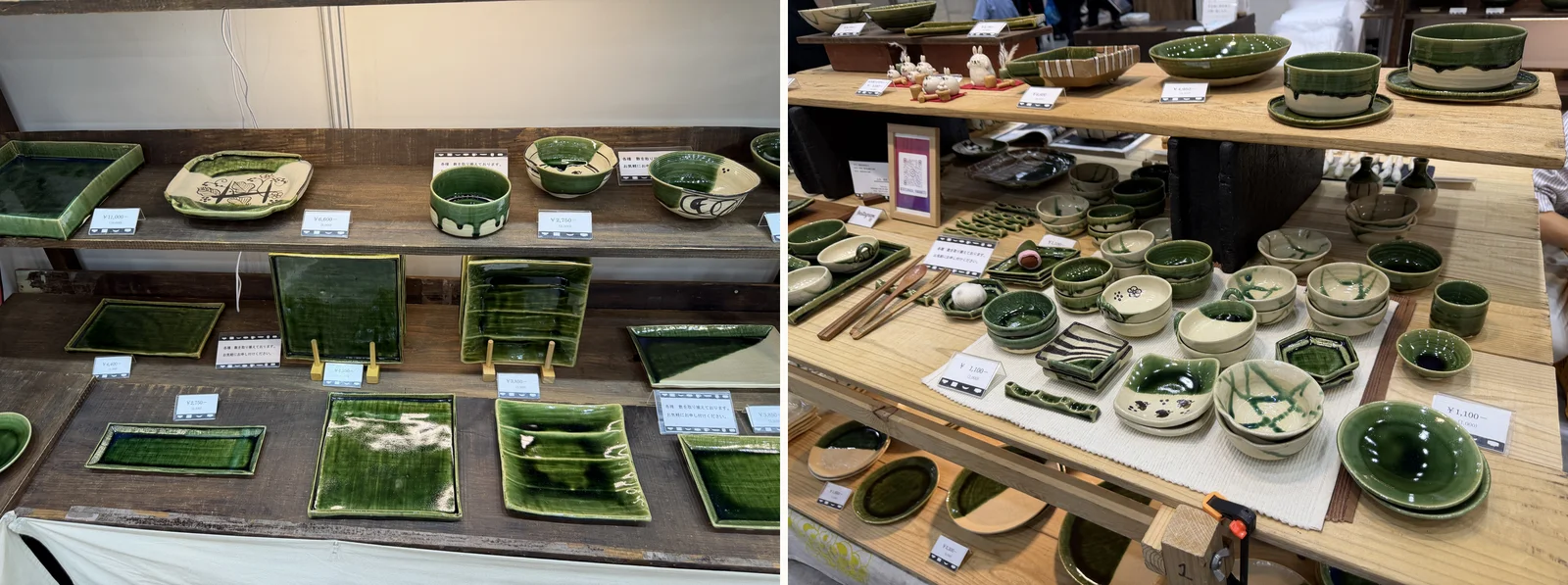
Yamamoto’s booth was filled with green tableware: plates, bowls, cups, chopstick rests, and other pieces in different combinations of green glaze and exposed pale clay.
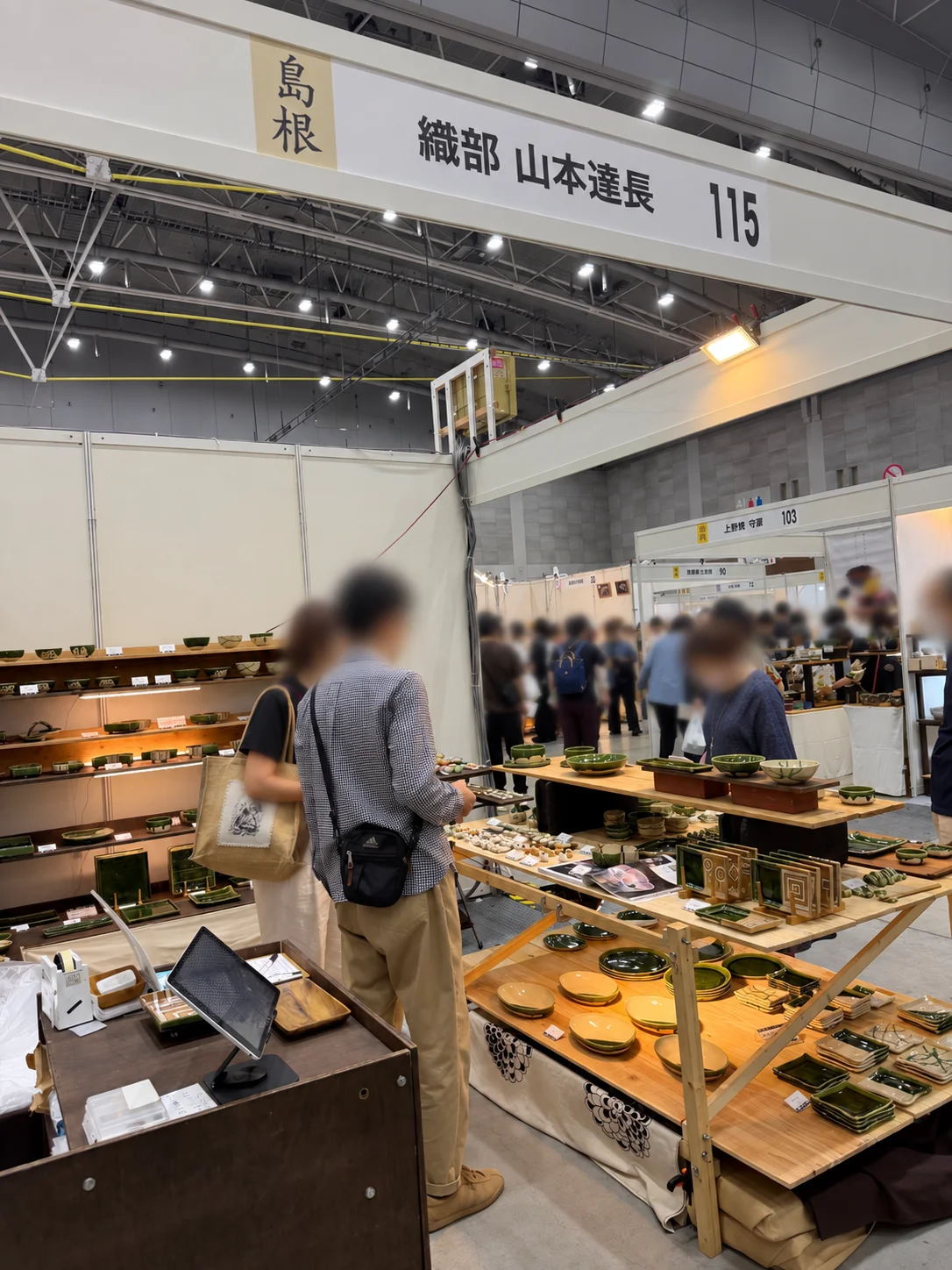
The range of green alone was impressive. Some pieces were dark and almost glossy black-green. Others were lighter. Some used green across almost the entire surface, while others left large areas of pale clay visible.
When I visited, however, the selection of sake ware was surprisingly limited. Yamamoto told me that production had not been keeping up. The main sake vessels I could see were this cylindrical guinomi and a flatter, shallower cup.
I had already bought a shallow Kutani ware sakazuki elsewhere at the same fair. A shallow cup creates a wide surface of liquid; this guinomi is narrower and more enclosed. So I chose the deeper Oribe cup — not because it was the only option left, but because it added a shape I did not already own.
That contrast should become even more interesting if I eventually pour the same sake into several cups side by side.
→ Read my Kutani Ware Sakazuki review
Using It with Amabuki Junmai Omachi Hiyaoroshi
For its first proper use, I poured Amabuki Junmai Omachi Hiyaoroshi into the cup.
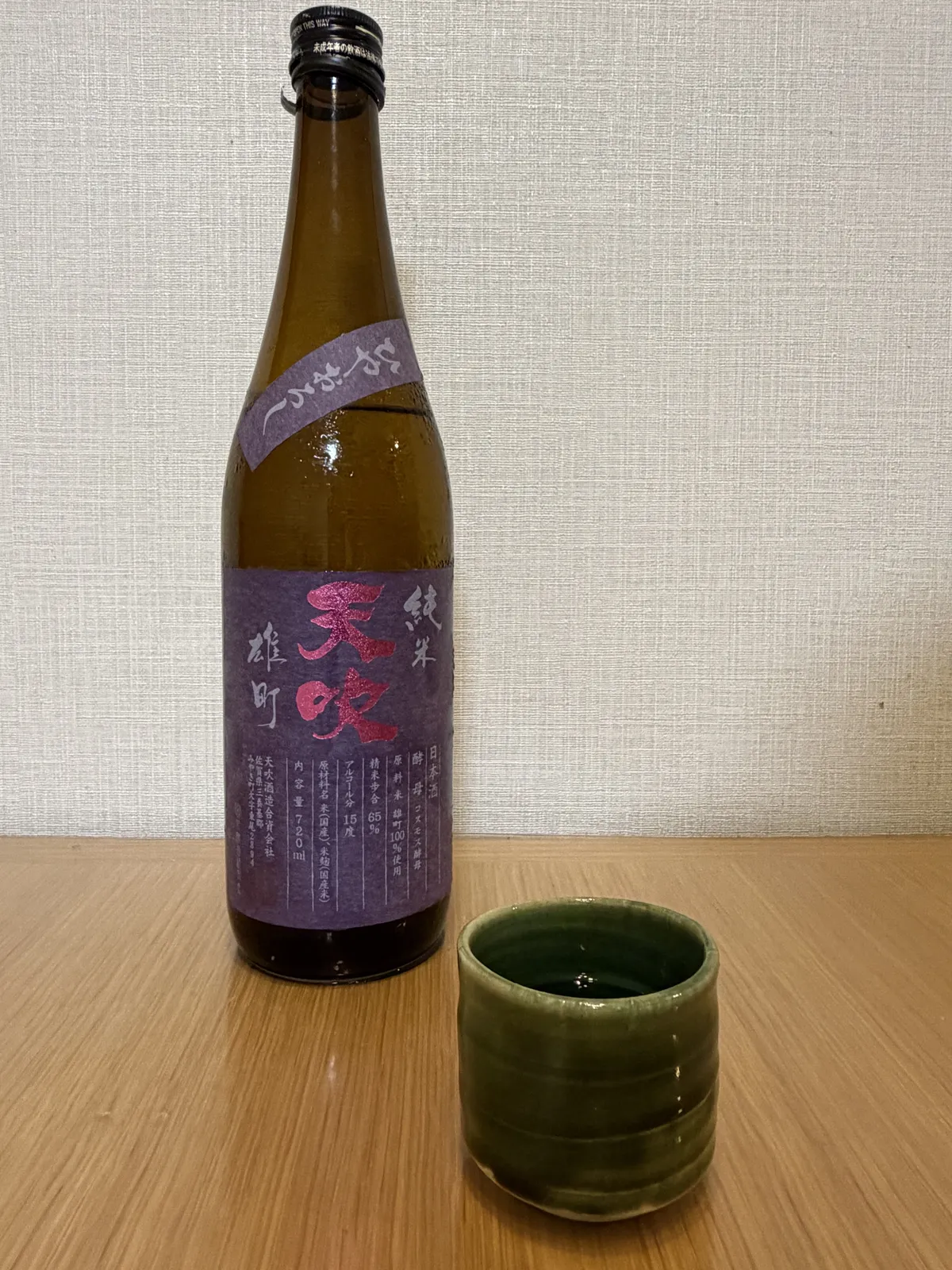
The deep green cup and the muted purple label created a subdued, autumnal combination — fitting for hiyaoroshi, which is itself an autumn release.
→ Read my full Amabuki Junmai Omachi Hiyaoroshi review
The more interesting difference appeared when I actually drank from it.
I had recently been drinking from my Bizen ware guinomi by Ryohei Sakai. The Bizen cup is unglazed, and its rim feels slightly rough and earthy against the lips. This Oribe cup feels almost the opposite: the glazed rim is smooth, hard, and cool, with less friction and a cleaner, more defined contact.
Did the cup change the taste of the Amabuki? I do not feel confident saying so. To test that properly, I would want to pour the same sake at the same temperature into several vessels and compare them side by side.
What I can say is that it changed the drinking experience — what reaches my lips, what I see, and how I hold the cup.
→ Read about my Bizen Ware Guinomi by Ryohei Sakai
Oribe vs Bizen: Two Very Different Sake Cups
I bought both cups at the same fair. They serve the same basic purpose, but beyond that, they could hardly feel more different.
| Feature | Oribe Ware | Bizen Ware |
|---|---|---|
| Surface | Glazed | Unglazed |
| Main color | Green | Brown and firing tones |
| Touch | Smooth and hard | Slightly rough and earthy |
| Rim | Smooth, glazed | More tactile and irregular |
| Visual focus | Glaze and color | Clay and firing |
| Interior | Deep green | Brown |
| Main impression | Cool, glossy, calm | Earthy, tactile, kiln-driven |
The Bizen cup tells the story of clay and fire. The Oribe cup tells the story of glaze and color.
One Limitation: It Hides the Color of the Sake
The interior is beautiful. It is also very dark.
When sake is poured inside, the pale color of the liquid becomes difficult to judge.
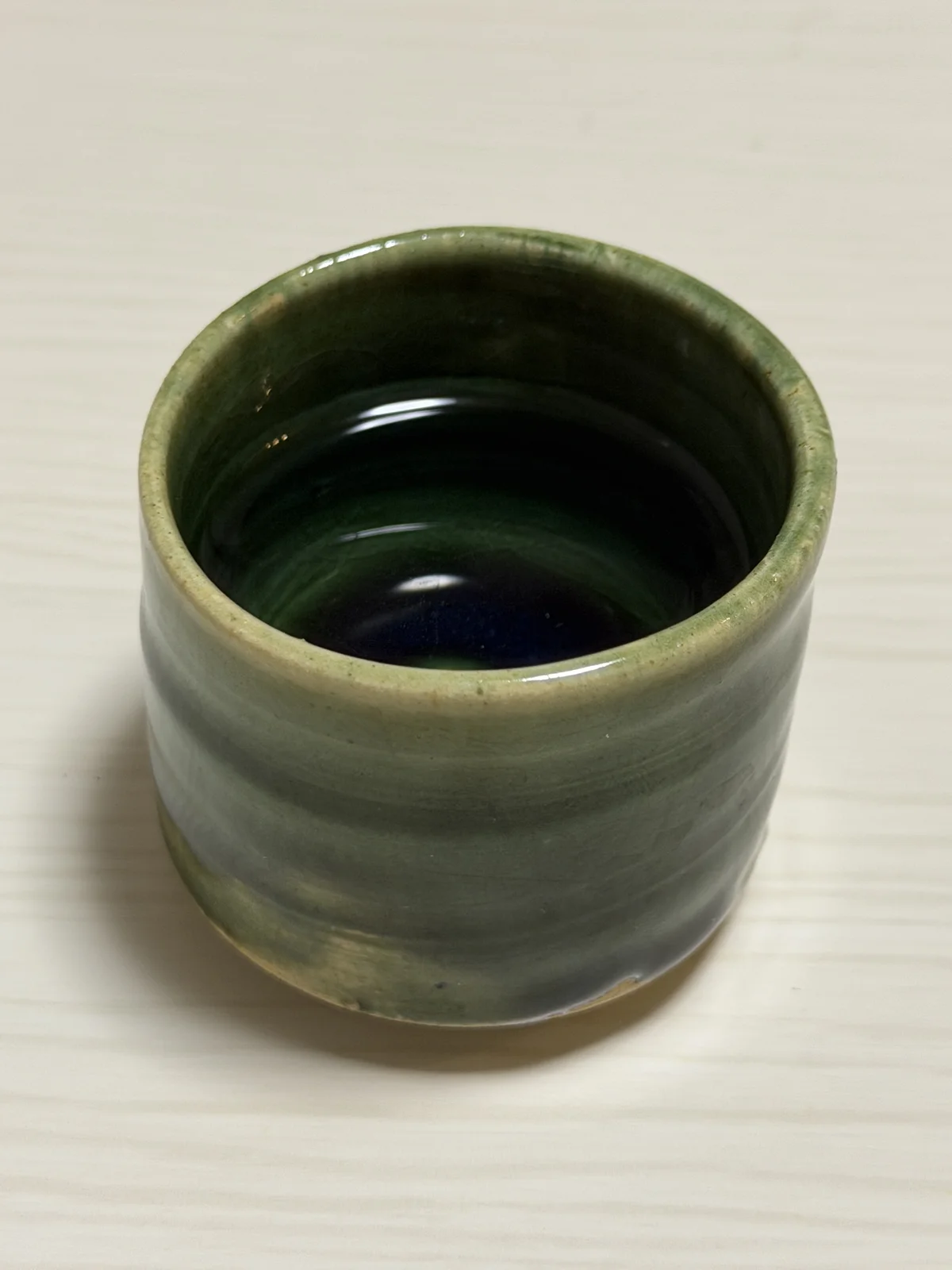
That makes this a poor cup for examining appearance. If I want to see whether a sake is completely colorless, pale yellow, or slightly cloudy, I would rather use clear glass or white porcelain — the same limitation I noticed with my Bizen guinomi.
For relaxed drinking at the table, though, I do not find it particularly important. Sometimes I want to analyze the sake. Sometimes I simply want to drink from a cup I enjoy holding.
Later, with Nabeshima Harvest Moon Classic
I later poured Nabeshima Harvest Moon Classic into the same cup.
→ Read my full Nabeshima Harvest Moon review
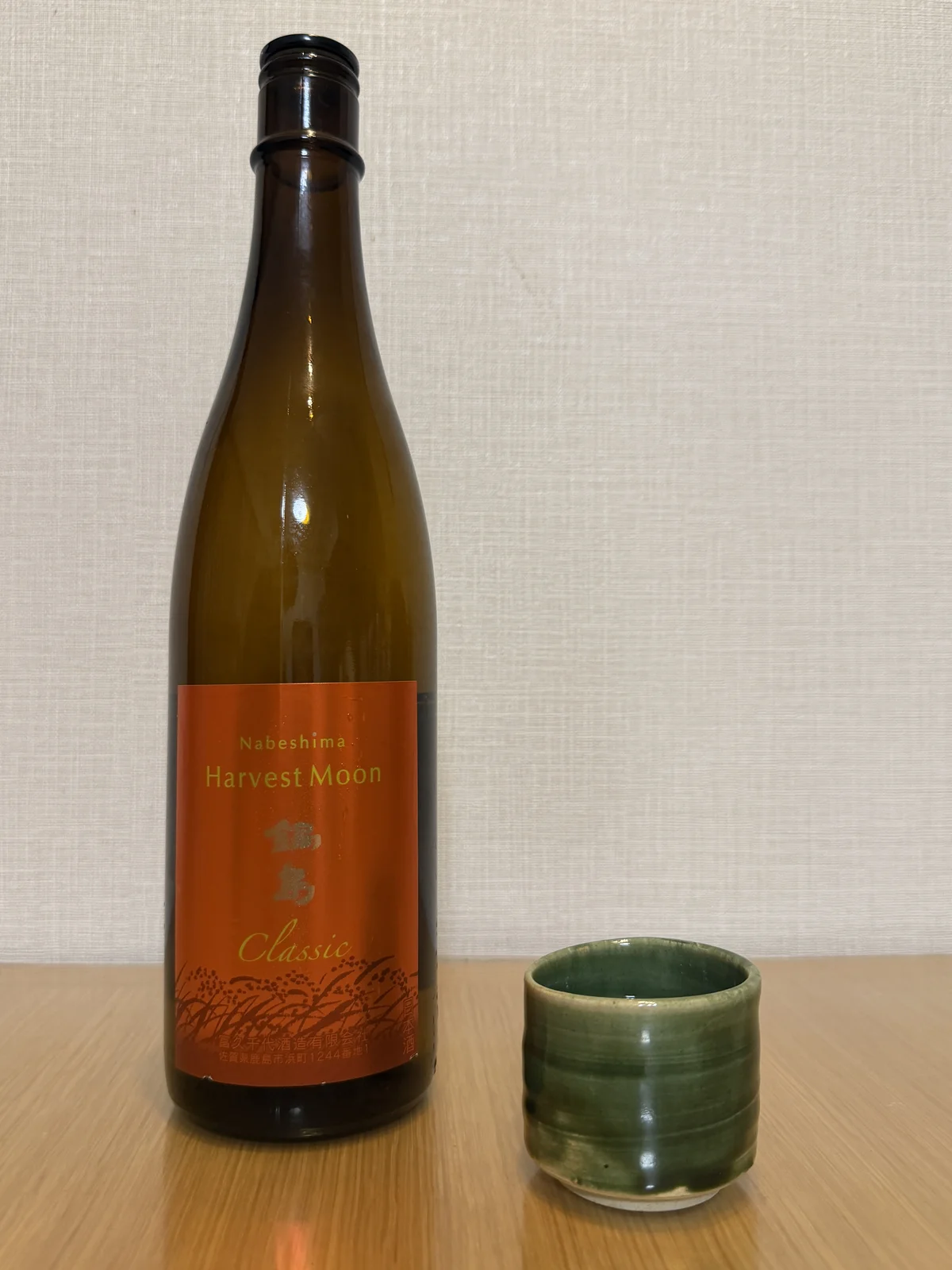
The orange label and green glaze made an even stronger autumn contrast than the Amabuki, reinforcing how seasonal this cup feels.
I have only begun using it, so treat this as preference rather than a rule. I would reach for it with:
- autumn sake such as hiyaoroshi
- junmai with moderate weight
- sake served slightly chilled or at room temperature
- sake paired with grilled fish or simple Japanese food
- bottles I want to enjoy slowly rather than analyze
The roughly 45 ml capacity suits this style of drinking. A small pour can be finished before the temperature changes much, then refreshed when I want another.
Caring for the Cup
Turning the cup over reveals a completely different surface. The bottom is pale and unglazed — almost cream-colored — which shows how dramatically the glaze changes the character of the piece.
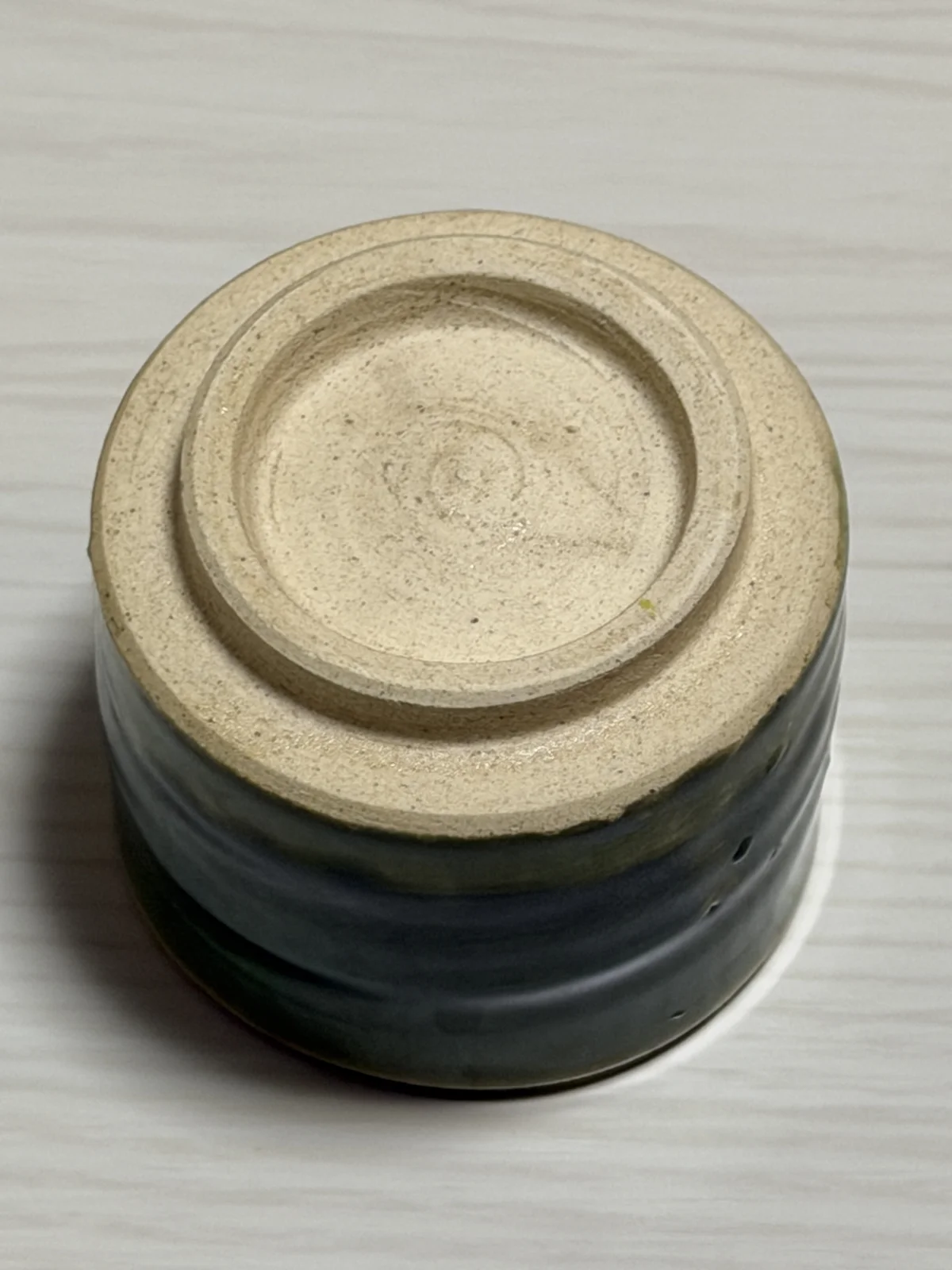
That unglazed foot also matters practically. The care note supplied with the cup recommends:
- Hand wash only — no dishwasher.
- Handle with care — pottery is more vulnerable to impact than porcelain.
- Dry thoroughly before storage, or mold can develop.
- Mind the foot — the unglazed foot dries more slowly than the glazed surface, so turn the cup upside down when drying so the foot faces up.
For a cup I intend to use rather than display, these feel like reasonable requirements.
Where to Find Tatsunaga Yamamoto’s Work
Yamamoto makes Oribe ware at Shisuigama in Izumo and exhibits and sells his work in different parts of Japan.
At the fair, he told me he was planning to exhibit at a ceramics event in Fukuoka the following year. Because that was a plan mentioned in conversation rather than a listing I have confirmed, I would check the official event schedule before making a special trip.
His Instagram is a useful place to see current work and exhibition information.
Final Thoughts
This cup is simple. There is no elaborate painting, no gold, no carved decoration. There is form, glaze, and green.
But the green is not one color. It changes around the rim, across the body, and into the interior. Throwing lines remain visible beneath the glaze, and the pale foot shows what the clay looks like without it.
At ¥1,100, I do not hesitate to use it. Yet it is handmade, connected to a specific potter, and rooted in the Oribe tradition. Traditional Japanese pottery does not have to begin with an expensive purchase — a small everyday cup can be the entry point.
The Bizen guinomi makes me think about soil, fire, and ash. This Oribe guinomi makes me think about glaze, surface, and color.
For ¥1,100, I bought more than a practical sake cup. I bought a small introduction to Oribe.
Related Reading
- Amabuki Junmai Omachi Hiyaoroshi Review — the first sake I used with this cup
- Bizen Ware Guinomi by Ryohei Sakai — an unglazed sake cup with a completely different feel
- Hagi Ware Plate by Tenryu Kiln — another find from the same ceramics fair
- Kutani Ware Sakazuki Review|Shogetsu Bird-and-Flower Sake Cup — the shallow cup that influenced why I chose this deeper guinomi
Sake is an alcoholic beverage. This article is intended for readers of legal drinking age in their country — please drink responsibly.