
Nabeshima Harvest Moon Review|An Autumn Nabeshima with a Fresh, Juicy Lift
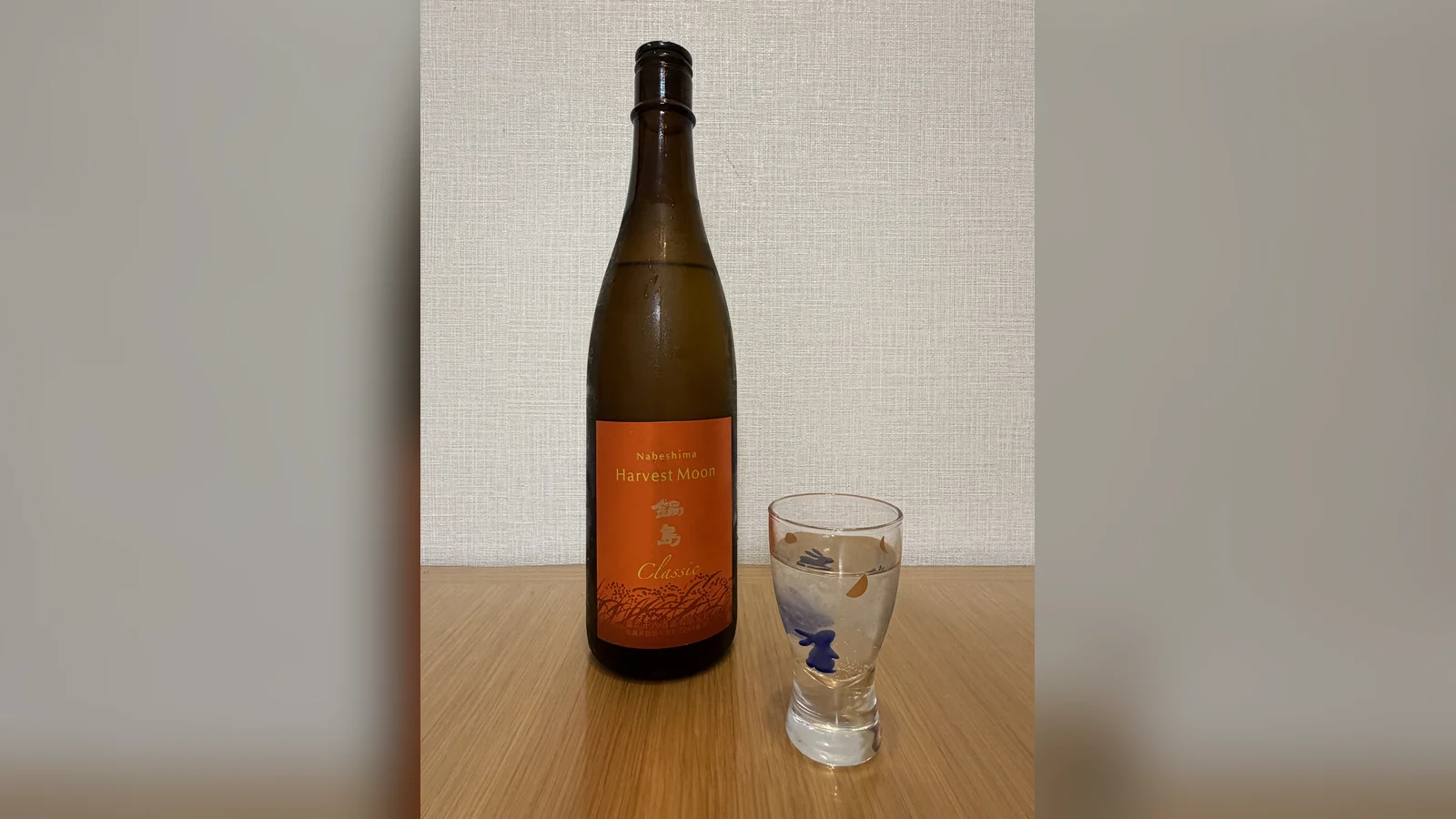
Table of Contents
- What Is Nabeshima Harvest Moon?
- The Label: From Summer Night to Autumn Harvest
- Where I Bought It
- Where in Japan
- How I Tasted It
- First Impression
- Tasting Notes
- The Gas — and What Happens When It Fades
- Three Autumn Bottles from Saga
- Summer Moon to Harvest Moon
- Who Is This For?
- Approachability: 3.5 / 5
- A Note on Availability
- Final Thoughts
- Related Reading
This article contains affiliate links. If you buy through my Palate Project link or use my discount code, you may receive a discount, and I may earn a small commission at no extra cost to you — it never changes what I recommend. Full disclosure.
Autumn sake in Japan usually means calm, rounded, settled bottles — sake that has rested through the summer and softened along the way.
Nabeshima Harvest Moon was not quite that.
It was fresher and juicier than I expected, with a noticeable prickle of gas, pear and citrus on the nose, and a clean finish. Of the three autumn bottles from Saga I opened this season, it was the one that felt most alive in the glass.
It is also the autumn counterpart to a bottle I reviewed earlier this year: Nabeshima Summer Moon. Same brewery, same moon-themed seasonal idea, and a very different sake.
What Is Nabeshima Harvest Moon?
Nabeshima is brewed by Fukuchiyo Shuzo in Kashima, Saga Prefecture.
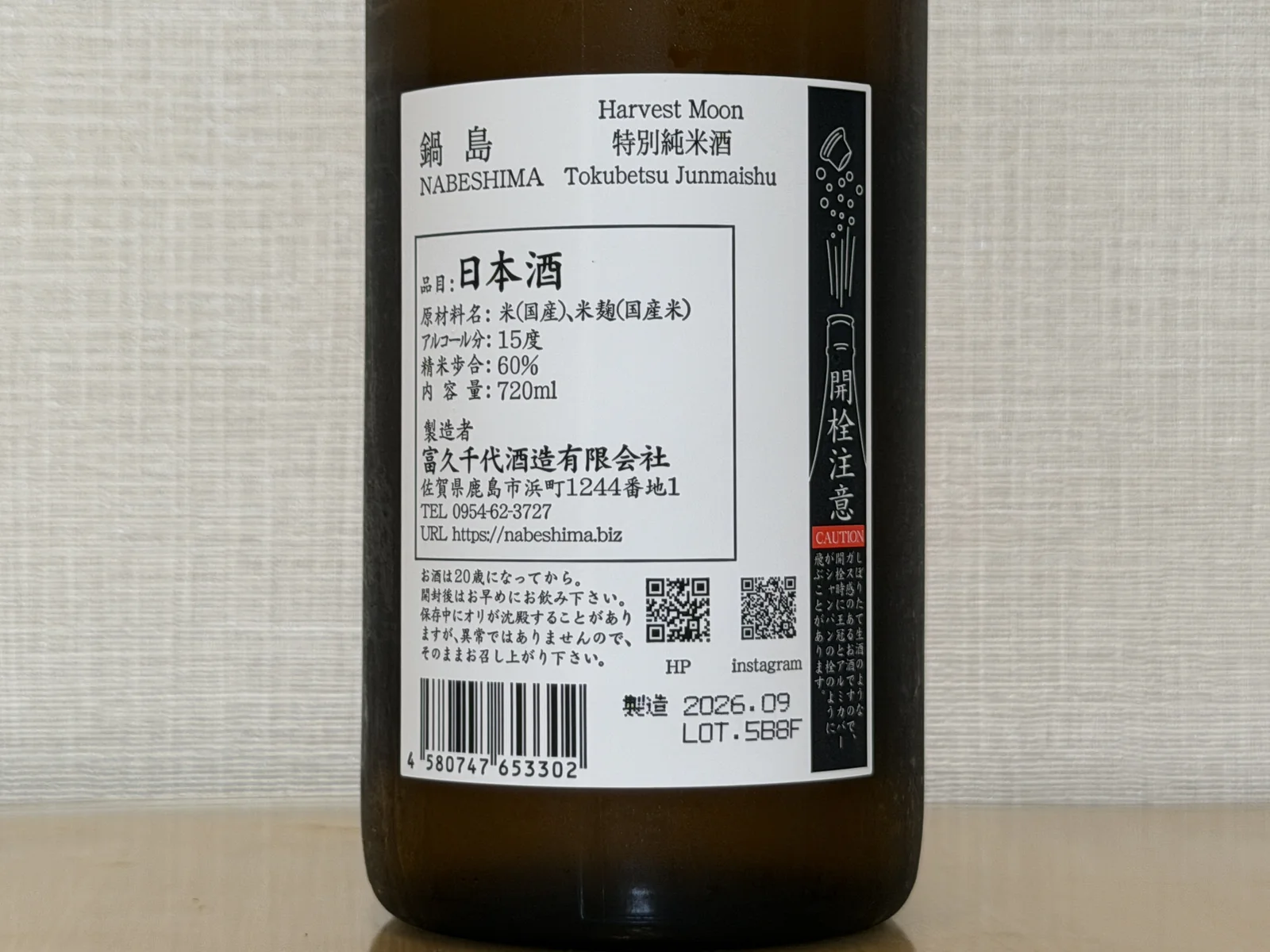
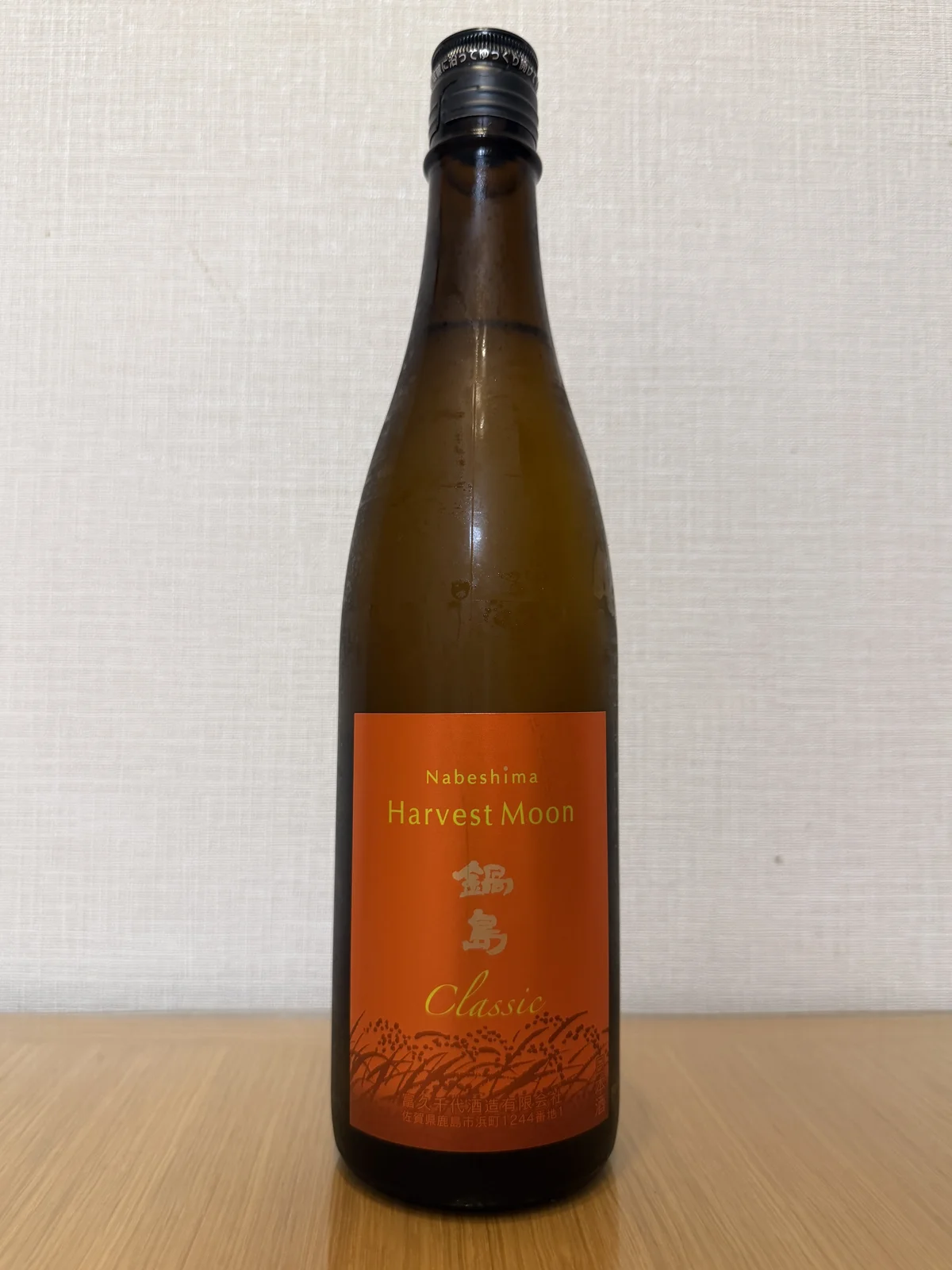
Harvest Moon is the brewery’s autumn release. The bottle I tasted is a tokubetsu junmai, polished to 60%, at 15% alcohol.
| Item | Detail |
|---|---|
| Brewery | Fukuchiyo Shuzo |
| Prefecture | Saga |
| Brand | Nabeshima |
| Classification | Tokubetsu junmai |
| Rice | Not stated on the label |
| Polishing ratio | 60% |
| Alcohol | 15% |
| Volume | 720ml |
| Production date | September 2026 |
The ingredients list reads simply: rice and rice koji. No brewer’s alcohol.
Tokubetsu junmai — literally “special junmai” — is a junmai designation used when the sake meets additional criteria, such as a polishing ratio of 60% or less or the use of a special brewing method. It is not simply a category between junmai and junmai ginjo.
Unlike Summer Moon, whose back label named its rice down to the village, Harvest Moon’s label does not state the rice variety or where it was grown.
The Gas Warning on the Label
One detail on the back label is worth reading before you open the bottle.
A vertical caution panel explains that this sake has a lively, gassy character similar to freshly pressed nama sake, and that the cap and aluminum cover may fly off when opened. The label itself compares this to a champagne cork.
That warning turned out to be accurate. The opening pressure was moderate, and the gas was one of the defining features of this bottle.
The label compares the gas to that of nama sake; it does not say this sake is nama. If those terms are unfamiliar, my guide to Muroka, Nama, and Genshu explains them.
Sometimes Called a Hiyaoroshi
Harvest Moon’s own label does not use the word hiyaoroshi. Some retailers describe it as Nabeshima’s autumn hiyaoroshi, but I treat that as a retail description rather than a statement from the brewery.
The gap is interesting in its own right. Hiyaoroshi usually suggests sake that has rested through the summer and settled into something calm and rounded. In the glass, Harvest Moon was far livelier than that word implies. The two other autumn bottles I tasted this season, Shichida and Amabuki, carry the word hiyaoroshi on their labels; I covered the style in more detail in my Shichida review, and the difference between hiyaoroshi and other autumn sake in my guide, What Is Hiyaoroshi?
The Label: From Summer Night to Autumn Harvest
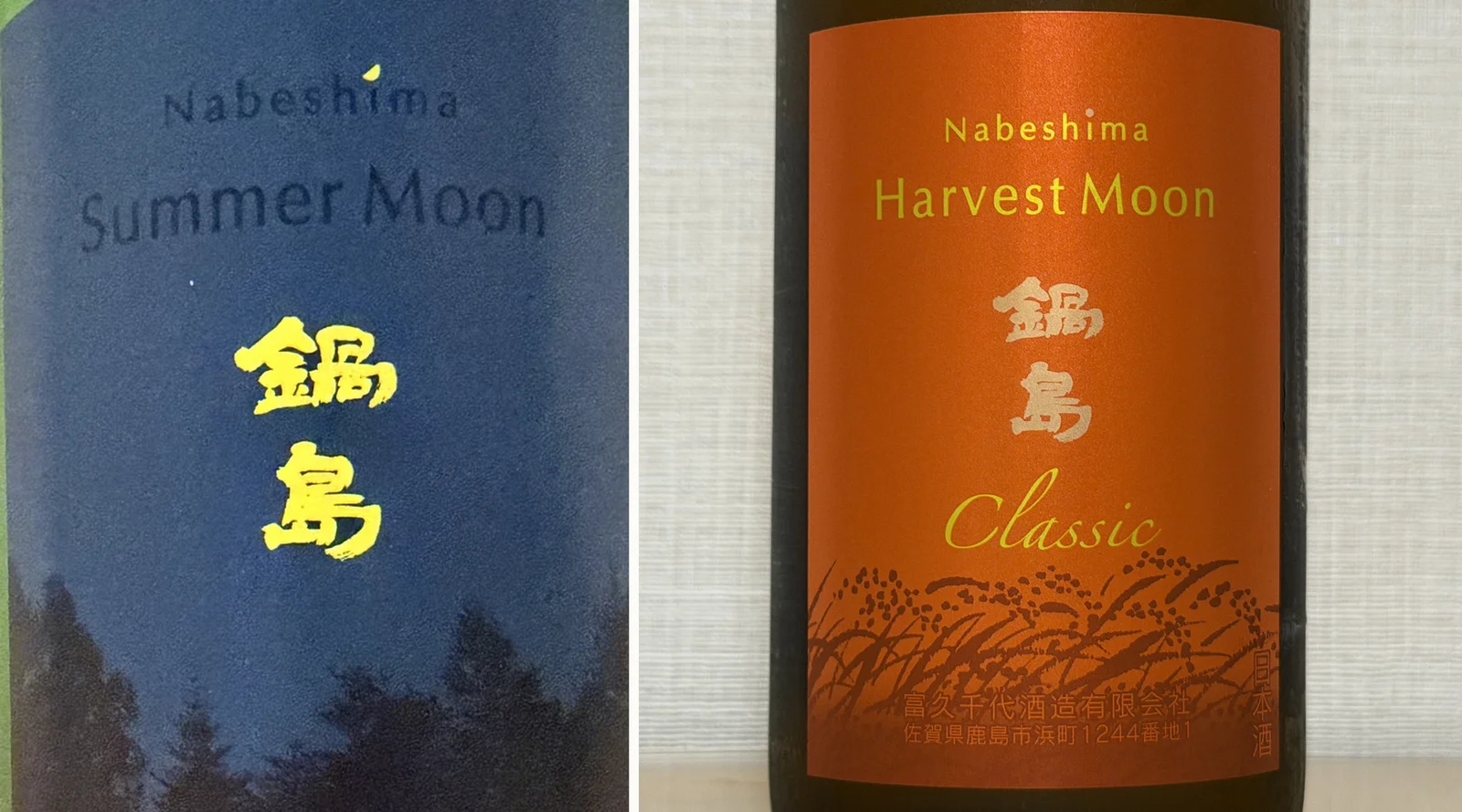
Summer Moon’s label was deep blue, with a dark forest silhouette and a small crescent moon — a cool summer night.
Harvest Moon’s label is warm orange, with a field of ripening rice stalks across the bottom and the word Classic written in script. Where Summer Moon looked toward the night sky, Harvest Moon looks toward the harvest.
There is one small detail I enjoyed. On Summer Moon, the dot over the “i” in Nabeshima was shaped like a crescent. On Harvest Moon, it is a full circle. I may be reading too much into it, but it is hard not to see a crescent becoming a full moon as summer turns to autumn.
Where I Bought It
I bought this bottle on September 12, 2026, at Jizake-dokoro Tachibana Saketen in Kumamoto City — the same shop where I bought Summer Moon — for ¥2,001 including tax.
As I mentioned in my Summer Moon review, Tachibana does not sell online. Bottles like this one are found by walking in.
Where in Japan
This sake is tied to one place on its label — and I found it across the prefectural border.
Fukuchiyo Shuzo is in Hamamachi, Kashima City, Saga Prefecture, on the western side of Kyushu facing the Ariake Sea.
I bought the bottle at Tachibana Saketen in Kumamoto City, Kumamoto Prefecture.
This season, I also tasted two other autumn bottles from Saga: Shichida from Tenzan Shuzo in Ogi, and Amabuki from Amabuki Shuzo in Miyaki. All three breweries sit within the same small prefecture.
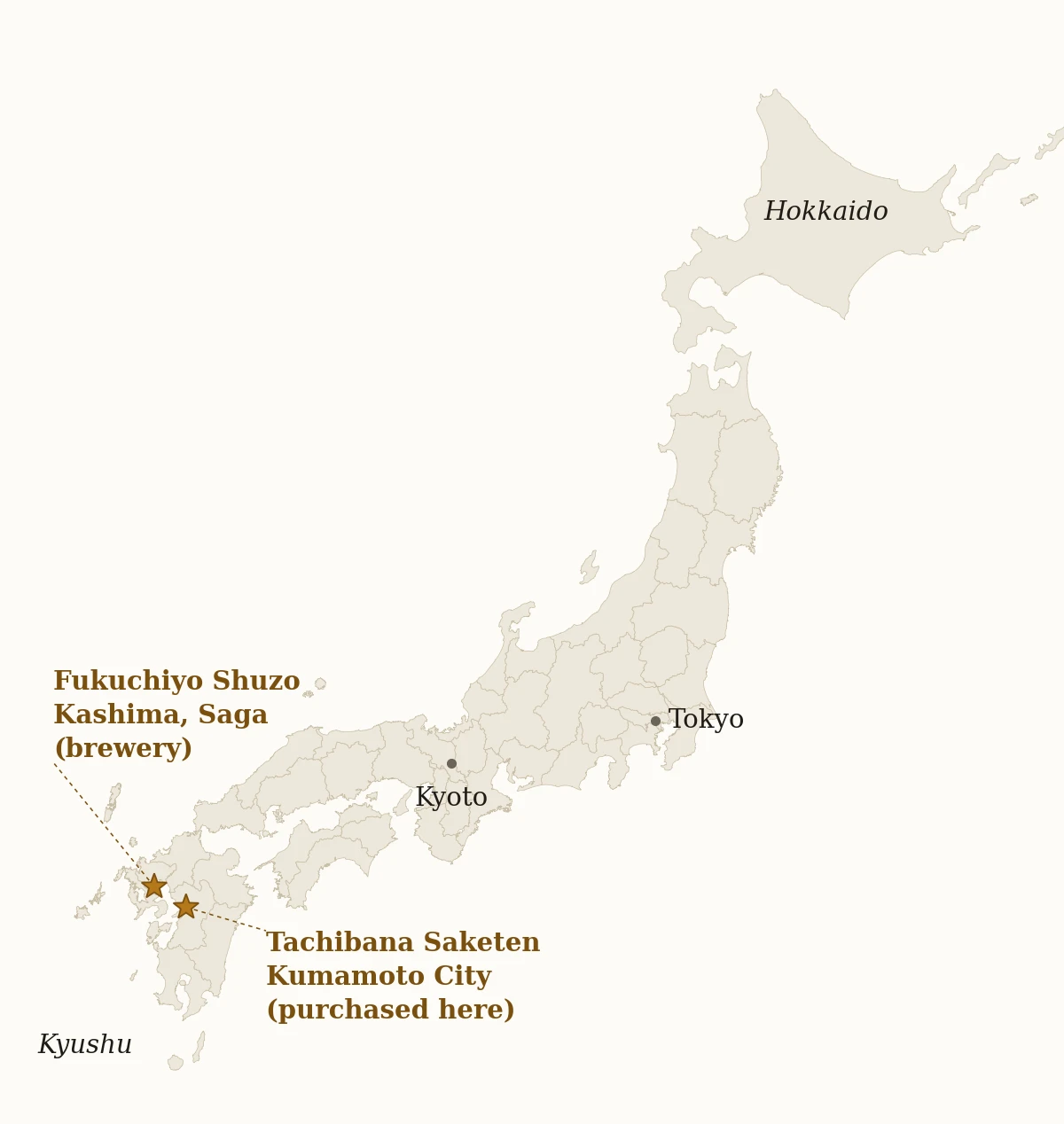
Where in Japan: Nabeshima is brewed by Fukuchiyo Shuzo in Kashima, Saga Prefecture. I bought this bottle at Tachibana Saketen in Kumamoto.
How I Tasted It
I opened the bottle at home on October 1, 2026.
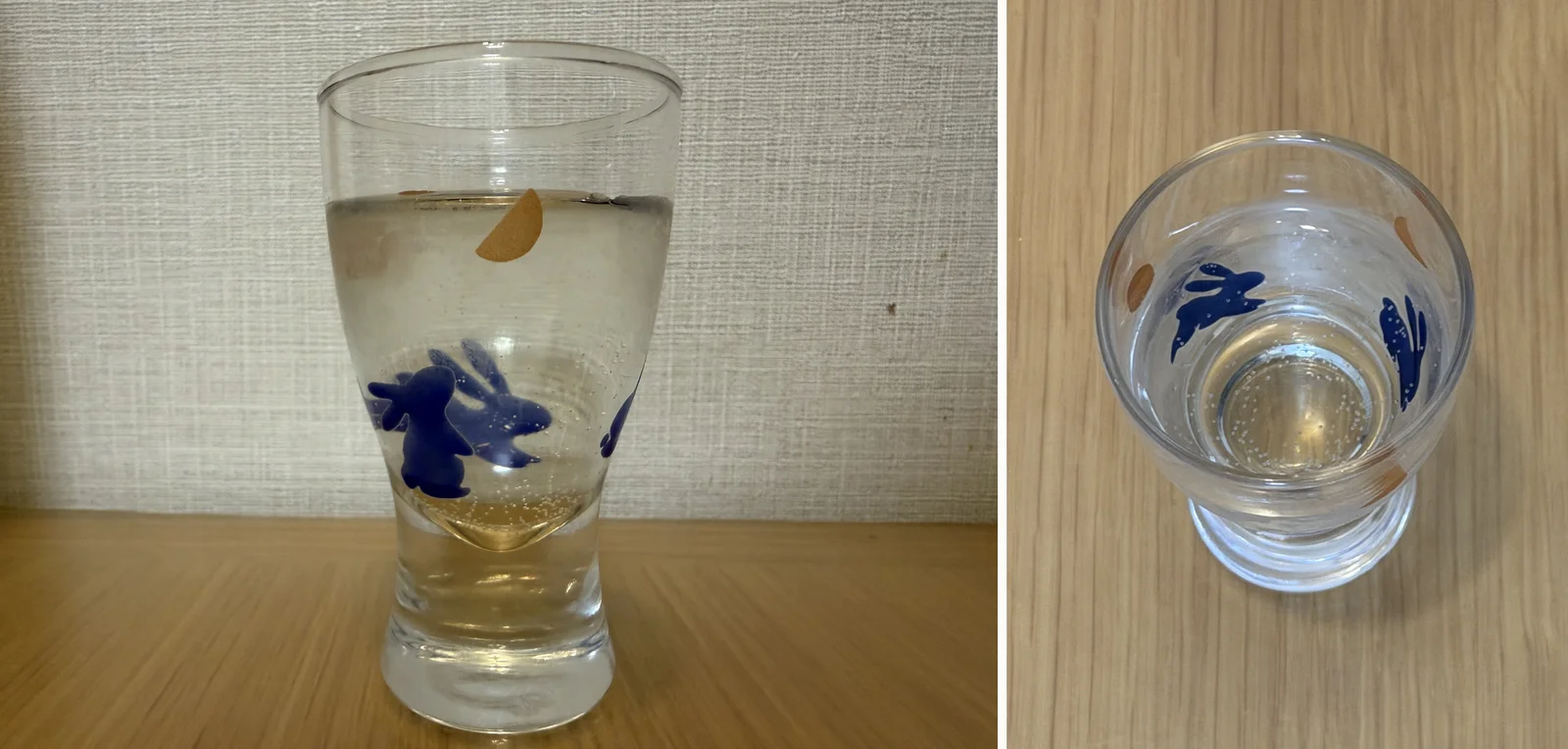
It had been kept in the refrigerator and was opened immediately after taking it out. I tasted it in a small clear-glass sake cup, without food.
I tasted it straight from the refrigerator, again after ten to fifteen minutes, again as it warmed further, and once more the following day.
Two More Cups
I also poured it into two ceramic cups from my own collection.
Fukagawa Seiji porcelain suited it well. The thin rim felt like a natural match for the sake’s fresh, lively character. In earlier reviews, the same cup seemed to bring forward the dry edge of Mii no Kotobuki +14 and Amabuki. With Harvest Moon, it seemed to suit the freshness instead. A thin rim may simply favor sake with a crisp, clean profile, whichever direction that crispness takes.
Oribe ware did not change the flavor in any way I could clearly notice. What stood out instead was the visual pairing: the deep green glaze sat beautifully against the warm orange of the Harvest Moon label — two autumn colors on the same table.
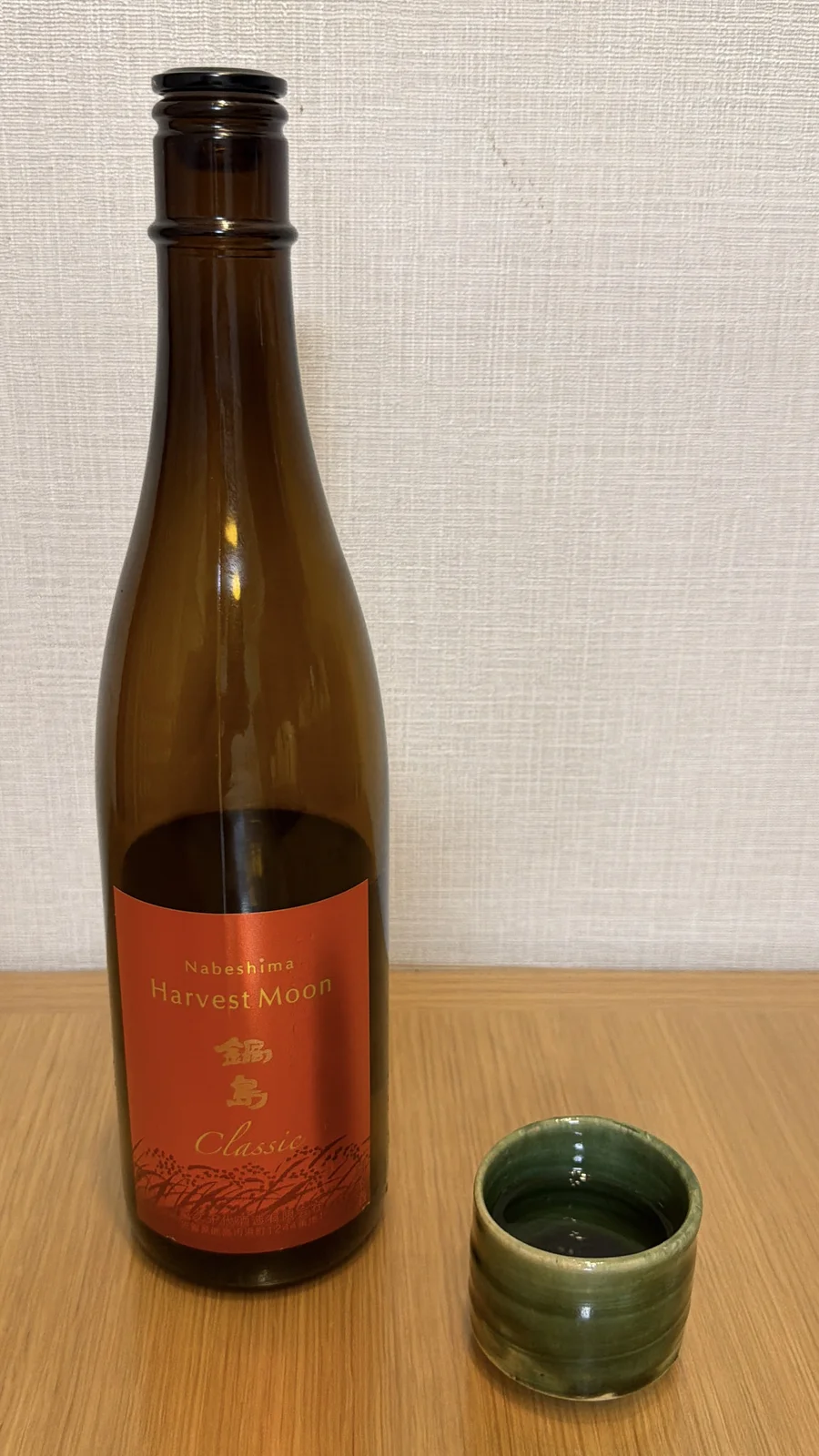
You can read more about the porcelain cup in my Fukagawa Seiji guinomi review, and about the green cup in my Oribe ware guinomi review.
First Impression
Fresher and juicier than I expected.
The cap opened with moderate pressure, and fine bubbles formed in the glass. The first sip brought fruit, a light prickle of gas, and a juicy texture — more lively than I expect from an autumn bottle.
Tasting Notes
Appearance
Clear, with only the faintest pale yellow tint — close to colorless, and noticeably clearer than the Amabuki hiyaoroshi I poured into the same white porcelain cup. Light in viscosity.
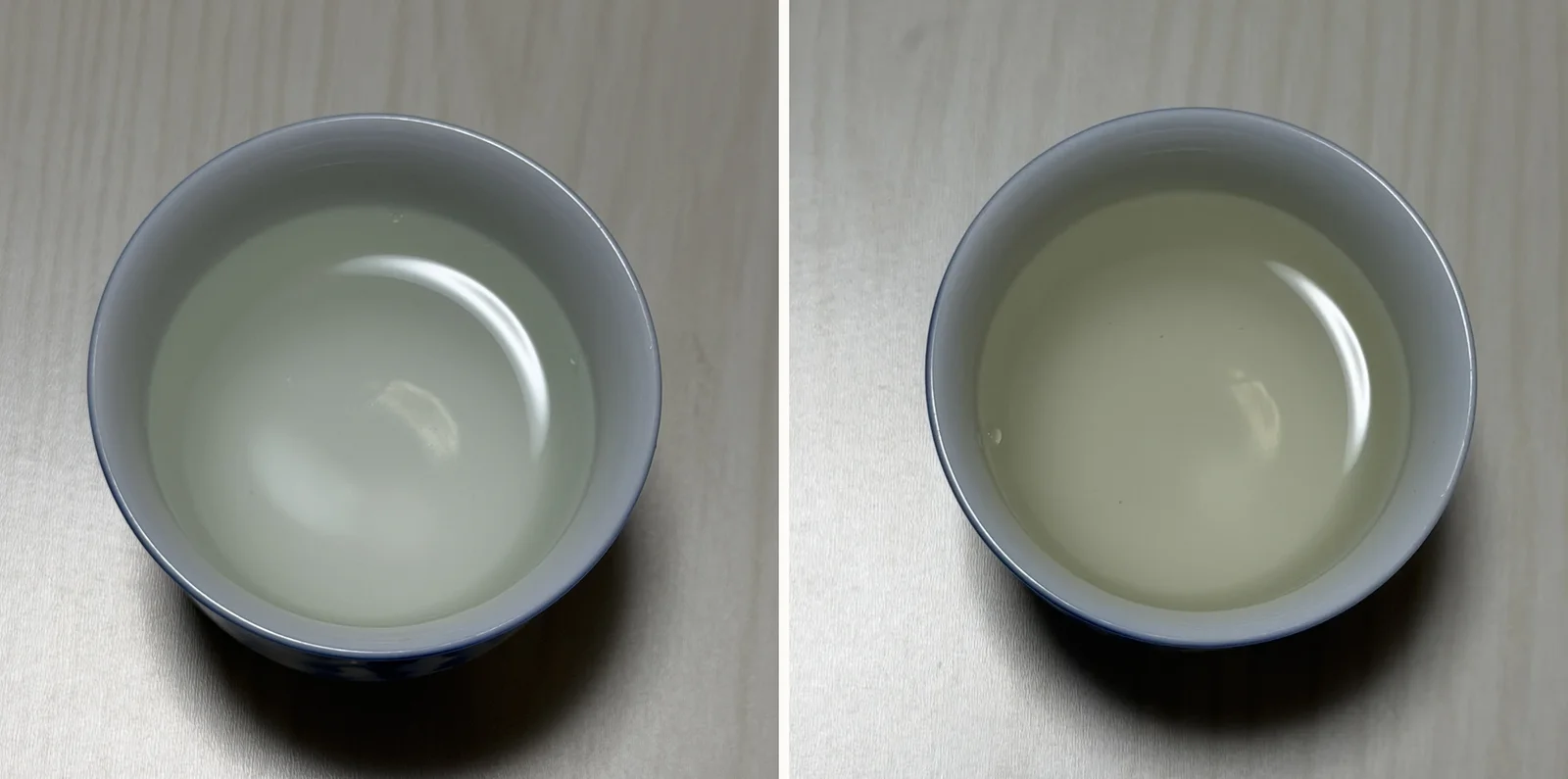
Left: Nabeshima Harvest Moon. Right: Amabuki Junmai Omachi Hiyaoroshi. Both in the same white porcelain cup.
Aroma
Moderate. Pear and citrus, with rice underneath. Alcohol on the nose was low to moderate.
Sweetness
Medium to moderately pronounced. Present and easy to notice, without becoming heavy.
Part of that impression comes from the freshness. While the sake was still cold, the fruit and the lively texture seemed to lift the sweetness a little.
Acidity
Medium to moderately pronounced. It keeps the sake lively.
Umami
Medium to moderately pronounced. There is enough substance to stop the sake from feeling thin.
Bitterness
Low — at least at first. It became more noticeable as the sake sat in the glass.
Body
Light to medium.
Texture
Juicy and light, with a moderate, perceptible carbonation. The perceived alcohol warmth is moderate.
Finish
Short to medium. Acidity and umami linger briefly, and then it cuts away cleanly.
The Gas — and What Happens When It Fades
The carbonation is what sets this bottle apart, so it is worth looking at how it changed.
| Stage | Gas | What I noticed |
|---|---|---|
| Straight from the fridge | Liveliest | Fresh, juicy, aroma most expressive |
| After 10–15 minutes | Softer | Sweetness rose slightly; aroma eased |
| Warmer still | Mostly gone | Sweetness held; bitterness, a touch of maturity, and alcohol warmth became more noticeable |
| Next day | Slightly reduced | Little change otherwise |
The pattern was clear. While the gas was lively, it carried the sake: it made the fruit feel brighter, the texture juicier, and the finish cleaner. As the gas faded, other things came into view — a little bitterness, a hint of maturity, and more alcohol warmth.
None of that was unpleasant. But it did mean that this sake is at its most appealing early, while it is still cold and still sparkling.
Best Served
I enjoyed Harvest Moon most straight from the refrigerator and within the first few minutes after pouring, while the carbonation was still lively. As the gas faded and the sake warmed, bitterness and alcohol warmth became more noticeable.
Three Autumn Bottles from Saga
This season, I tasted three autumn releases from Saga within about a week: Shichida Junmai Omachi Hiyaoroshi, Amabuki Junmai Omachi Hiyaoroshi, and Nabeshima Harvest Moon.
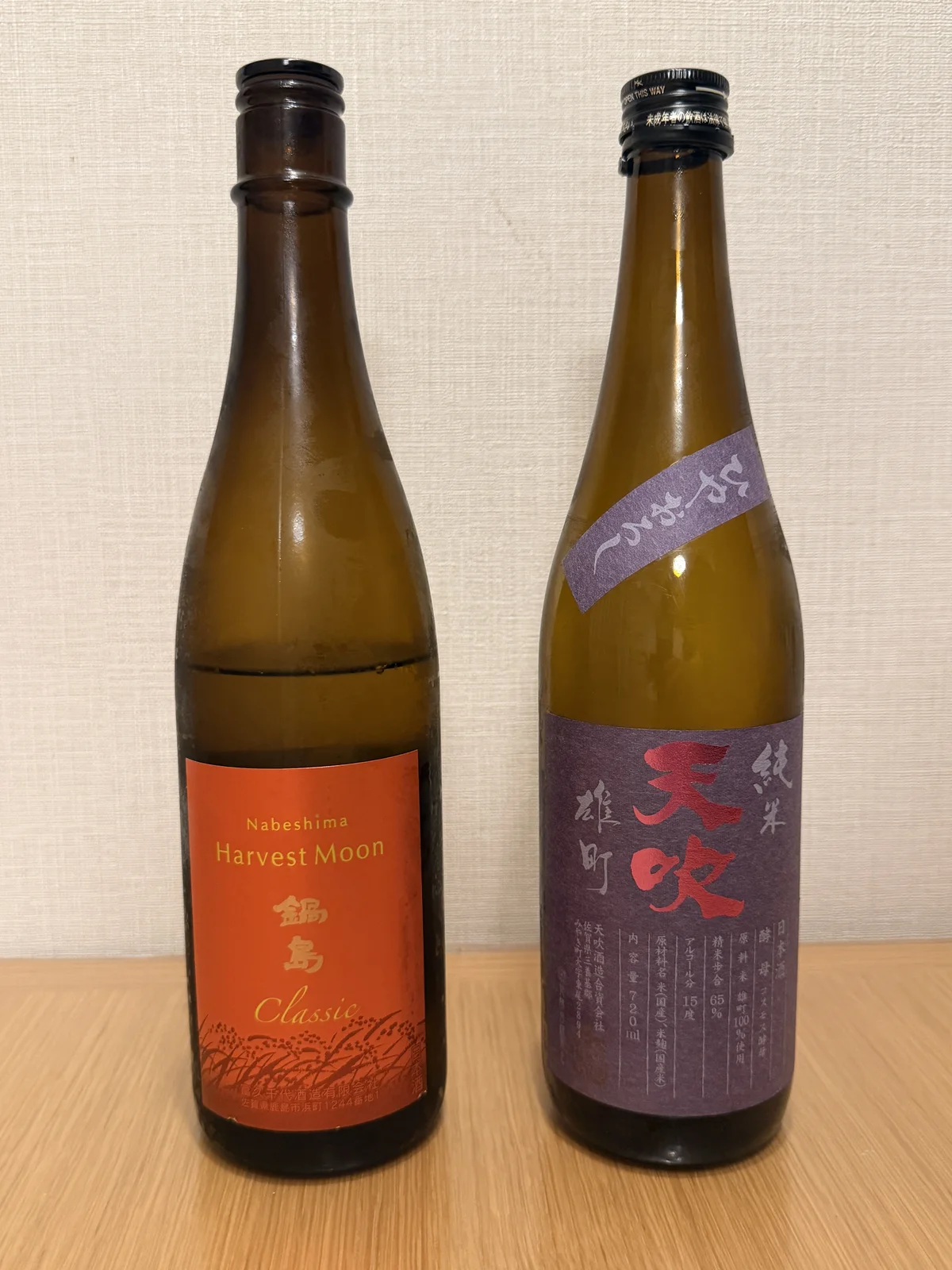
I did not open all three on the same day, so this is a comparison of tasting notes rather than a side-by-side tasting.
| Shichida | Amabuki | Harvest Moon | |
|---|---|---|---|
| Classification | Junmai | Junmai | Tokubetsu junmai |
| “Hiyaoroshi” on the label | Yes | Yes | No (some retailers call it one) |
| Rice (label) | Omachi 100% | Omachi 100% | Not stated |
| Polishing ratio | 75% | 65% | 60% |
| Alcohol (label) | 17% | 15% | 15% |
| Aroma | Banana-like, sweet-leaning | Quiet, rice-led | Pear, citrus |
| Sweetness | Noticeable | Lower | Noticeable |
| Gas | Almost none | Almost none | Noticeable |
| Body | Medium | Medium | Light to medium |
| Overall impression | Layered, vigorous, clean exit | Dry, firm, composed | Sweet, fresh, light |
| Approachability | 3 / 5 | 2.5 / 5 | 3.5 / 5 |
Next to the two hiyaoroshi bottles, Harvest Moon stood out for its freshness. It was lighter, livelier, and fruitier, and the gas gave it an energy the other two did not have.
On sweetness, it sat roughly level with Shichida and clearly above Amabuki. But the character of that sweetness was different. Shichida’s came wrapped in depth and vigor — a sake with a lot going on at once. Harvest Moon’s came with freshness and lightness, closer to fruit than to weight.
I would be careful about explaining why. Harvest Moon uses a different classification, a different polishing ratio, and an unstated rice, and the back label itself points to a lively, gassy character. Any one of those — and many other brewing decisions — could contribute. What I can say is that, in the glass, it felt the most youthful in character of the three.
Summer Moon to Harvest Moon
Summer Moon and Harvest Moon come from the same brewery and share the same idea: a seasonal bottle named for the moon.
In the glass, they went in different directions. Summer Moon was a ginjo with brewer’s alcohol, restrained in aroma, light, and built around a short, crisp finish. Harvest Moon is a tokubetsu junmai — fruitier, juicier, and livelier, with noticeably more gas.
On my approachability scale, Summer Moon scored 3 / 5 and Harvest Moon 3.5 / 5. The difference comes mostly from Harvest Moon’s fruit and gas, which give a newcomer more to hold on to in the first sip.
Who Is This For?
Try this if you enjoy fresh, lightly sparkling sake with clear fruit, and want to drink it on its own.
If you prefer a fuller or more settled autumn sake, the hiyaoroshi bottles from Shichida or Amabuki may suit you better.
Approachability: 3.5 / 5
I rate Nabeshima Harvest Moon 3.5 out of 5 on my approachability scale.
A low score on this scale reflects difficulty for a newcomer, not quality.
What makes it easy: the body is light, the acidity is not sharp, there is noticeable sweetness, and the gentle carbonation adds freshness and a juicy lift. It is easy to enjoy on its own.
What holds it back: as the gas fades and the sake warms, bitterness, a hint of maturity, and alcohol warmth become more noticeable. The bottle is at its most approachable early, while it is still cold and sparkling.
That places it above the two Saga hiyaoroshi I tasted this season — Shichida at 3 / 5 and Amabuki at 2.5 / 5 — and above Summer Moon at 3 / 5.
See what Approachability means on this site for the full method behind this score.
A Note on Availability
Harvest Moon is a seasonal autumn release, sold through Fukuchiyo Shuzo’s authorized retailers.
As of October 2026, I could not confirm a regular U.S. retail listing for this bottle. For readers outside Japan, availability will depend on specialist importers and retailers.
What you are more likely to find is a different bottle from the same brewery. At the time of writing, Palate Project (formerly Tippsy) lists two Nabeshima junmai daiginjo bottles in the United States, Aiyama and Tankan Wataribune. Neither is Harvest Moon, and I have not tasted them here. Palate Project describes both as light and sweet, so they are a realistic way to get to know the brewery’s style.
If you’d like to explore Nabeshima or other Saga sake for yourself and you are in the United States, you can browse Japanese sake through Palate Project. My referral link may give you a 10% discount, and I may earn a commission if you make a purchase.
You can also use the discount code FRIEND-BZXDMXW for 10% off.
Final Thoughts
I opened Nabeshima Harvest Moon expecting a calm autumn sake. What I found was something closer to the opposite: fresh, juicy, lightly sparkling, and brightest in its first few minutes in the glass.
Tasted in the same season as two Saga hiyaoroshi, it showed how wide the range of “autumn sake” can be — even within one small prefecture.
And next to Summer Moon, it completed a small seasonal story from a single brewery: a crescent in summer, a full moon at harvest, and two very different bottles.
Related Reading
- Nabeshima Summer Moon — the summer counterpart from the same brewery
- Shichida Junmai Omachi Hiyaoroshi — a fuller, banana-scented autumn bottle from Saga
- Amabuki Junmai Omachi Hiyaoroshi — a drier, firmer autumn bottle from Saga
- Nabeshima Omachi vs Yamadanishiki — two more sides of Nabeshima
This article contains affiliate links. If you buy through one, I may earn a small commission at no extra cost to you. It never changes what I honestly think.Full disclosure here.
Sake is an alcoholic beverage. This article is intended for readers of legal drinking age in their country — please drink responsibly.